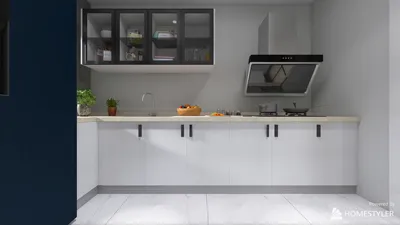


Have you ever wrapped up a kitchen design and sensed that something wasn’t quite right? I once worked with a retired baker who adored her new cabinets but exclaimed, “It’s beautiful, yet it doesn’t feel *complete*.” That one remark led me to delve deep into the world of crown molding. In compact kitchens, these small touches can significantly elevate the overall style. Here, I’m excited to share 10 crown molding ideas for kitchen cabinets that I have experimented with and loved, keeping in mind that even the coziest spaces can radiate a grand personality with the right design tools like Homestyler.
1. Timeless Shaker Crown
I’ve combined straightforward shaker cabinets with a seamlessly matching crown to achieve a unified and classic aesthetic. The charm lies in its understated elegance—it enhances your kitchen without overwhelming it. Just a tip: in kitchens with very low ceilings, opt for a lower crown to prevent a constricted atmosphere. I always prefer to plan these details in the early stages using a room planner, like Homestyler, to ensure proportionate elegance right from the start.
2. Layered Moldings for Added Flair
Combining two distinct moldings can introduce height and immediate sophistication. I once applied this technique in a snug galley kitchen—and it dramatically enhanced the cabinets' stature. Do be cautious, though; this method does take up some vertical space, so precise measurements are essential before proceeding.
3. Cove Crown with Gentle Curves
A cove-shaped profile adds a touch of softness to angular cabinetry. This style works remarkably well in kitchens replete with right angles and sleek stainless steel. Its installation is quite forgiving, easily accommodating any minor wall imperfections.
4. Craftsman-Style Step Crown
Flat, stepped designs are perfect for modern farmhouse or craftsman-style kitchens. They are budget-friendly since they need fewer complicated cuts. The result? Strong lines that maintain simplicity and do not clutter the space.
5. Bead and Curve Fusion
This design elegantly merges a rounded bead with a delicate curve—visually appealing without being overly intricate. I recently used it with pastel cabinetry in a charming cottage kitchen, and it gave the area a curated feel rather than a mass-produced one.
6. Tall Traditional Opulence
If your ceiling height permits, a 4 to 6-inch ornate crown can impart a custom, luxurious appearance. However, be cautious: maintaining cleanliness may feel like a workout session. In one of my projects, we pre-finished the molding in a wash-friendly semi-gloss to simplify upkeep.
7. Minimalist Flush Cap
Not every crown molding needs to draw attention. A flush cap that aligns with the cabinet face ensures a sleek transition to the ceiling—ideal for ultra-modern, handle-free designs. I often align these decisions with my Homestyler workflow to guarantee that lines remain clean throughout the space.
8. Contrasting Paint Crown
Applying a contrasting paint color to the crown can integrate it into the room’s aesthetic rhythm. In a completely white kitchen, a striking navy or charcoal crown can disrupt monotony and harmonize with accent colors from furniture or decor.
9. Integrated Lighting Crown
Crafting crown molding that includes hidden LED uplighting can provide both ambiance and an enhanced sense of height. This may present a DIY challenge, but the results are fantastic—your evening kitchen glimmers like a scene from a magazine.
10. Open Shelf Extension Crown
I have transformed a top open shelf into a decorative crown-like feature that not only adds storage but also mimics the elegance of traditional molding. This approach is especially useful in kitchens where typical profiles may feel too formal. If you enjoy blending functionality with aesthetics, it’s a great idea to experiment in a kitchen layout planner like Homestyler before installation.
FAQ
Q1: What precisely is crown molding for kitchen cabinets?
A: It is an ornamental trim fitted on top of cabinets, filling the gap to the ceiling and contributing to a cohesive overall appearance.
Q2: Does crown molding make my kitchen appear taller?
A: Indeed, by guiding the eye upward, it can create the illusion of higher ceilings, particularly when using vertical profiles.
Q3: What materials are ideal for kitchen cabinet crown molding?
A: Common materials include solid wood, MDF, and polyurethane, each with its own advantages—wood provides excellent staining, MDF is cost-effective, and polyurethane is moisture-resistant.
Q4: Is crown molding installation difficult?
A: With the appropriate tools and a bit of patience, intermediate DIY enthusiasts can manage it. More complex profiles might require a professional carpenter’s expertise.
Q5: How do I select the appropriate size for crown molding?
A: It depends on factors such as ceiling height, cabinet style, and personal aesthetic preferences. Designers often recommend keeping the crown height in proportion to the cabinetry for visual balance.
Q6: Should my crown molding match my cabinets?
A: Not necessarily—while matching can foster harmony, choosing a contrasting color can inject visual intrigue. It ultimately boils down to a matter of style.
Q7: Is it feasible to add crown molding to existing cabinets?
A: Definitely. It is a popular method to refresh a kitchen’s appearance without the need to replace all cabinets. Many pre-made kits simplify installation.
Q8: Where can I find kitchen crown molding examples?
A: Design platforms and the portfolios of professionals typically showcase numerous examples—starting points include Houzz, Pinterest, and various manufacturer websites. Additionally, the NKBA (National Kitchen & Bath Association) offers guidelines for design scale and proportion (nkba.org).
Looking to transform your space? Homestyler is your go-to online home design platform! With an easy-to-use design tool, stunning 3D renderings, and a wealth of design projects and DIY video tutorials, you'll effortlessly create your dream home—whether you’re a beginner or an expert!
Design Now for FREE
































