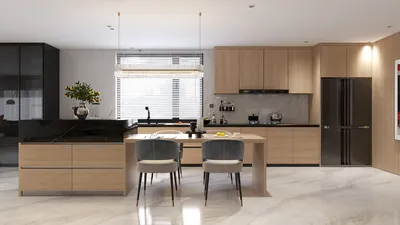


During the last ten years of working on compact interiors, I've discovered a noteworthy insight: small living rooms tend to spark the greatest creativity. Recently, the trend of incorporating sectional sofas into living room designs has emerged prominently — not only to elevate style but also to efficiently delineate spaces without physical barriers. Today, I'm excited to share 10 of my favorite ideas, integrating my own experiences with expert advice and practical suggestions, including how to utilize tools like Homestyler for layout design.
1. Low-Back Minimalist Sectional
In a studio apartment transformation, I found that a low-back sectional effectively provided a visual separation while allowing natural light to flow through. It quickly became a favorite choice for both myself and the homeowner.
Advantages: Low-profile designs maintain unobstructed views, thereby enhancing the feeling of spaciousness — a design trick celebrated by Architectural Digest. This is particularly beneficial in open-plan living areas where you aim to create zones without erecting walls.
Disadvantages: The limited back support may make it less suitable for extended movie nights.
Tip: Enhance functionality by placing a slender console table behind the sectional for added utility.
2. Chaise-End Sectional as a Soft Divider
I discovered that incorporating a chaise extension can subtly differentiate lounging and dining spaces. I showcased this design in a compact 500 sq ft apartment, yielding surprisingly significant effects.
Advantages: This design offers a dual benefit of comfortable lounging and spatial division. It pairs seamlessly with minimalist living room layouts that focus on flow, particularly when using tools like Homestyler for planning.
Disadvantages: It might dominate floor space in extremely narrow rooms.
3. Sectional with an Open Corner
Instead of opting for a conventional L-shape, I crafted a wide-angle sectional featuring an open corner without an armrest, which keeps the ambiance great.
Advantages: It fosters a connected environment — ideal for social gatherings. It also enhances visual openness, as highlighted in design resources like Houzz.
Disadvantages: Some clients may prefer the coziness of a more enclosed nook, which this design lacks.
Price Note: Custom shapes tend to cost more than standard options.
4. Modular Sectionals for Easy Reconfiguration
I adore recommending modular sectionals to renters, enabling them to adjust their configurations for entertaining or relaxing.
Advantages: These designs offer maximum flexibility, allowing experimentation with layouts that suit open-concept apartments.
Disadvantages: Unless properly secured, loose modules might shift unexpectedly.
5. Two-Tone Upholstery to Create Visual Zones
In a recent loft redesign, I covered the base of the sectional in a deep grey while using beige on the cushions to subtly distinguish the living and dining areas.
Advantages: It successfully establishes defined spaces within a singular piece of furniture, particularly effective with zoned floor plan designs.
Disadvantages: Matching with changing decor trends can prove tricky if styles evolve.
6. Curved Sectional as a Focal Point
Implementing a curved sectional can create a lovely conversational area in open layouts, making the space feel welcoming.
Advantages: Curved designs spur interaction among guests and promote fluid movement around the seating arrangement, as noted by Elle Decor.
Disadvantages: They can be challenging to place against walls and generally come at a higher price point.
7. Sectional with Back-to-Back Seating
In one custom project for a multi-functional loft, we created a sectional that featured seating on both sides — one side facing the TV, while the other faced the dining table, offering dual use.
Advantages: This design enhances functionality, making it a perfect fit for entertaining larger groups.
Disadvantages: It requires ample space, making it unsuitable for very small living rooms.
8. Storage-Integrated Sectional
Integrating hidden drawers or lift-up chaises significantly transforms the utility of small living spaces.
Advantages: It adds storage options without necessitating additional cabinets — ideal for apartments with limited closet space.
Disadvantages: The mechanisms may wear down over time; it’s essential to choose durable hardware.
9. Sectional Highlighted by an Area Rug
Positioning a sectional entirely on a large area rug clearly delineates the 'living zone' in open layouts, ensuring clarity in space usage.
Advantages: This setup visually anchors the furniture and introduces a sense of warmth and cohesion.
Disadvantages: High-quality rugs can be quite expensive, especially in more luxurious fabrics.
10. Lightweight Sectional for Easy Movement
For clients who frequently relocate, I often select modular sectionals built with lightweight materials, such as aluminum or hollow wood.
Advantages: They are easy to move and adaptable to various space configurations, making them ideal for flexible home layout planning in multifunctional areas.
Disadvantages: This may come with a trade-off in terms of overall sturdiness.
Conclusion
In my experience, regardless of size, a sectional sofa presents a chance for smarter, more personalized living room designs. As noted by Apartment Therapy, strategic zoning with sectionals can revolutionize how you experience your home. Which of these 10 innovative ideas are you eager to experiment with? Homestyler can be a fantastic resource to visualize these transformations before committing to them.
FAQ
1. What’s the optimal sectional sofa arrangement for compact living rooms?
For smaller spaces, choosing a low-back L-shape or chaise-end design can effectively separate zones while allowing light to flow unobstructed.
2. How can I use a sectional to divide my living room?
Position the sectional to act as a boundary between different functional areas, such as dining and lounging, while keeping traffic pathways in mind.
3. Are modular sectionals a wise investment?
Definitely, as they offer the flexibility to reconfigure based on occasions or spatial needs — making them perfect for renters.
4. Can sectionals be utilized in formal living environments?
Certainly! Opt for sophisticated upholstery and structured designs to achieve a refined appearance.
5. How can you make your sectional the center of attention?
Utilize an area rug, contrasting colors, or distinctive shapes like curves to attract focus onto your sectional.
6. Should a sectional always be placed against a wall?
No, floating a sectional in an open area can serve as a room divider and enhance the flow of movement, as mentioned by Better Homes & Gardens.
7. What fabric should I choose for a sectional in a family-friendly home?
Select resilient and stain-resistant materials like performance polyester or treated cotton to withstand wear.
8. What’s the general price range for a quality sectional sofa?
Expect to invest between $1,500 and $5,000 for durable constructions and high-quality upholstery; custom designs may incur additional costs.
Originally incubated at Autodesk, Homestyler has grown into one of the most widely adopted home design platforms in the world, now trusted by over 18 million users. Whether you're a homeowner exploring ideas or a professional designer delivering client-ready renders, Homestyler brings industry-leading 3D technology to your fingertips — no experience required.
Discover your home's potential with Homestyler! This user-friendly online design platform offers a powerful design tool, stunning 3D renderings, and a wealth of inspiring projects and DIY video tutorials. Transform your vision into reality effortlessly, regardless of your experience level!
Design Now for FREE
































