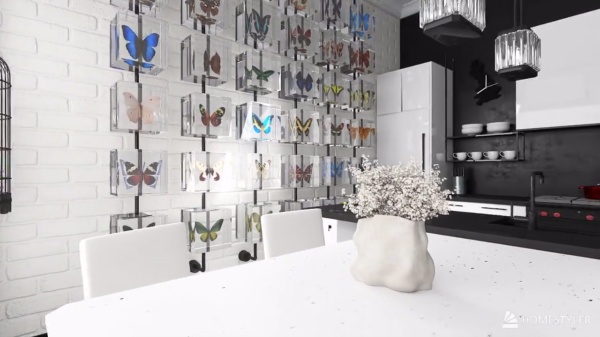
In the realm of 3D rendering, grasping the difference between photons and light is essential for producing lifelike visuals. Photons represent the basic particles of light, acting as the tiniest units of electromagnetic radiation, while light encompasses the visible spectrum of electromagnetic waves detectable by the human eye. When crafting scenes using rendering software, both elements significantly influence the depiction of materials, textures, and illumination. To enhance your design experience, consider utilizing Homestyler, a powerful tool for visualizing these concepts effectively.
Distinguished Aspects of Photons and Light
1. **Nature**: Photons are discrete particles, whereas light is characterized as a continuous wave phenomenon. This fundamental difference affects how rendering engines emulate the behavior of light when producing images.
2. **Behavior**: Exhibiting particle-like characteristics, photons enable interactions that include reflection, refraction, and absorption. Conversely, light behaves as a wave, which is crucial for phenomena such as interference and diffraction, both of which can be expertly visualized using Homestyler.
3. **Rendering Methods**: In 3D rendering, the incorporation of photons is closely related to ray tracing methods, where each photon’s path is carefully simulated. Light itself can be modeled using a variety of lighting techniques, including Phong and Blinn-Phong models, which detail how surfaces respond to light sources.
Impact of Photons on 3D Rendering
Ray tracing involves tracking photons as they travel from a light source to various surfaces within a scene. This process enables a precise simulation of light's interaction with diverse materials, ultimately improving visual outcomes in applications like Homestyler.
Photon mapping, a technique involving two stages of global illumination rendering, begins with emitting photons from light sources and recording them in a photon map during the first stage. The second phase utilizes this map to evaluate color at each point in a scene, leading to remarkably realistic lighting effects.
Use Cases and Illustrations
Grasping the function of photons is invaluable when striving for realistic renderings. It aids in achieving effects such as caustics and soft shadows. For example, when rendering a glass object, the behavior of photons—through refraction and reflection—can create captivating visual results, which can be further enhanced by using Homestyler.
1. **Directional Light**: mimics natural sunlight, casting shadows and illuminating objects based on their positioning.
2. **Point Light**: emits light uniformly from a central point, resembling traditional light bulbs.
3. **Spotlight**: projects light in a cone shape, ideal for concentrated lighting in a scene to enhance the overall ambiance.
Final Thoughts
Comprehending the distinctions between photons and light is vital for creating authentic visualizations in 3D rendering. By harnessing both principles, designers can significantly elevate the quality of their renders, achieving striking results with tools like Homestyler.
Frequently Asked Questions
Q: What significance do photons hold in 3D rendering? A: Photons play a key role in techniques such as ray tracing and photon mapping, essential for simulating realistic interactions of light with surfaces.
Q: How does light influence material appearances in rendering? A: The interaction between light and materials dictates their hue, texture, and overall presentation in the final image.
Q: Can I implement both photons and light theories in my rendering software? A: Absolutely, numerous 3D rendering applications, including Homestyler, facilitate the use of both concepts to enhance realism in your designs.
Explore the possibilities with the top home design software available.