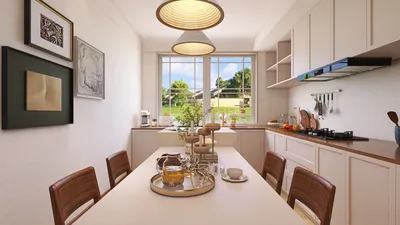


In the past, a client of mine wanted their dining table to serve as both a cat runway and a homework area — and yes, I agreed, only to find myself searching online for ‘how to attach a cat ladder to a MDF panel.’ This amusing incident taught me an important lesson: cramped spaces often inspire innovative solutions. If you're considering a dining table for a compact living area, begin by creating an interactive room map with Homestyler to visualize how the furniture will fit and function within the space.
1. Wall-mounted drop-leaf table
I am a big fan of wall-mounted drop-leaf tables since they can fold flat when not in use and quickly lift to accommodate diners. They are cost-effective and ideal for one to three people, but ensure you use proper studs or solid wall anchors — a careless installation can lead to unfortunate mishaps, trust me.
save pin
2. Narrow extendable table
A slim, extendable trestle allows for a steady walkway while still offering the option to expand when guests arrive. However, consider their leg placement as some lower-quality hinges can be unstable, so it is wise to invest a little more in reliable, sturdy extensions. I opted for oak veneer when aiming for a wooden aesthetic that was gentle on the wallet.
save pin
3. Built-in banquette with storage
Built-in banquettes can transform awkward corners into snug dining nooks while concealing winter linens or games underneath. If your dining setup is connected to the kitchen, think about optimizing the flow from cooking to dining to ensure your meals are enjoyable rather than hurried. Adding custom bench cushions will enhance comfort, but remember to account for upholstery maintenance — your pets and children will appreciate it later.
save pin
4. Convertible console-to-table
I frequently suggest console-to-table furniture to friends who appreciate multi-functional pieces: during the day, it serves as a console or desk, and by evening, it converts into a full dining table. They look stylish in hallways and provide makeshift serving surfaces, although larger diners might require more elbow room — consider adding removable extension leaves for greater flexibility.
save pin
5. Small round pedestal or tulip table
Round dining tables feel more inviting in compact apartments since they lack corners that obstruct movement, and a pedestal base offers additional legroom. While high-quality finishes can be costly, a well-made laminate top paired with a solid base can provide the desired aesthetic at a lower price point. Before making a purchase, create a mock-up, and if possible, utilize a photorealistic 3D preview through Homestyler to assess scale and color in your lighting.
save pin
FAQ
Q1: What size dining table fits a studio apartment?
Ideally, a compact table measuring about 24–30 inches deep and 30–36 inches wide is suitable for a studio. It's essential to ensure there's enough clearance for chairs and walkways to maintain comfort.
Q2: Are drop-leaf tables sturdy enough for daily use?
Indeed, high-quality drop-leaf tables are appropriate for everyday dining, but it’s crucial to choose models with robust hinges and support brackets; how you install them is just as important as their design. If you intend to open and close it frequently, budget for a piece in the mid-range.
Q3: Can a round table seat four in a small apartment?
A round table measuring 36 to 42 inches can indeed accommodate four individuals snugly; anything smaller is better suited for two or three. The round shape facilitates easier movement in tight layouts.
Q4: How much clearance do I need around the table?
Allow at least 36 inches from the table edge to walls or main pathways to ensure comfortable seating and movement. The National Kitchen & Bath Association (NKBA) advises a minimum of 36 inches for one-sided access and 42–48 inches for more active traffic (source: https://nkba.org).
Q5: Are banquettes worth the investment?
Built-in banquettes typically offer more seating and storage per linear foot compared to standalone chairs. They also create a warm atmosphere. Although they may incur higher initial costs, their functionality can enhance daily life and add a custom feel to resale value.
Q6: What materials resist stains and scratches?
High-pressure laminate and engineered stones offer surprising durability and are easier to maintain than some types of wood. If you prefer wood, choose a solid top with protective finishing and be prepared to refinish it over time.
Q7: How to match a table to limited lighting?
Opt for lighter table surfaces that reflect light well, and consider a slim pendant light above the table to create a focal point without overwhelming the space. Mirrors placed on adjacent walls can quickly and affordably amplify natural light.
Q8: Can I plan the layout myself before buying?
Absolutely! You should definitely plan the layout. While using tape to mockup furniture layouts can be effective, I frequently rely on digital tools for precision to avoid sizing errors when ordering. For a quick visual assessment, an interactive room map with Homestyler is an excellent option to explore potential arrangements before making any commitments.
Homestyler is the ultimate online home design platform for anyone looking to transform their space. With its easy-to-use design tool, stunning 3D renderings, and a wealth of DIY video tutorials, you can effortlessly explore and implement your design ideas—perfect for both beginners and seasoned designers!
Diseño ahora GRATIS
































