

Direct Answer
Affordable furniture tends to be quicker to acquire and more reliable for small apartments, whereas DIY projects often save money and can better accommodate unconventional spaces. The ideal choice largely depends on your schedule, available tools, and the level of customization your space requires.
In actual scenarios, I've noticed that the most efficient small apartments often utilize a combination approach—purchasing essential furniture items while crafting a few custom pieces when store-bought options are inefficient or wasteful.
Quick Takeaways
Introduction
When clients inquire about whether affordable furniture or DIY solutions are better for small apartments, they typically assume DIY will naturally be cheaper. Having worked on numerous compact apartments in cities such as Los Angeles and Seattle, I find the reality to be far more nuanced.
Small living spaces are unforgiving of poor furniture choices. For instance, a sofa that's merely six inches too deep can obstruct movement, and a large cabinet might consume too much much-needed floor space. That's why many designers begin by mapping the layout with visualization tools, like Homestyler, which allow experimenting with furniture configurations before making purchases.
This guide will analyze real costs, durability, and space-saving differences between purchasing budget furniture and building DIY pieces, along with guidance on when each approach is most appropriate.
save pin
Understanding Budget Constraints in Small Apartment Design
Key Insight: In small apartments, optimizing space utilization matters more than simply minimizing furniture cost.
Many first-time renters focus primarily on purchase price. However, in limited spaces, ill-fitting furniture results in hidden costs through lost usable area.
From my experience, three primary constraints typically influence furniture decisions:
According to the National Multifamily Housing Council, the average size of new apartments in major U.S. cities has steadily declined over the past decade. This trend compels smarter spatial planning rather than merely opting for lower-priced furniture.
Pros and Cons of Buying Affordable Furniture
Key Insight: Budget-friendly furniture provides speed, dependable quality, and consistent aesthetics—advantages that DIY projects often find challenging to replicate.
Retailers specializing in compact living solutions have refined designs for small spaces. Products like flat-pack wardrobes, lift-top coffee tables, and storage beds are examples tailored for tiny homes.
Advantages of affordable furniture
Limitations
In many of my small apartment redesigns, budget furniture performs well for core components such as beds, sofas, and wardrobes due to factory-produced engineering and quality control.
save pin
Pros and Cons of DIY Furniture for Small Spaces
Key Insight: DIY solutions are particularly effective when standard furniture sizes don’t fit the room’s unique dimensions.
Some of the most space-efficient apartments I've encountered rely on inventive DIY elements—floating desks, wall-mounted shelving, and custom-built storage benches are common examples.
Strengths of DIY furniture
Common pitfalls in DIY projects
A frequent unseen issue is inaccurate measurements. Even a shelf off by half an inch can ruin the fit along a tight wall. I recommend using digital room planning tools like Homestyler to precisely map dimensions and furniture placement prior to construction.
save pin
Cost Breakdown DIY vs Store-Bought Solutions
Key Insight: DIY options are more economical mainly when designs are straightforward and tools are already on hand.
Many online comparisons overlook the time spent on labor and the expense of acquiring tools, which significantly shifts cost-effectiveness.
For simple furniture, DIY savings usually range between $30 and $50. However, for built-in units or awkward corners, DIY can unlock storage solutions that retail furniture simply cannot provide.
Durability and Space Efficiency Comparison
Key Insight: Longevity generally depends more on materials than whether furniture is purchased or self-made.
Budget-friendly furniture often uses particleboard, which tends to degrade after multiple moves. In contrast, even basic DIY furniture built from plywood can offer greater durability.
Material comparison
For renters who relocate frequently, lightweight furniture may be preferable despite shorter lifespan due to easier mobility.
Answer Box
The most space-efficient small apartments often blend affordable furniture with strategic DIY pieces. Factory-made furniture suits complex items like sofas and beds, whereas DIY excels in filling unused corners and vertical storage niches.
When DIY Makes More Sense Than Buying
Key Insight: DIY becomes preferable when an apartment’s layout doesn’t conform to typical furniture dimensions.
Situations where DIY clearly excels include:
For example, in a 420-square-foot studio I worked on, a custom-built wall desk added nearly six square feet of workspace—an accomplishment no off-the-shelf desk could match.
save pin
Hybrid Approaches for Budget Apartment Interiors
Key Insight: The most effective method combines cost-effective furniture purchases with targeted DIY enhancements.
This blend offers both reliability and customization.
Typical hybrid strategy
Before purchasing furniture, I often advise clients to use virtual planning software like Homestyler to visualize the full apartment layout. This preview helps avoid buying pieces that overpower compact rooms visually or spatially.
Final Summary
FAQ
Is DIY furniture less expensive than buying?
Sometimes. DIY is cheaper when projects are simple and tools are already available. However, complicated builds can exceed the cost of budget furniture.
What is the best furniture approach for small apartments?
Most designers recommend mixing affordable furniture with custom DIY pieces to optimize storage and space use.
Is DIY furniture durable?
It can be, especially when crafted from materials like plywood or solid wood, which often outlast particleboard furniture.
What types of furniture should not be DIY?
Items requiring structural integrity or upholstery—such as sofas, mattresses, and intricate bed frames—are generally better purchased pre-made.
How can I save money furnishing a small apartment?
Focus on essential items, select multi-functional pieces, and create smaller storage solutions yourself.
Is affordable furniture suitable for renters?
Yes. Lightweight, low-cost furniture works well for renters who move often.
What DIY furniture works well in tiny apartments?
Projects like floating desks, wall-mounted shelves, storage benches, and narrow cabinets are popular DIY choices for small living spaces.
How can I plan furniture layout effectively before buying?
Using digital room planners such as Homestyler allows you to test sizes and movement paths before purchasing or building new furniture.
References

White Dresser for Bedroom,48 Inch Wide 6 Drawers

Minimalist White Solid Wood Dresser 3D Model
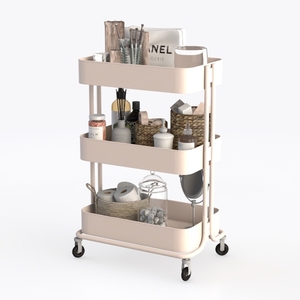
Minimalist Blush Metal Rolling Utility Cart 3D Model
Homestyler offers an easy-to-use online design tool paired with stunning 3D renderings, inspiring interior projects, and helpful DIY video tutorials. It’s the ideal platform to create and visualize your perfect home design effortlessly.
تصميم الآن مجانا
































