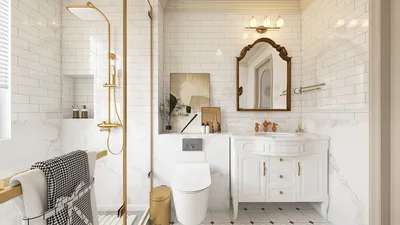


In today’s tech-savvy lifestyle, devices like the Oura Ring 5 are revolutionizing how we monitor our health and wellbeing right from home. Integrating such advanced wearables inspires new ways to design living spaces that promote relaxation and recovery. Thoughtfully arranged furniture and calming environments can complement the data-driven insights these gadgets provide, creating a harmonious blend of technology and comfort in your personal sanctuary. Using tools like Homestyler to visualize these designs further enhances the process, making every small space feel more connected to our holistic health goals.
Small bathroom decor strategies revolve around optimizing vertical areas, simplifying color schemes, and selecting versatile fixtures. In compact bathrooms, the strategic placement of mirrors, the use of floating storage, and the choice of consistent materials can effectively double the visual space without extensive renovations.
Having planned numerous small bathrooms for apartments and older residences, I’ve realized that innovative layouts and smart decor choices significantly impact spatial perception more than the actual room size.
Common Pitfalls and Quick Insights
Although mini bathroom decor advice often appears straightforward online, my extensive experience with small-space projects in urban and suburban settings has shown that tiny bathrooms pose unique challenges. A design suitable for a large master bath may feel particularly cramped when applied to a 40-square-foot powder room.
Many homeowners focus on aesthetic appeal rather than spatial efficiency. In small bathrooms, the design choices influence how spacious or cramped a room appears. This guide offers practical decor recommendations suitable for real-world applications, explaining the principles behind effective mini bathroom design.
Why Do Small Bathrooms Tend to Feel Overcrowded?
Small bathrooms often feel cluttered not due to the limited square footage, but because numerous distinct visual elements disrupt spatial unity. Excessive colors, busy adornments, and oversized decor contribute to what is commonly known as visual noise.
Typically, three main causes trigger this sensation:
To counteract this, interior designers advocate for visual continuity—harmonizing materials and tones so the eye flows seamlessly, creating an impression of expansive space.
For example, matching finishes on vanities, shelves, and mirror frames unify the bathroom’s aesthetic and amplify perceived size.
The Impact of Mirrors in Enhancing Mini Bathrooms
Mirrors wield significant power in transforming spatial perception. A large mirror spanning the vanity can nearly double the perceived area of a small bathroom.
In many projects, I prioritize wide mirrors over decorative, small ones because their reflective capacity amplifies light and breadth.
Strategies for mirror usage include:
Combining lighting with reflective surfaces can boost ambient brightness by up to 30%, according to the Illuminating Engineering Society. This effect greatly benefits compact bathrooms.
Effective Mini Bathroom Decor Techniques
The best mini bathroom designs balance a sense of lightness with cleverly concealed storage. Below are ten frequently applied ideas in my small bathroom layouts:
Maintaining consistent hardware finishes such as chrome or matte can prevent visual clutter caused by mixing diverse metals in tight spaces.
Common Mini Bathroom Design Errors
Some design trends, while popular, inadvertently shrink the visual dimensions of small bathrooms.
Experience shows that minimizing objects and décor elements fosters a richer, more elegant space by highlighting architectural features without overwhelming the room.
Integrating Storage with Aesthetics
In compact bathrooms, storage solutions should also contribute aesthetically rather than being merely functional.
Layering three tiers—simple containers, glass jars, and neutral baskets—helps to organize essentials while maintaining a stylish look.
Illumination’s Role in Bathroom Perception
Lighting profoundly affects how spacious a bathroom feels. Instead of a single overhead source, layering ambient, task, and accent lighting reduces shadows and visually enlarges the room.
Final Thoughts
FAQs
1. Which colors optimize mini bathroom appearance?
Light neutrals—white, pale gray, soft beige—reflect more light, visually amplifying the bathroom’s size.
2. Are dark colors unsuitable for small bathrooms?
Not necessarily; dark hues can work well if paired with sufficient lighting and reflective surfaces like mirrors or glossy tiles.
3. How to decorate a bathroom with minimal storage?
Employ vertical shelving, wall-mounted hooks, and over-toilet storage to expand usable space without overcrowding.
4. Do larger tiles make small bathrooms seem bigger?
Yes; fewer grout lines create a cleaner, more spacious visual impression.
5. Are floating vanities beneficial?
Absolutely; floating vanities expose floor area and lessen visual bulk, enhancing openness.
6. What mirror size is ideal in small bathrooms?
Mirrors spanning the vanity’s width are most effective for enlarging perceived space.
7. Can plants thrive in small bathrooms?
Yes; humidity-loving plants like pothos or ferns inject vitality without occupying much room.
8. What is the biggest decor mistake in mini bathrooms?
Overloading the space with decorative items can overwhelm. Minimalist styling paired with intentional storage is ideal.


Homestyler offers an easy-to-use online design tool combined with stunning 3D renderings and a vast collection of interior projects. With helpful DIY video tutorials, it’s the ideal platform to inspire and guide your home design journey.
Desain sekarang Gratis
































