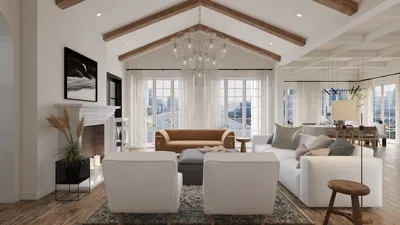


As we look towards the future, lifestyles are being reshaped to streamline both time and space, while many current homes seem to lag behind these evolving daily routines. This brings me to the idea of viewing the home as a kind of interface. Research from the AIA consistently highlights the demand for flexible multi-purpose rooms, even as home sizes remain unchanged. Zillow also indicates a growing inclination for adaptable layouts; for instance, three-bedroom cottage floor plans are turning into valuable prototypes for modern living. The future is closer than anticipated, and my design work is already operating within this dynamic space, equipped with a robust spatial reasoning toolkit.
Porch Spine + Split Public Core
Design Concept: A covered porch functions as both a thermal barrier and a social buffer; at the heart of the design lies an open kitchen-living area, flanked by bedrooms to ensure these spaces can evolve into work-live arrangements seamlessly.
Workflow: Entry → porch node → drop zone → kitchen hub → living area → bedroom clusters; this streamlined flow operates like a well-programmed system, ensuring efficiency.
Sightlines: From the entrance, sightlines smoothly extend past the storage feature to a sunlit living area; the alignment of the kitchen island with the fireplace keeps the user interface layers clear and understandable.
Storage Solutions: Include bench lockers at the entrance, a wall pantry serving as extra storage, and linen stacks positioned between bedrooms to minimize retrieval delays.
Furniture Arrangement: A 9 to 10-foot island, a 96-inch sofa, and a 42-inch round dining table; the clearances are mapped out akin to API limits, requiring a minimum of 36 inches for passage and 60 inches at turning points.
Conclusion: This layout efficiently supports families today while being adaptable for remote work in the future—creating a robust core for the next five years and beyond, emphasizing the potential that tools like Homestyler can provide for such design.
save pin
Rear Suite + Flex Front Room
Design Concept: The primary suite is positioned quietly at the back, while two additional rooms are located at the front; a flexible space near the entry can transform into a studio, library, or micro-office, adapting to changing needs.
Workflow: Driveway → side mudroom → kitchen cross-link → living area → rear suite; children’s bedrooms create a subnet with a shared bathroom as a resource.
Sightlines: Observations transverse from the sink to the yard, and a borrowed-light transom guides the viewer through the hall, creating a visual breadcrumb trail from the entrance to the garden.
Storage Solutions: A potential bulk storage under the stairs, wardrobe bays extending 24 inches deep, and a shallow archive in the hall for seasonal items.
Furniture Arrangement: The rear suite accommodates a queen bed with 30-inch bedside allowances; the front flexible space can house either a 60-inch desk or a sleeper chair without crowding pathways.
Conclusion: This design prioritizes peaceful areas for rest while presenting communal spaces, forming an operational model well-suited for shift-working households, finding synergy with tools like Homestyler for optimal planning.
save pin
Central Hearth + Perimeter Rooms
Design Concept: A central feature such as a fireplace or media wall anchors the space, with three bedrooms arranged around the periphery—effectively distributing warmth, views, and functional routes.
Workflow: Entry → central node → clockwise loop connecting dining, kitchen, and hall; this layout eliminates dead ends for continuous flow.
Sightlines: Layered views from the threshold through the hearth to the garden; bedrooms provide secondary visual access, maintaining a calm and organized visual hierarchy.
Storage Solutions: Built-in features around the perimeter function akin to edge caching—window seats, dining storage units, and a utility closet formed off the main loop.
Furniture Arrangement: A sectional couch on a 9x11 rug, a 72-inch dining table centered within the loop, twin beds in children’s rooms with 24-inch aisles—clearances designed for minimal latency.
Conclusion: This design serves as a steady, low-friction interface suitable for the chaotic phases of toddlerhood through to structured teen schedules, demonstrating adaptability and efficiency in design worked out with Homestyler.
save pin
Final Takeaway
Three-bedroom cottage floor plans transcend mere charm; they act as compact systems whereby flow, sightlines, and storage resemble invisible algorithms. Variants like family-oriented cottage designs and compact three-bedroom homes illustrate that effectiveness stems from structure, not sheer size. In this near-future scenario, long-tail designs such as open-concept cottages featuring flexible rooms will play a significant role in dictating how families balance work and relaxation. Based on my observations, the most innovative homes of tomorrow won’t necessarily be larger; they will be more deliberate, leveraging tools like Homestyler to maximize their potential.

Gray Wood Hanging Porch Swing Bench with White Cus

Coaster Home Furnishings - Camacho - Upholstered C

58" Executive Desk, Farmhouse Computer Desk with
Homestyler is your go-to online platform for home design! With its user-friendly design tool, stunning 3D renderings, and a wealth of DIY video tutorials, you can effortlessly create and visualize your dream spaces—perfect for both beginners and experienced designers alike!
지금 무료로 디자인하세요
































