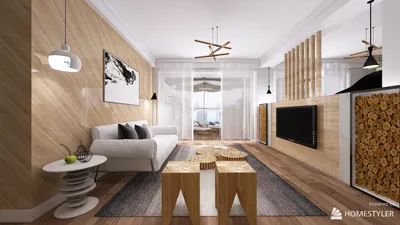


As we look ahead, contemporary apartments are still grappling with challenges like noise transmission, clutter accumulation, and inefficient circulation. Surveys conducted by AIA and NAHB indicate that buyers consistently favor adaptable, multi-functional spaces—yet many residences still feature rigid walls. Bridging this gap, adopting a spatial reasoning approach allows me to interpret 2200 sq ft apartment layouts as preliminary blueprints for future living patterns. My design philosophy assumes the interface must accommodate updates—such as family changes, remote work, and wellness elements—without encountering system failures.
Split-Core Gallery Spine
Design Logic: A central gallery serves as a hosting backbone, dividing private suites on one side and social spaces on the other—creating an environment ready for hybrid work and entertaining.
Flow: Entry → drop zone → gallery → living area → kitchen island → balcony; the private space links to sleeping and studying areas like a background process.
Sightlines: Aligned door openings reveal a tiered experience: from the quiet foyer to an artwork reveal and a horizon view through the glass; privacy gradients are carefully composed.
Storage: The gallery wall transforms into an integrated storage solution—flush cabinetry, spacious hall closets, concealed laundry areas, and seasonal alcoves at the ends.
Furniture Fit: Maintaining a living width of 10–12 ft per seating area; clearances of 42 in for the island; 30 in desk offsets in the private area; precise radii prevent movement loss.
Verdict: This spine design accommodates future adaptations—from a nursery to a creative studio and from salon dinners to VR workouts—without requiring a complete redesign.
save pin
Corner-Pivot Great Room
Design Logic: A corner great room utilizes dual exposures; natural light functions like an operating system, adjusting day and night routines throughout the expansive space.
Flow: The corner pivot positions the kitchen at its hinge, the dining area radiating outward, and the lounge oriented to capture the long view; bedrooms branch off like controlled subroutines.
Sightlines: Diagonal axes connect the entrance to the skyline; low storage and transparent shelving create a UI hierarchy—foreground tasks complemented by serene background views.
Storage: Perimeter cabinets form a continuous storage solution, with tall pantry units at the pivot point; bedroom alcoves accommodate vertical storage for organization.
Furniture Fit: The lounge depth extends 12–14 ft for sectional sofas and circulation; the dining set floats on a 96×42 table grid; pivot points support sit-stand work areas.
Verdict: The corner functions as a processor, efficiently managing light and social interactions; in five years, it will remain dynamic and reliable.
save pin
Enfilade Plus Pocket Labs
Design Logic: Rooms are arranged enfilade to provide ceremonial clarity, while each links to pocket 'labs'—small, multifunctional spaces for focus, gaming, or meditation—designed for future adaptability.
Flow: The sequence follows Foyer → parlor → dining → lounge as the main thread; side doors lead to labs and utility areas, ensuring the main path remains uninterrupted.
Sightlines: Doorways frame intimate scenes; translucent partitions for labs both blur boundaries and maintain focus, giving precedence to task-oriented data.
Storage: Labs double as storage; with wall beds, tool walls, and foldable benches, alongside deep drawers under windows for seasonal gear.
Furniture Fit: Enfilade rooms sized 11–13 ft to correspond with proportional designs; lab spaces at dimensions of 6×8 or 7×9, ensuring sound control and equipment arrangement.
Verdict: The enfilade narrates functionality; the labs provide flexibility. As lifestyles evolve, modules can be exchanged without impacting the core structure.
save pin
Final Takeaway
At 2200 sq ft, an apartment evolves into a programmable interface where spaces and transitions manage usage like software systems. Whether you interpret a 2200 sq ft apartment layout as a spine, a corner processor, or a modular enfilade, the future demands flexible designs, not just larger rooms. From my perspective, the most intelligent homes of tomorrow won't be defined by size but by intentionality, and I continue to design as if every wall represents a line of code—embracing tools like Homestyler to visualize these innovative possibilities.
Looking for an easy-to-use home design platform? Homestyler has you covered! With its intuitive online design tool, stunning 3D rendering, a wealth of design projects, and helpful DIY video tutorials, you can effortlessly create and visualize your dream spaces. Start designing today!
立即免费设计
































