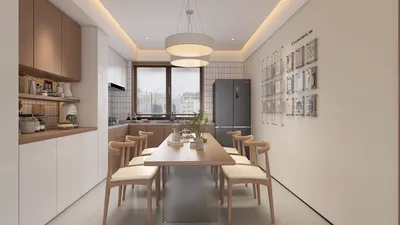


I once faced a challenge while installing a pendant light that was positioned two inches too low due to a tape measure that had lost its accuracy—my client humorously noted that it served as both a modern chandelier and a face warmer. This minor misstep imparted a significant lesson: lighting above a dining area can be surprisingly intricate, with even slight adjustments leading to major effects. Particularly in compact spaces, selecting the appropriate pendant can transform a cozy corner into an expansive, well-designed retreat.
1. Unique Sculptural Pendant
For narrow dining spaces, I frequently recommend a singular sculptural pendant. This design acts as a central focus without overcrowding the ceiling. The beauty lies in its visual simplicity and distinctive character—consider forms crafted from blown glass or matte ceramic. The key is to ensure that its dimensions harmonize with the table's size; a piece that’s too large can feel overpowering, while one that’s too small tends to vanish. In a recent studio apartment, a single pendant added significant flair to a minimalist dining table, enhancing the overall aesthetic without obstructing sightlines.
save pin
2. Collection of Small Pendants
Arranging 3 to 5 smaller pendants at varied heights creates a sophisticated, layered effect that exudes luxury, especially in tight quarters. This configuration is particularly appealing for adding texture and rhythm above a rectangular table. Advantages include a customizable arrangement and pleasantly dispersed light, while a potential drawback is the more intricate installation that may require additional wiring. In a recent condo renovation, a cluster of pendants elegantly addressed an awkward beam, drawing attention upward.
save pin
3. Linear Bar Pendant
A linear bar pendant is ideal for long tables, providing consistent illumination across the entire surface. This option is both clean and efficient, making it perfect for family dinners or dual-purpose dining and workspaces. However, it can appear too utilitarian if the finish leans industrial; thus, I often complement it with warmer bulbs or a wooden accent to introduce softness. For budget-conscious consumers, a dimmable linear pendant can transition effortlessly between bright meal preparation and intimate dinner settings.
save pin
4. Adjustable/Cable-Pull Pendant
Pendants that allow for height adjustments are invaluable in versatile spaces. When a dining table also serves as a workspace, adjusting the pendant’s height helps maintain an open ambiance during the day and creates an intimate setting at night. The trade-off may include a higher price and some upkeep for the pulley system. In a townhouse I designed, this flexibility was essential for a homeowner who frequently switched between professional video calls and social dinners—making the extra investment worthwhile.
save pin
5. Integrated LED Discs or Compact Accent Pendants
For those with limited overhead clearance, slim LED discs or shallow accent pendants provide clean lighting without adding bulk. These fixtures are energy-efficient and perfect for low ceilings, though their aesthetic may lean towards modern minimalism, potentially clashing with more ornate interiors. In a recent micro-apartment renovation, replacing a cumbersome fixture with low-profile LEDs created an instantly more open feel while improving sightlines.
In all these scenarios, I consistently remind clients to consider scale, dimmability, and color temperature—aiming for warm light, typically between 2700K and 3000K, which is ideal for dining settings. Thoughtful fixture selection is more rewarding than opting for single-function designs; more often than not, the best choice is a simple pendant positioned effectively.
save pin
Tips 1:
Always measure twice before hanging, positioning pendants 28 to 34 inches above the tabletop for standard ceilings. When a table is set against a wall, slightly off-center hanging can create a more intentional appearance. Utilizing a dimmer and warm LED bulbs can create the perfect atmosphere for any event. To visualize different layouts and experiment with pendant placements in 3D, I frequently utilize Homestyler’s 3D floor planner to preview proportions effectively.
save pin
FAQ
What is the ideal height for a dining table pendant light? - Generally, pendant lights should hang approximately 28 to 34 inches above the tabletop for standard 8 to 9-foot ceilings; adjust higher for taller ceilings to minimize glare and maintain clear sightlines.
What size pendant is most suitable for my table? - A simple guideline suggests that the combined widths of the pendants should be around 1/2 to 2/3 of the table's width. For a single pendant, a diameter approximately 1/3 of the table width is recommended—scale is crucial.
Is it possible to use multiple types of pendants over one table? - Certainly, combining different shapes and finishes can create a curated look if color temperature and hanging heights are well-coordinated. Keeping a unifying element, such as material or bulb type, is essential.
Are LED bulbs suitable for pendant lights? - Absolutely. LEDs are not only energy-efficient but also available in warm color temperatures that are perfect for dining areas. Opt for dimmable LEDs labeled between 2700K and 3000K to foster a cozy atmosphere.
How can I effectively manage low ceilings? - Choose low-profile fixtures like flush or semi-flush mounts, integrated LED discs, or very shallow pendants to maintain ample headroom while still providing sufficient lighting.
What considerations are there for dining tables in open-plan layouts? - In open plans, pendants can visually delineate the dining area. Using a linear bar or a cluster centered over the table effectively anchors the space within a larger room.
Where can I test different pendant layouts before purchase? - Utilize a free floor plan creator, like those offered by design tools, to experiment with fixture placements and proportions; this approach minimizes the chances of costly errors.
Are there established lighting guidelines to follow? - Yes, the Illuminating Engineering Society (IES) provides recommended illuminance levels and placement guidance; their resources are a dependable reference for both designers and homeowners. For hands-on layout planning, consider using a kitchen layout planner for lighting integration with cabinetry and islands.
save pin
Homestyler is your go-to online home design platform, perfect for transforming your ideas into reality. With its user-friendly design tool, stunning 3D renderings, and a wealth of DIY video tutorials, you can effortlessly create and visualize your dream spaces—no experience needed!
Design Now for FREE
































