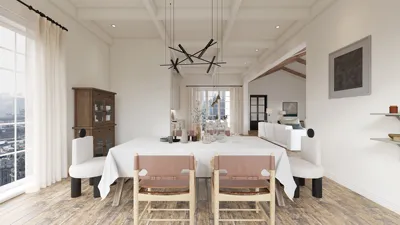


There was a time I installed a chandelier upside down due to my eagerness to complete a late-night project. My client found it amusing, I learned the importance of double-checking hardware, and we ended up with a design that I cherish to this day. This amusing mishap highlighted for me the critical role lighting plays in shaping a dining area, particularly in smaller spaces where every fixture vies for attention. Indeed, the constraints of compact spaces often ignite remarkable creativity. In this article, I will explore 5 dining room lighting trends for 2024, inspired by my work with clients, which enhance both style and functionality while incorporating tools like Homestyler for planning.
1. Layered Lighting Featuring Statement Pendants
Combining a striking pendant as a centerpiece with recessed or wall-mounted lights offers depth and the flexibility to create different moods. The benefits are obvious: dramatic lighting above the dining table alongside soft, ambient illumination. The key challenge lies in scale — a pendant that’s too large can overwhelm the space, while one that’s too small may go unnoticed. To avoid these issues, I typically create mock-ups of various sizes before proceeding with an order. For visual planning, I often utilize Homestyler to generate a 3D view, testing proportions and sightlines, which ultimately helps in avoiding returns and frustration.
save pin
2. Warm Tunable LEDs for Enhancing Dining Ambiance
Tunable warm LEDs allow users to transition from bright white light for tasks to a softer amber for evening meals. I suggest choosing fixtures with a Color Rendering Index (CRI) of 90 or above to ensure that food colors appear natural, which is particularly important for those who enjoy capturing photos of their culinary creations. While there may be a slightly higher initial cost and the requirement for compatible dimmers, the atmospheric benefits are undoubtedly worthwhile.
save pin
3. Compact Chandeliers Ideal for Small Dining Areas
Mini chandeliers are gaining popularity in 2024; they infuse chandelier elegance without occupying excessive space, making them perfect for smaller apartments. These fixtures can be hung lower than traditional chandeliers to create an intimate feel, but it’s essential to consider headroom and sightlines. I once opted for a brass mini chandelier over a narrow table, and it vastly improved the ambiance while allowing for easy movement within the space.
save pin
4. Sculptural Wall Sconces as Artistic Details
Wall sconces that resemble art pieces can function as uplighting while also adding decorative flair. They're particularly useful when centering a pendant over the dining table isn't an option or when highlighting a buffet wall. However, the downside may include wiring considerations if integrating them into an existing setup, but surface-mounted or plug-in options can provide a simpler installation with significant visual impact.
save pin
5. Integrated Lighting within Millwork and Ceilings
Concealed LEDs in coves, floating shelves, or built-in cabinetry introduce subtle drama while minimizing glare. These types of integrations create inviting layers without diverting attention away from the overall design. Implementing them requires careful coordination with cabinetry work, which could increase budgets, but they consistently deliver a polished, hotel-like ambiance that clients frequently rave about.
save pin
Lighting Planning Tip
For precise layout planning, I often import the room’s design into a realistic mockup, using tools like Homestyler to experiment with different fixture placements and heights. If you’re eager to explore scale and layout efficiently, consider using a reliable floor planner that visualizes fixtures in 3D prior to making a purchase. This approach has saved both me and my clients time and prevented returns on more than one occasion.
save pin
FAQ
Q: How high should a pendant hang over a dining table? A: Generally, it should be positioned 30–36 inches above the table surface for standard ceilings; lower for a cozy atmosphere and higher for clearer sightlines in taller spaces.
Q: Are warm LEDs preferable for dining areas? A: Absolutely — warm LEDs (2700K–3000K) provide a cozy, flattering light that enhances food presentation and people’s features, with tunable options offering added flexibility.
Q: How can I determine the right size for a chandelier? A: A quick guideline is to add the dimensions of the room in feet and use that total as the chandelier’s diameter in inches; always create a mock-up in the space if feasible.
Q: Is it possible to install wall sconces without rewiring? A: Yes, plug-in sconces or battery-operated options are excellent alternatives when direct rewiring is impractical.
Q: What’s a cost-effective method for layering lighting? A: Begin with a central fixture and then enhance the space with dimmable LED strips under shelves or tapelight — an affordable yet high-impact strategy.
Q: Are decorative fixtures required to have a high CRI? A: For dining settings, aim for a CRI of 90 or higher to ensure natural rendering of food and skin tones; manufacturers typically provide CRI details in their specifications.
Q: Where can I find examples of lighting placement in realistic room scenarios? A: Utilize a 3D floor planner to test dimensions and sightlines in a simulated space before making fixture selections.
Q: Are there standard references for lighting guidelines? A: For detailed lighting recommendations, refer to the Illuminating Engineering Society (IES) standards, which outline suggested illuminance and quality metrics (IES, 2020).
save pin
Discover the ease of home design with Homestyler! This user-friendly platform offers a powerful online design tool, stunning 3D renderings, and a wealth of DIY video tutorials. Whether you're a beginner or an experienced designer, you can effortlessly create and visualize your dream space.
Concevez maintenant gratuitement
































