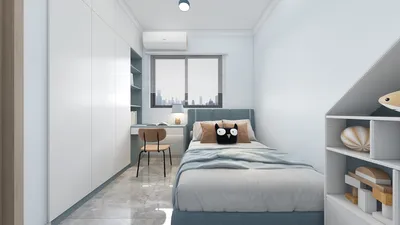


The future of hospitality design is evolving, shaped by modern travel trends and micro-mobility solutions. As travelers grapple with challenges such as noise, luggage management, and early morning disturbances, I approach design as if the room itself is a predictive framework for tomorrow's travel experience. Recent AIA data shows a growing demand for adaptable and wellness-oriented environments, making it essential for hotel room layouts to reflect how we rest, work, and rejuvenate during our journeys. Here’s my interpretation of this design interface, supported by a background toolkit of spatial reasoning.
Bay-Window Studio King
Design Logic: A gently curved bay encases the bed, allowing natural light to create a soothing algorithm that promotes circadian comfort while reducing noise from the corridors.
Flow: The layout advances from entry → drop zone → bathroom pivot → wardrobe node → bed platform → window niche; luggage transitions seamlessly, operating in the background without disrupting sleep.
Sightlines: The initial focus is on the bed and horizon; next layers reveal the desk, followed by the bathroom; this UI-style hierarchy maintains an uncluttered main canvas.
Storage: Features like underbed drawers, a vertical wardrobe with divided hanging space, and a compact luggage shelf serve as efficient caches with easily navigable retrieval paths.
Furniture Fit: The 76" king bed allows for 24" space on each side; the desk dimensions are 48" x 20"; a lounge bench in the bay maintains a circulation clearance of 30".
Verdict: Guests find the space to be like an intuitive operating system—easy to navigate, non-fatiguing, and relevant for years, particularly as wellness remains a fundamental standard.
save pin
Split-Axis Queen + Work Nook
Design Logic: This configuration divides the sleeping and working areas along perpendicular axes, predicting a rise in hybrid travel where meetings and rest occur side-by-side.
Flow: Starting from an entry buffer → bathroom core → work nook branch → sleep branch; these pathways never intersect at busy moments, resembling threads managed by a sophisticated scheduler.
Sightlines: The work nook is discreetly hidden; the bed frames the primary view; a strategically placed mirror reflects light, enhancing the space without compromising privacy.
Storage: A 30" wardrobe, an overhead shelf, and a concealed printer cubby create tiered storage options for items of varying retrieval speed, ensuring housekeeping remains efficient.
Furniture Fit: The 60" queen bed is centrally positioned; the task chair accommodates a turning radius of 36"; night tables at 18" width uphold circulation guidelines.
Verdict: This layout is poised to thrive in the upcoming trend of extended stays—focusing on work and rest coexisting seamlessly, complemented by smart partitions and memory features.
save pin
Accessible King with Linear Bath
Design Logic: The continuous bathroom design provides ADA compliance without making the room seem overbearing; elegance is integrated into the spatial planning.
Flow: A spacious entry → roll-in bath → wardrobe bay → bed face → terrace door; this design minimizes friction for mobility devices throughout each step.
Sightlines: Low thresholds maintain uninterrupted views; a direct sightline from the door to the headboard establishes orientation upon entry.
Storage: Features like pull-down rods, side-access drawers, and open shelves create accessible storage solutions with defined distances for easy access.
Furniture Fit: The room includes a 76" bed with 48" of space on either side; the desk is set at a 30" height; the turning radius of 60" is maintained throughout key areas.
Verdict: Looking ahead five years, universal design will be a necessity; this layout embodies humanity and future readiness, going beyond mere compliance.
save pin
Final Takeaway
A hotel bedroom layout serves as a dynamic interface that integrates rest, work, and rituals into a unified experience. Variants like the king bay studios and split-axis nooks illustrate how thoughtful choices—such as sightlines, clearances, and storage—can profoundly influence guest behavior. From my perspective, the most innovative spaces in hospitality won’t necessarily be larger but will reflect a greater intentionality. What I consistently observe in my projects is that intentional flows and storage strategies, akin to the principles found in tools like Homestyler, can subtly transform a guest's journey.

Modern Mixed Material Glass Door Wardrobe With Open Storage Shelves 3D Model

Aheaplus Industrial Pipe Clothing Rack

Metal Storage Cabinet with Doors and Shelves, 75"
Homestyler is your go-to online home design platform for effortlessly creating stunning spaces. With its user-friendly design tool, impressive 3D renderings, and a wealth of DIY video tutorials, you can easily transform your vision into reality—no expert skills needed!
立即免费设计
































