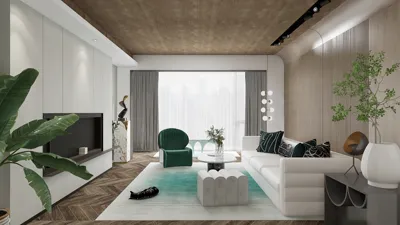


In the last ten years as an interior designer, I’ve witnessed the transformation of living room designs from simple accent walls to striking wall murals that create an immersive experience. Small areas, in particular, challenge us to be innovative. A carefully selected mural can enhance a compact living space, making it feel larger, vibrant, and personal. Today, I will present 10 mural concepts for living rooms — all derived from my professional projects and informed by design principles — that can elevate an ordinary wall into a captivating focal point. Don’t forget to explore tools like Homestyler for additional inspiration.
Nature-Inspired Panoramas
My Insight: I previously designed a cozy urban apartment for a client longing for the outdoors. By incorporating a tranquil forest mural, we effortlessly infused the space with a breath of fresh air.
Advantages: Nature murals not only create a serene atmosphere but also visually enlarge the room. To target specific interests, consider using the keyword: "nature wall murals for small living spaces." Research indicates that nature imagery contributes to lower stress levels according to the American Society of Interior Designers.
Disadvantages: If not coordinated with neutral furniture, these murals can feel overly themed. Additionally, maintenance might pose a challenge in frequently used areas.
Recommendation: Opt for subdued greens and blues for a classic and enduring appearance.
Abstract Color Bursts
My Insight: I enjoy introducing bold, abstract patterns for clients who thrive on energy. In one project, we featured sweeping brushstrokes in vibrant sunset colors, making it the room's centerpiece.
Advantages: These designs foster creativity and add dimension, particularly suited for modern interiors. Use the keyword: "abstract wall mural design for modern living rooms" for SEO purposes.
Disadvantages: Such designs may overpower minimalist furniture, requiring a bold aesthetic commitment.
To enhance creativity, think about how wooden elements can warm the space, pairing them harmoniously with your abstract mural.
Cityscape Horizons
My Insight: In a compact condo, one client desired a link to New York City. We utilized a striking black-and-white mural of the skyline, effectively broadening the view without any physical alterations.
Advantages: Sophisticated and enriching for a metropolitan atmosphere, it aligns beautifully with industrial décor.
Disadvantages: High-contrast murals may contribute to a feeling of busyness in smaller rooms if styled without care.
Cost Consideration: Keep in mind that using licensed imagery can elevate your budget significantly.
Botanical Illustrations
My Insight: Watercolor botanical murals can truly enhance the serenity of living rooms. In a coastal cottage project, one such mural provided a comforting embrace.
Advantages: Such designs are timeless and seamlessly integrate with neutral or soft pastel schemes. The long-tail keyword for optimization is: "botanical illustration mural for living spaces."
Disadvantages: Murals may fade when exposed to direct sunlight over the years; employing UV-protective finishes can mitigate this.
Geometric Patterns
My Insight: In a studio apartment, I installed an eye-catching geometric mural behind the sofa, providing visual structure to the space.
Advantages: This design adds order, rhythm, and a trendy flair to compact layouts and pairs wonderfully with metal or glass accents.
Disadvantages: Too many sharp angles could potentially create a rigid effect unless softened by textiles.
Consider layouts such as L-shaped arrangements to maximize space efficiency in multifunctional living areas.
Textural Trompe-l'œil
My Insight: I incorporated a realistic brick wall mural in a rental unit where renovations were prohibited, instantly delivering loft-like aesthetics.
Advantages: This approach adds distinct character without the need for physical construction. A top keyword for optimization would be: "trompe l'oeil wall murals for rentals."
Disadvantages: Poor-quality prints may appear unnatural; investing in high-resolution imagery is crucial.
Ocean and Water Themes
My Insight: A sweeping underwater mural transformed my client's seaside home into an immersive experience.
Advantages: Blue hues are recognized for promoting relaxation according to Environmental Psychology studies, effectively enhancing spatial depth visually.
Disadvantages: This theme may not align with all seasonal decor styles or personal preferences.
Cultural Heritage Scenes
My Insight: I created a mural inspired by traditional Chinese watercolor landscapes, infusing a living room with soulful homage to the owner's background.
Advantages: This type of mural offers deep personal significance and uniqueness, often serving as an heirloom piece.
Disadvantages: Such specificity may limit flexibility when changing decor styles in the future.
Minimalist Line Art
My Insight: For a minimalist aesthetic, I chose a single-line face art mural. Its elegance complements the decor without overwhelming the space.
Advantages: Easily coordinated with existing furnishings, it helps maintain a light and airy environment, fitting Scandinavian styles perfectly.
Disadvantages: This option may feel too understated for those seeking dramatic visual impact.
Subtle enhancements like glass backsplashes can beautifully complement minimalist murals, promoting a seamless visual flow.
Vintage Map Walls
My Insight: I installed an aged world map mural for a travel-loving couple; it became an excellent conversation piece.
Advantages: It adds charm, ignites curiosity, and serves as a personal statement within the space.
Disadvantages: This style may risk becoming outdated if your taste gravitates towards modern trends.
Conclusion
Having a small living room shouldn’t be seen as a limitation — rather, it’s an opportunity to design smarter. Wall murals have the potential to transform your environment from ordinary to uniquely personalized. As highlighted by the American Institute of Architects, visual focal points enhance the perception of space. Which of these 10 mural ideas would you be excited to implement in your home with the help of Homestyler?
FAQ
1. What types of wall murals work best in small living rooms?
Light-toned murals, whether nature or abstract, can visually enhance space while adding depth.
2. Can wall murals damage walls?
Most contemporary murals utilize removable adhesives that, when applied correctly, won’t damage walls.
3. How should I select colors for a wall mural?
Evaluate your furniture palette; warm tones promote coziness, while cool tones foster calmness.
4. Are wall murals suitable for rental properties?
Certainly, especially peel-and-stick varieties designed for easy removal, as mentioned by Architectural Digest.
5. What is the cost of installing a wall mural?
Prices can vary, ranging from $100 for DIY peel-and-stick options to $1,000+ for custom hand-painted creations.
6. Can I install a wall mural by myself?
Many pre-pasted or peel-and-stick murals are user-friendly, designed for DIY installation with basic tools.
7. Are wall murals in trend for 2024?
Absolutely — expansive murals are part of the biophilic and maximalist design trends noted by Vogue Living.
8. Where can I seek inspiration for wall mural designs?
You can gather ideas from design blogs, Pinterest boards, and tools like AI-assisted home planners to visualize concepts before making a commitment.
Looking to transform your space? Homestyler is your go-to online design platform! With its user-friendly design tool, stunning 3D renderings, and a wealth of DIY video tutorials, you can effortlessly create and visualize your dream home. Start designing today!
Concevez maintenant gratuitement
































