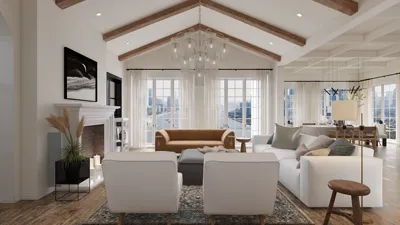


In a memorable project, I once fitted an extravagant chandelier in a tiny studio after the client insisted it would transform their apartment into a "palace." Initially, it seemed out of place, but after adjusting its scale and adding various light layers, it became enchanting. This experience taught me that while innovative ideas are key for small spaces, execution must be thoughtful and precise. By utilizing tools like Homestyler, one can effectively plan and visualize such designs in tight confines.
Compact areas often inspire the most daring lighting selections. In this discussion, I will present five striking lighting concepts that I have successfully applied in small kitchens, cozy living rooms, and narrow corridors. These ideas are practical, budget-friendly, and have a slight theatrical flair — perfect for capturing beautiful photographs and brightening your evenings.
1. Dynamic layered lighting with adjustable features
For most of my smaller projects, I employ a three-tiered lighting approach: ambient, task, and accent. By incorporating dimmable ambient lights along with adjustable spotlights or wall-washers, you can manipulate the lighting atmosphere like a film director. This method offers adaptability — bright during meal preparation and intimate for movie nights. However, wiring and switch configurations can be challenging, but solutions can be efficiently managed, perhaps with the aid of Homestyler to visualize placements.
save pin
2. Mini pendants as captivating focal points
Rather than opting for a singular, large fixture, consider utilizing a trio of smaller pendants hung at varying heights to add drama without overcrowding the ceiling. I applied this technique in a galley kitchen that initially felt flat; the pendants created defined zones and introduced vertical charm. Shopping for pendant kits makes this option cost-effective, but be mindful of ceiling heights to maintain clear sightlines.
save pin
3. Concealed LED strips for a gentle theatrical ambiance
Hidden LED lights tucked into coves, beneath shelves, or behind headboards produce a soft glow that enhances textures while concealing messiness. I recently upgraded a diminutive bedroom with warm LED strips, and the space felt both larger and cozier. Keep in mind the importance of choosing the right color temperature — opt for warm LEDs in living areas for an inviting feel instead of a sterile one.
save pin
4. Striking sconces to highlight key areas
Wall sconces can effectively act as spotlighting elements, accentuating pieces of art, mirrors, or reading nooks. I once installed asymmetrical sconces flanking a quaint mantel to produce a dramatic focal point; they introduced character while conserving valuable floor space. Placement is crucial as ill-aimed sconces might cast undesirable shadows, so consider the beam angle thoughtfully.
save pin
5. Programmable lighting scenes and zoned controls
One of my favorite methods is to set up lighting scenes like "Dinner," "Relax," or "Clean" — with each scene coordinating multiple fixtures. In a compact apartment, I utilized a straightforward app and wireless dimmers to establish instant ambiance. The initial cost is higher compared to a simple switch, but the time saved and the consistency of results justify the investment, and utilizing Homestyler can further streamline this process.
For visualizing layouts and determining where each fixture should be placed, I frequently turn to room planning resources that enable me to preview compositions and glare points effectively.
save pin
Tips 1:
A quick budgeting tip: blend high-impact statement pieces with affordable LEDs to achieve dramatic effects without overspending. When it comes to installation, organize circuits sensibly so that dimming and scene control feels intuitive, not cumbersome.
save pin
FAQ
Q: What is drama lighting design?
A: Dramatic lighting focuses on contrast, focal points, and layered illumination to craft mood and visual intrigue. It’s about molding light rather than merely illuminating a space.
Q: Can dramatic lighting work in very small rooms?
A: Definitely — small spaces thrive on targeted accents and layered lighting, adding depth and personality without the need for additional square footage.
Q: Which bulbs are best for achieving warm, dramatic effects?
A: For living areas, warm white LEDs (2700K–3000K) are ideal; select dimmable drivers and bulbs with a CRI of 90+ for genuine color rendering.
Q: How can I avoid glare with accent lights?
A: Utilize diffusers, select fixtures with controlled beam angles, and position lights so that the source isn't in the typical line of sight.
Q: Are smart lighting systems advantageous for rental spaces?
A: Absolutely, especially if you use plug-and-play options like smart bulbs or wireless switches; they are reversible and can create significant effects with minimal changes.
Q: How much should I allocate for a dramatic lighting transformation?
A: Small enhancements can begin around a few hundred dollars (LED strips, bulbs, or a couple of pendants), while fully scene-enabled systems with multiple fixtures and professional installation can run into the low thousands.
Q: Where can I find visual tools for mapping out lighting plans?
A: I suggest using a 3D floor planner, like those found in Homestyler, to experiment with fixture placement and sightlines before making any installations — it’s a time saver that helps you anticipate shadows and reflections.
Q: Is there credible literature on lighting design standards?
A: Yes, the Illuminating Engineering Society (IES) offers recommendations that outline industry-standard practices for illuminance and safety — be sure to check IES publications for more details.
save pin
Looking to transform your home design dreams into reality? Homestyler offers an intuitive online design tool, stunning 3D renderings, and a wealth of inspiring design projects. Plus, with easy-to-follow video tutorials, you’ll have everything you need to create your perfect space effortlessly!
تصميم الآن مجانا
































