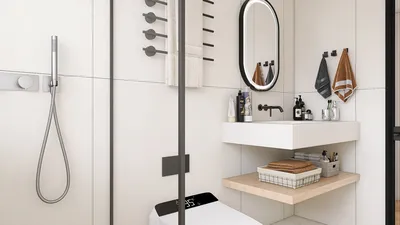


I once encountered a client who insisted on placing their washer behind the shower curtain — a true story that left me both amused and enlightened about the intricacies of wet-zone design. This experience urged me to enhance my planning, gather layouts for compact spaces, and merge plumbing with cabinetry in my designs. Working with small areas ignites considerable creativity; thus, I compiled five practical strategies that I implement in real projects to harmoniously integrate a washer and dryer into a bath setting, eliminating any potential frustration.
1. Stacked Washer-Dryer with Floating Vanity
Positioning a stacked washer-dryer next to a floating vanity not only conserves floor space but also enhances a modern, airy atmosphere. This layout is budget-friendly since it can be seamlessly concealed in a closet; however, ensuring effective vibration isolation and easy maintenance is crucial — I once had to remove a closet door that was too tight for proper dryer venting.
save pin
2. Pocket Door + Fold-Down Drying Rack
Incorporating a pocket door to hide the laundry area paired with a wall-mounted fold-down drying rack installed above a toilet or towel radiator is highly effective. This setup allows for versatile drying without taking up floor space. The key is to ensure sufficient clearance and moisture resistance for the wall anchors. A tip: opt for rust-proof fittings and secure anchors into studs wherever feasible — I consistently recommend a budget-friendly stainless-steel rack.
save pin
3. Corner Laundry Nook Behind a Half Wall
Creating a corner laundry nook behind a half wall conceals the appliances while promoting light flow — I frequently design these configurations using 3D layouts to verify sightlines. It’s a clever solution for odd-shaped spaces, but careful planning for vent runs and access points is essential; ensure that the panels allow technicians to reach the rear of the machine without demolishing the wall.
save pin
4. Cabinetized Appliance Garage with Integrated Sink
Concealing a washer beneath a countertop next to a small sink contributes to a visually cohesive utility space instead of a chaotic laundry area. The benefit lies in achieving a tidier aesthetic and additional prep space, whereas the drawback involves increased plumbing complexity — be sure to place the drain and shutoff valves in readily accessible cabinets, and note that custom cabinetry could escalate costs.
save pin
5. Dedicated Wet Zone with Proper Drain and Venting
When feasible, establishing a dedicated wet zone complete with a floor drain, waterproofing, and mechanical ventilation is ideal. I often map out the venting strategy during the bathroom design phase as part of my wet-zone planning process. This approach is the most effective for long-term moisture control, though it tends to be more expensive and may require adherence to local codes.
save pin
FAQ
Q1: Is it permissible to install a washer and dryer in a bathroom?
A: Absolutely, provided you adhere to local codes regarding electrical, ventilation, and plumbing standards. Prioritize a GFCI-protected circuit along with sufficient ventilation to prevent moisture issues.
Q2: What’s the best way to handle dryer venting in a combined bathroom?
A: Ideally, utilize a short, direct duct run to the outside when possible, and routinely check for lint accumulation. In apartments lacking exterior venting, opt for a quality condenser or heat-pump dryer with efficient drip management.
Q3: How should I manage moisture and mold risks?
A: Effective ventilation is essential — ensure to operate an exhaust fan during and post laundry sessions while maintaining humidity below 50%. According to the U.S. EPA, controlling moisture is paramount for preventing indoor mold growth.
Q4: Do stacked washer units require specialized cabinets?
A: Not necessarily; many stacked models fit within standard closet spaces, but allow for service clearance and utilize vibration-dampening mounting pads. If constructing cabinets, ensure removable panels are included for maintenance access.
Q5: Is it acceptable to use the bathroom water supply for the washer?
A: Yes, if the plumbing layout and valve sizing are appropriate — isolate the washer with its dedicated shutoff valves and consider anti-siphon protection if locally mandated. Consulting a plumber is advisable for sizing the supply line to avoid drops in water pressure.
Q6: What additional budget should I anticipate?
A: Basic setups using stacked machines and simple enclosures can be cost-effective, but prepare for higher expenditures for floor drainage, waterproofing, or rerouted venting. I generally suggest that clients reserve a contingency budget (10–15%) for unforeseen plumbing or code-related issues.
Q7: Are there any quick space-saving accessories you would recommend?
A: Affordable options like wall-mounted detergent shelves, magnetic lint bins, and fold-down drying racks can significantly ease daily tasks. I keep a carefully curated list of inexpensive, rust-resistant hardware that performs reliably in humid environments.
Q8: How can I visualize these designs before final implementation?
A: Creating a 3D mockup or scaled sketches aids in avoiding costly mistakes — I always check sightlines and access points prior to final decisions. If interested, begin by exploring design case studies illustrating small-room examples and their proportions, possibly utilizing Homestyler for an intuitive experience.
save pin
Homestyler is your go-to online home design platform! With an easy-to-use design tool, stunning 3D renderings, and a variety of inspiring design projects and DIY video tutorials, you can effortlessly create and visualize your dream space—no prior experience needed!
Design Now for FREE
































