

I once considered placing a sofa directly across from the front door due to my admiration for the TV viewing angle, but my client's shocked reaction — "That's feng shui suicide!" — made me reconsider. This experience taught me that designing for small living rooms requires a creative approach to bending the rules. In limited spaces, every furniture piece must justify its presence, and the path of energy from the front door is more significant than you might realize when using Homestyler to visualize your layout.
1. Establish an Entry Zone with a Slim Console
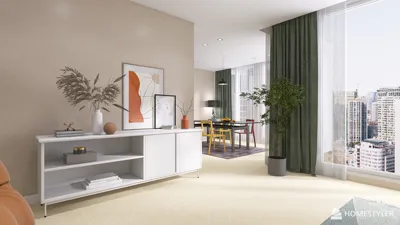
In compact living areas, the front door typically opens directly into the seating arrangement. I suggest utilizing a narrow console or a mounted shelf to subtly separate the spaces without obstructing the flow. This allows for a convenient spot to place keys and adds a plant that enhances the qi, while also ensuring that the seating isn’t positioned directly in line with the entrance for better feng shui.
save pin
2. Employ an L-Shape Sofa to Direct Traffic
Arranging your furniture in an L-shape effectively guides movement away from the door and establishes a natural pathway. In a previous project within a 28 sqm apartment, I oriented the short side of the sofa towards the entrance, creating a cozy nook while maintaining an open entryway. Although this design might limit flexibility, the enhancement in space flow and the perception of openness more than compensates for it.
save pin
3. Float Furniture to Enhance Qi Flow
Where feasible, shift your furniture slightly away from the walls to allow air and energy to circulate more freely. By floating a sofa or a couple of chairs, you create invisible pathways that prevent the energy from the door from being blocked by a wall. This minor adjustment can have a significant psychological effect; however, be cautious of scale, as too much empty space in a small room might feel uncomfortable.
save pin
4. Strategically Place Mirrors to Broaden and Redirect
A mirror placed thoughtfully opposite or next to the front door can visually enlarge the space and gently redirect incoming energy. I always recommend against directly reflecting the door; instead, angle mirrors to reflect light or a beautiful view. While mirrors can be economical enhancements, it’s best to use them in moderation to avoid generating restless energy.
save pin
5. Layer Lighting and Rugs to Define Spaces
Incorporating layered lighting — including overhead, task, and accent lights — alongside an appropriately sized rug helps to define functional areas without constructing physical barriers. In one design update, I added a rug that aligned with the sofa rather than the door, creating a welcoming experience at the entry. The challenge lies in ensuring electrical outlets and rug sizes are planned carefully to maintain a cohesive flow.
Designing small living rooms is a delightful puzzle that I truly enjoy. It requires prioritizing essential elements, and when the principles of feng shui at the front door are adhered to, even a limited layout can feel inviting and expansive.
save pin
Tips 1:
Practical advice: measure clear pathways — maintaining at least 80–90 cm ensures comfortable entry flow. If you're looking to virtually test various furniture arrangements and circulation, consider using an interactive 3D floor planner like Homestyler to visualize different configurations before moving any heavy items.
save pin
FAQ
Q1: What is the ideal sofa placement in relation to the front door in a small living room?
A1: The best practice is to avoid placing the sofa directly in line with the door; instead, position it to the side or consider an L-shape to keep the seating facing inward, thus creating a clear pathway.
Q2: Should a mirror be directed at the front door according to feng shui principles?
A2: Mirrors should not face the door directly; instead, angle them for reflecting light or attractive views to prevent energy from escaping back outside.
Q3: How can I create a buffer at the entryway when space is tight?
A3: Consider using a narrow console, a floating shelf, or incorporating a rug or tall plant to create a psychological buffer without restricting movement.
Q4: Will floating furniture detract from a small room's appearance?
A4: When done correctly, floating furniture can enhance flow and create an illusion of space; aim for at least 30–40 cm away from the walls and ensure proportionate sizing to avoid unnecessary gaps.
Q5: Are rugs significant for feng shui in compact living areas?
A5: Indeed — a well-placed rug helps to anchor seating zones and defines areas, which grounds the energy and maintains order, but be mindful of size and pattern to prevent overwhelming the space.
Q6: How can I balance natural light and privacy at the entry door?
A6: Using translucent curtains or frosted glass can let in light while ensuring privacy; layered window treatments allow you to adapt the ambiance throughout the day.
Q7: Do plants contribute positively to front door feng shui in smaller spaces?
A7: Definitely. A vibrant plant near the entrance invites positive energy; select low-maintenance varieties suitable for low-light conditions.
Q8: Where can I find more information on arranging small spaces effectively?
A8: For reliable resources on practical layout designs and 3D visual previews, the American Society of Interior Designers' website offers valuable standards and insights (https://www.asid.org). You may also utilize a free floor planning tool like Homestyler for visualizing your arrangements.
save pin
Discover the ease of home design with Homestyler! This user-friendly platform offers an intuitive online design tool, stunning 3D renderings, and a wealth of design projects and DIY video tutorials. Transform your space effortlessly and unleash your creativity today!
Zaprojektuj teraz za darmo
































