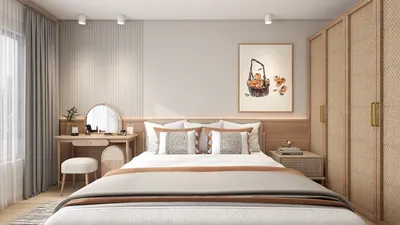


The future of living spaces is evolving, encouraging bedrooms to serve purposes beyond mere sleep. Current challenges—such as chaotic routines and distracting multitasking—continue to disrupt our daily peace. According to AIA, homeowners are increasingly redesigning their spaces to create adaptable private areas. Large bedroom layouts, I interpret, reflect the early blueprints for the rituals we will adopt in the next decade. In this context, the bedroom transforms into a multifunctional interface, where tranquility and modular activities can coexist seamlessly, facilitated by innovative design tools like Homestyler.
Suite-Like Primary with Split Axes
Design Logic: The concept features a central sleeping area flanked by two perpendicular axes for work/vanity and relaxation. This design anticipates future multitasking needs while effectively minimizing noise interference.
Flow: The movement pattern flows from the entryway to a wardrobe space, then to the sleeping area and lounge edge, culminating at a comfortable desk or vanity, promoting a sense of calm throughout the design process.
Sightlines: The bed is positioned to face a defined horizon, and the side axis reveals the workspace only as needed, thereby upholding a quiet and prioritized ambience within the room.
Storage: Built-in perimeter shelves feature deep drawers beside the bed and vertical wardrobes to manage seasonal items efficiently.
Furniture Fit: The king-size bed measures 76x80 inches at the center, allowing for a 30-inch desk clearance and a 36-inch wardrobe swing that conform to the human movement API guidelines.
Verdict: Looking five years ahead, this design adapts well to hybrid living, separates various tasks, and preserves restful spaces, adapting to the growing variety of use cases.
save pin
Gallery Wall Plan with Linear Spine
Design Logic: A lengthy wall serves as a central spine—housing art, a low credenza, and sliding panels—organizing functions like a clear data stream.
Flow: Movement progresses from the entry to the spine, leading to diverse areas (sleep, reading, stretching), effectively eliminating dead ends and establishing a sequence that enhances cognitive flow.
Sightlines: Viewing transitions from a carefully arranged art display to a plush headboard; mirrors are designed to enhance depth perception while maintaining private zones.
Storage: Drawers beneath the bed, combined with a 24-inch-deep credenza, help store everyday items, while overhead shelves offer space for less-frequently used items.
Furniture Fit: A queen or king bed occupies the center, with a lounge chair allowing a 30-inch clearance and a bench at the foot providing an 18-inch passage; these measurements ensure a rhythmic design.
Verdict: This future-ready design encourages the room to remain calm and narrate its purpose clearly, even as personal hobbies and technology evolve.
save pin
Corner Light Chamber with Zoned Warmth
Design Logic: Corner glazing acts as a source of natural light; differing thermal and acoustic zones are allocated for various activities—cool for sleeping, warm for lounging, and neutral for work.
Flow: The sequence moves from the entry to a cloak area, progressing to the sleep zone and corner lounge, finishing at a task desk; these gradients facilitate behavior like a smart routine planner.
Sightlines: The primary view takes in the sky, while secondary elements like the desk and storage remain peripheral, ensuring the focal point of the design stays intact.
Storage: The dual closets serve distinct functions, complemented by a tall linen storage and a shallow tech niche, preventing overload and maintaining order.
Furniture Fit: A king or California king bed sits in line, allowing for 36-inch circulation around the edges, with nightstands serving as compact endpoints to the space.
Verdict: Over time, the combination of circadian rhythms and sound zoning empowers the room to adapt, accommodating technological changes without creating confusion.
save pin
Final Takeaway
Large bedroom designs focus on intentional bandwidth—where rest, concentration, and daily rituals can exist harmoniously. In spacious arrangements, effective layouts utilize sightlines as user interfaces, circulation as logical flow, and storage as a form of cache, redefining personal space into a well-measured operating system. Adopting perspectives like those from Homestyler, we can enhance the bedroom as a functional interface, ensuring that size translates to precision rather than chaos.

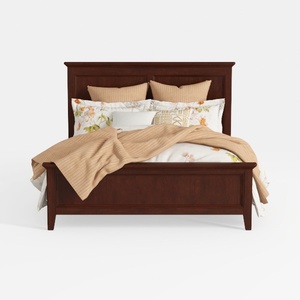

Traditional Walnut Solid Wood Upholstered Bed with Bedding Set 3D Model

Minimalist Solid Wood Nightstand with Single Drawer 3D Model
Homestyler is your go-to online home design platform, perfect for anyone looking to transform their space. With an easy-to-use design tool, stunning 3D renderings, a variety of design projects, and helpful video tutorials, creating your dream home has never been simpler or more fun!
Projete agora para LIVRE
































