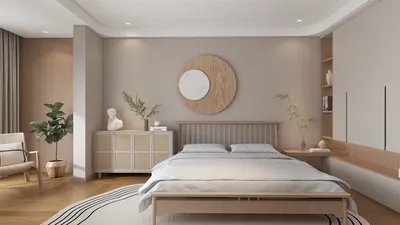


I once worked with a client who envisioned a bedroom that could effortlessly transform into a Zoom-friendly workspace imbued with a jungle atmosphere — complete with potted palms behind the bed. That experience taught me that effectively merging sleep and work environments requires more than just greenery; it demands a strategic approach. When addressing the design of a dual-purpose office-bedroom space, small areas can inspire significant innovation. Here, I’ll share five practical strategies that I frequently apply in real projects complemented by the exceptional capabilities of Homestyler. For a comprehensive insight, check out the detailed case study that influenced one of my designs.
1. Desk Positioned by a Window with a Foldable Bed
I find that positioning the desk by the window not only keeps you refreshed during working hours with ample daylight, but also mentally distinguishes the work area from the sleeping space. A wall-mounted foldable bed, or a contemporary Murphy bed, can be hidden away at night, leaving the workspace visually prominent — ideal for a daytime office atmosphere. This design is both stylish and space-efficient, although it tends to involve a higher initial investment and requires regular maintenance checks on the mechanism.
save pin
2. Open Half-Height Partition with Shelving
For clients seeking a gentle separation in their spaces, I often create a half-height partition lined with open shelves. This solution provides storage space, a headboard-like effect, and maintains an open feel within the room. It's cost-effective and suitable for DIY projects; however, it sacrifices complete visual privacy and sound insulation. A pro tip: vary the shelf heights to accommodate books and conceal cables while still allowing airiness.
save pin
3. Cozy Corner Workspace and Sleep Area
Transforming a corner into a snug L-shaped desk helps carve out a focused work nook while the rest of the room remains a tranquil bedroom. This configuration is particularly effective in studio apartments where distinct atmospheres are desired — contrasting focused daylight in the work corner with soft lighting near the bed. The main concern here is managing sound; I often add thick curtains and a plush area rug for effective noise absorption.
save pin
4. Movable Panels with Multi-Function Furniture
Incorporating sliding panels made of wood, frosted glass, or fabric allows for the desk area to be concealed after hours without any need for extensive renovations. In one project, I paired these panels with a sofa bed that converted for guests, seamlessly transforming the environment from office to cozy living space. It’s a stylish and adaptable solution, though the panels can impact your budget and require precise measurements to prevent misalignments. To achieve sharp visual presentations and realistic previews, I often direct clients to a 3D tour showcasing a similar approach using Homestyler, enabling them to visualize the outcome.
save pin
5. Color Blocking and Strategized Lighting
Never underestimate the power of paint and lighting: one client’s dual-space room developed distinct identities after we painted the wall behind the bed a warm hue, contrasting with a cool accent color behind the desk, complemented by layered lights suited to both work and relaxation. This is a cost-effective yet highly impactful approach as colors and lighting can instantly alter perceptions of space. A word of caution, however: committing to these changes can be labor-intensive, so it’s wise to test larger color swatches first.
save pin
Tips 1:
For those on a limited budget: define areas with rugs, conceal cords with adhesive channels, and select desks featuring integrated storage to maintain an organized appearance. These minor adjustments can lead to significant perceived spatial improvements.
save pin
FAQ
Q1: Is it really feasible to work in the same space where I sleep?
I've done it myself during crunch times. It’s entirely manageable with clear visual demarcations and established routines: set a specific time to close off the work area and adopt a calming pre-sleep ritual to signal it's time for rest.
Q2: How can I minimize noise between my work and sleep areas?
Incorporating soft materials such as rugs and curtains, utilizing acoustic panels if your budget allows, and a white-noise machine can help mask distractions. Even stacking books on shelves can assist in sound absorption.
Q3: Is investing in a Murphy bed worthwhile?
For many clients, absolutely! It maximizes floor space and looks tidy. However, consider the costs and the complexity of installation relative to how frequently you’ll need the extra space.
Q4: What’s the most effective lighting arrangement?
Layered lighting proves to be essential: task lighting for your desk, warm bedside lamps for winding down, and dimmers to adjust mood settings. Smart bulbs can offer convenience without extensive rewiring.
Q5: How do I ensure good ventilation and air quality in my space?
If possible, prioritize cross-ventilation and consider adding a compact HEPA air purifier to filter dust and allergens. While plants enhance the aesthetics, they're not a replacement for proper air filtration, especially for allergy sufferers.
Q6: Any ergonomic advice for compact desks?
Elevate your monitor to eye level, use an ergonomic chair, and keep an external keyboard handy if you work off a laptop. Remember to take short standing breaks, and consider using a footrest to alleviate stiffness.
Q7: Where can I find real-world examples and layout inspiration?
I encourage exploring case studies and visual references to eliminate surprises; seeing a realistic render can help solidify your design decisions. Here’s an inspiring concept model by Homestyler that illustrates how various zoning ideas can manifest in a 3D environment.
Q8: Are there any safety or health recommendations for blending work and sleep spaces?
Indeed — adhere to ergonomic standards for your workspace and keep screen time limited to prevent disruption of your sleep hygiene. For official ergonomic guidelines, consult OSHA’s recommendations regarding workstation setups (https://www.osha.gov/ergonomics).
save pin
Discover the ease of home design with Homestyler! This user-friendly platform offers an intuitive online design tool, stunning 3D renderings, and a wealth of inspiring design projects. Plus, with DIY video tutorials, creating your dream space has never been easier—perfect for both beginners and seasoned designers!
Desain sekarang Gratis
































