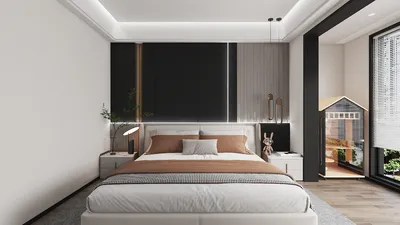


There was a time when a client adamantly insisted that their bed must be positioned facing north, claiming it would enhance their Monday meetings. While I struggled to suppress my laughter, that project imparted a valuable lesson: design rules are often adaptable, and compact spaces can ignite significant creativity. If your master bedroom measures 4.7 x 2.22 meters, you're already armed with a manageable canvas; the key lies in envisioning furniture placement, circulation, and storage as an interconnected design rather than isolated challenges. To assist you, I will present five practical design ideas that I apply in actual renovations and small penthouse transformations — all geared towards optimizing comfort while maintaining a clear, uncluttered ambiance. Plus, utilizing tools like Homestyler can make it easy to visualize your layout quickly, offering a straightforward way to explore the concepts mentioned below.
1. Linear arrangement with a low-profile bed
Position the bed against the longer 4.7 m wall with a low headboard and streamlined nightstands. This arrangement allows for an unobstructed sightline, giving the room a sense of spaciousness; I've implemented this design in narrow urban apartments where a calm, hotel-like atmosphere was desired. The trade-off here is reduced wall space for taller wardrobes, but you can reclaim valuable storage with built-in drawers beneath the bed without cluttering the floor area.
save pin
2. Elevated storage and wall-mounted nightstands
Install wardrobes or shelving slightly above the floor to create a visually striking ‘floating’ effect, which also facilitates easier cleaning. Floating installations reduce visual bulk and contribute to an airy feel in the 2.22 m width. It's worth noting that custom hangers or clever hardware might be necessary, so be ready to allocate a bit of your budget for robust fixings.
save pin
3. Centered bed with a narrow walkway (ideal for balance)
By centering the bed on the long wall and maintaining a slim walkway of approximately 60–70 cm on one side for movement, you can stack vertical storage like a slim wardrobe on the opposite side. This design achieves a harmonious balance, making it perfect for those who prefer symmetry in lighting and bedside furnishings. If precise dimensions are required for an accurate layout, creating a measured floor plan can save you from costly mistakes.
save pin
4. Nook or partition for a compact dressing area
If you can dedicate around 60–80 cm in space, consider adding a shallow partition or curtain to form a mini dressing zone at one end of the room. I've transformed small master bedrooms by introducing a 70 cm dressing alcove with full-height mirrors, creating a sense of luxury without compromising the bedroom's primary function. Keep in mind that partitions may limit flexibility, so opt for lightweight materials or curtains for easy adjustments.
save pin
5. Multifunctional headwall with integrated storage
Construct a headwall that incorporates recessed shelving, reading lights, and narrow closets to merge various functions into a single flat surface. This approach saves space and fosters a tailored, hotel-like ambiance that complements your sleeping routine. I have integrated these headwalls in numerous projects where clients desired a sleek appearance with ample hidden storage. While installation can be more complex, the rewards in both storage efficiency and aesthetic appeal are substantial — plus, you have the option to preview the design with realistic 3D renderings using Homestyler before making a final commitment.
save pin
FAQ
Q1: Is 4.7 x 2.22 m sufficient for a master bedroom?
Absolutely — while compact, it efficiently accommodates a bed, bedside storage, and a narrow wardrobe. Thoughtful planning of circulation and vertical storage ensures comfort rather than a feeling of confinement.
Q2: Which bed size is best suited for 4.7 x 2.22 m?
A queen-sized bed (160 x 200 cm) fits nicely along the 4.7 m wall while allowing for adequate circulation space; alternatively, a full/double bed offers more walking space if you're looking for extra storage or a dressing area.
Q3: How much clearance should I have around the bed?
I recommend maintaining at least 60–70 cm on one side for usable walkway space, and 40–50 cm on the other side if you're tight on space. These clearances facilitate smooth movement without wasting valuable square meters.
Q4: Should I consider sliding doors to conserve space?
Yes, using sliding doors for either the room entrance or wardrobe is a clever way to save swing space; although they may be slightly pricier, the increase in usable floor area is often worth it.
Q5: What lighting strategy is most effective in a narrow master?
Layered lighting, including recessed ceiling lights, wall sconces, pendant lights, and task lamps, can prevent the room from feeling flat. Opt for warm color temperatures to create a cozy ambiance while avoiding glare from small reflective surfaces.
Q6: Any suggestions for ventilation and egress?
Ensure that the room is equipped with a compliant window and a clear egress path; since window locations are typically fixed, arrange the furniture to avoid obstructing natural ventilation and emergency exits.
Q7: Are there specific codes or minimum size requirements for livable rooms?
Indeed. Per the International Residential Code (IRC) R304.1, every habitable room must have at least 70 square feet (about 6.5 m²) of floor area; your room at 4.7 x 2.22 m is approximately 10.4 m², thus surpassing that minimum. Always verify local building codes for precise regulations and egress prerequisites.
Q8: How can I start planning my remodel with measurements?
Begin by creating a measured floor plan detailing walls, door swings, and window placements, and then try out a few layouts before purchasing furniture. Digital planning tools like Homestyler simplify the process of adjusting sizes and placements, helping you sidestep expensive errors.
Homestyler is your go-to online home design platform. With its user-friendly design tool, stunning 3D renderings, and a wealth of DIY video tutorials, you can effortlessly create and visualize your dream space. Start designing today and unleash your creativity!
Progetta ora GRATIS
































