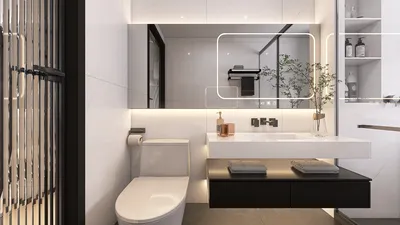


I once made the mistake of placing a 36 x 48 mirror too low, which led my client to humorously remark that I had given them a 'chin-height reflection.' This taught me the valuable lesson that mirror placement is just as important as its dimensions. Now, I always kick off every project with a quick visual mockup using tools like Homestyler to avoid similar blunders and assess sightlines before any drilling begins.
In small spaces, creativity knows no bounds, and using a 36 x 48 bathroom mirror can be an excellent way to showcase that creativity. Here are five practical yet slightly quirky suggestions I personally implement in real projects to make that rectangular mirror truly shine.
1. Centered single-slab above a 36” vanity
For a bathroom featuring a 36" vanity, placing a 36 x 48 mirror directly above it creates a clean and polished aesthetic. The alignment is visually appealing and intentional, allowing for a full reflection of the face and upper-body—perfect for styling hair and makeup.
Benefits include simplicity, symmetry, and affordability. However, be aware that poor lighting placement may necessitate the addition of sconces or transitioning to backlit options.
save pin
2. Backlit frameless for modern minimalism
Utilizing a backlit 36 x 48 mirror transforms it into a centerpiece while simultaneously resolving lighting issues. In one of my renovations, I replaced an old frame with a sleek backlit version, making the bathroom appear more spacious and spa-like.
Pros include even illumination and a contemporary aesthetic. The only drawback is the slightly higher expense and the need for a qualified electrician to ensure proper wiring.
save pin
3. Mirror plus medicine cabinet hybrid
If you desire storage while maintaining visibility, consider a recessed mirrored cabinet crafted to fit the 36 x 48 dimensions. I always specify shallow shelves for neatly storing towels and daily essentials.
Advantages include hidden storage, making it ideal for compact bathrooms. However, recessed installations necessitate adequate wall depth and additional labor.
save pin
4. Offset mounting for double lighting schemes
If your lighting is asymmetrical or your countertop is lengthy, mounting the 36 x 48 mirror slightly off-center can create visual balance. I’ve successfully done this to align a mirror with a window reflection, enhancing the intentional feel of the room.
Benefits include customized balance and adaptability. The catch is that precise measurements are crucial to ensure the offset doesn’t look unintentional.
save pin
5. Use as a partial wall mirror to enlarge space
Installing a 36 x 48 mirror vertically while leaving some visible tile can add depth, creating a window-like effect that makes the wall feel larger. In a studio bath, this adjustment made the entire space appear wider without a significant remodel.
Advantages of this approach include an immediate perception of extra space. It’s essential to consider the grout and lighting reflectivity, so choose finishes wisely to avoid highlighting imperfections. If you’re exploring floor and layout options, using Homestyler to export detailed plans can really help in testing placements before making any commitments.
save pin
Installation tips I swear by
Position the mirror so that the center aligns around eye level for your household members; typically, this is about 58"–64" above the floor. Use continuous cleats for heavier mirrors and always verify the type of wall — masonry requires anchors, while studs favor screws.
If coordinating with a backsplash, allow a small reveal (1/4"–1/2") for easy cleaning and caulking. When uncertain, utilizing cardboard for a mockup remains a practice I follow on tight installations.
save pin
Final note before you start
A 36 x 48 mirror can serve as a focal point or a supportive element based on lighting and vanity selections. I've implemented it across various settings, from rentals to luxurious baths to small powder rooms—the core principles remain unchanged: measure accurately, mock it up, and ensure proper lighting.
For specific bathroom layout tips and clearances from shower to vanity, I often refer to a bathroom design guide that ensures dimensions comply with both code and ergonomic standards.
save pin
FAQ
Q1: Is 36 x 48 a common bathroom mirror size?
Indeed, this size is quite popular for single-sink vanities, striking a good balance of reflection area without overwhelming most standard bathrooms.
Q2: What height should a 36 x 48 mirror be hung?
The guideline is to align the center of the mirror at about 58"–64" from the floor, though adjustments may be necessary based on the height of your household and the thickness of your vanity's backsplash.
Q3: Can a 36 x 48 mirror be backlit?
Absolutely. Backlit LED mirrors in this size are widely available and provide flattering, even lighting, usually requiring a hardwired connection or a nearby outlet.
Q4: Will a 36 x 48 mirror fit above a 48" vanity?
You can certainly use it, but it may appear smaller relative to the broader vanity. Designers often choose a wider mirror or pair the 36 x 48 with sidelights to maintain proper proportions.
Q5: How much does installing a 36 x 48 mirror cost?
Prices vary according to mirror type. A basic framed glass might be budget-friendly; however, a recessed cabinet or backlit version generally incurs higher labor and material costs. Always account for mounting hardware and potential electrical work in your budget.
Q6: Can moist bathroom conditions damage the mirror?
Prolonged exposure to humidity can affect the backing over time. Opt for mirrors with moisture-resistant backing or ensure proper ventilation to maximize lifespan.
Q7: Are there accessibility guidelines for mirror height?
Indeed. Accessibility regulations (such as ADA) suggest lower mounting or tilting mirrors for wheelchair accessibility. For precise specifications, consult authoritative standards such as those provided by the ADA or local building codes.
Q8: Where can I find professional guidance on bathroom layouts?
Reliable references such as the National Kitchen & Bath Association (NKBA) provide guidelines and best practices for bathroom ergonomics and layouts. You can check nkba.org for comprehensive details.
save pin
Looking to transform your space? Homestyler is your go-to online home design platform! With its user-friendly design tool, stunning 3D renderings, inspiring design projects, and helpful video tutorials, you’ll effortlessly create your dream home. Get started today and unleash your creativity!
Design Now for FREE
































