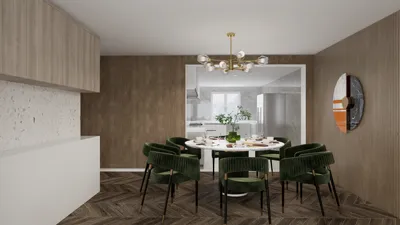


I once had a client who envisioned their narrow dining area as a charming Parisian bistro, despite the space being scarcely wider than a hallway. We nearly installed a tiny brass chandelier; however, it would have obstructed the pathway from the kitchen to the living room. This experience taught me to approach a pass-through dining room layout as a creative design challenge rather than a limitation. To begin, I always suggest people use 3D visualization tools, such as Homestyler, to understand traffic flow before finalizing any designs.
1. Establish a Clear Path for Movement
Ensure the walking route is obvious: maintain at least one unobstructed lane free of furniture, and position seating away from major pathways. The advantage is enhanced movement and fewer awkward moments; however, this may mean letting go of some decorative items. Overall, the space will feel more serene and functional.
save pin
2. Embrace Linear Seating Arrangements
Using a built-in bench or a slim banquette against one wall allows for more seating without obstructing the flow. I implemented this strategy in a compact apartment, which the owner appreciated for its snug atmosphere, though it did mean customizing cushions and committing to a slightly elevated upholstery budget.
save pin
3. Incorporate Versatile Surfaces
Consider the dining surface as multifunctional: a counter that also serves as prep space, a foldable ledge, or a slender console that becomes additional seating when required. For those looking to experiment before purchasing, sketching an accurate layout and testing various tabletop arrangements can provide tremendous flexibility, with the only trade-off being increased planning and patience.
save pin
4. Maintain Consistency in Materials and Lighting
Using uniform flooring or a cohesive color scheme visually expands the pass-through and minimizes clutter. Layering linear lighting — like recessed tracks or a series of pendant lights — will guide both the eye and footsteps; this approach has a professional touch but may slightly strain the budget. I often recommend combining a standout fixture with budget-conscious recessed lighting to enhance both workflow and ambience in the kitchen.
save pin
5. Opt for Adaptable Furniture and Hidden Features
Folding chairs, nesting tables, or a narrow expandable table can help you modify the space for casual weekday breakfasts or festive weekend dinner gatherings. In one of my projects, I incorporated sliding panels to conceal clutter — guests found it enchanting, while the homeowner valued the secret storage, although we needed to carefully plan clearances.
save pin
FAQ
Q: What is a pass-through dining room layout?
A: This dining configuration is situated within a circulation area between rooms, often fulfilling the roles of both a pathway and a dining space. The objective is to balance movement with seating without obstructing traffic flow.
Q: What is the ideal width for a functional pass-through?
A: Ideally, aim for at least 36 inches (91 cm) for a single path. If you anticipate two-way traffic or cooking activities nearby, 42 inches (107 cm) is preferable. According to the recommendations from the National Kitchen & Bath Association (NKBA), a width of 36–42 inches is common (https://www.nkba.org).
Q: Is it feasible to place a full dining table in a pass-through?
A: Full-size tables can be accommodated if the room is sufficiently spacious. However, I often suggest using extendable or narrower tables to avoid hindering traffic flow; many clients prefer furniture that can be easily tucked away to maintain a better circulation.
Q: What lighting options are most effective for a pass-through dining area?
A: Implementing linear lighting along the pathway, complemented by a focused fixture over the table, tends to work well together. Utilizing dimmers is beneficial, allowing you to shift from functional lighting to a cozy ambiance in moments.
Q: How can I add storage without obstructing the pathway?
A: Consider vertical storage solutions, floating shelves, or drawers beneath benches to keep the floor area clear. Built-ins that are flush with the walls allow for circulation while enhancing functionality.
Q: Is a pass-through dining layout suitable for open-concept homes?
A: Definitely — it can serve as a transitional bridge that delineates zones while preserving an open feel. The key lies in using consistent materials and a clear configuration that connects rather than divides the space.
Q: Will I need structural alterations to create a pass-through?
A: Occasionally yes — if you plan to remove or enlarge an opening, it's crucial to consult a structural engineer or qualified contractor to assess any load-bearing walls and necessary permits. Smaller visual modifications typically help avoid extensive renovations.
Q: Are there any tools available to help plan a pass-through dining layout?
A: Certainly! Either hand-drawing in 3D or leveraging floor planning software like Homestyler can assist in experimenting with layouts and clearances prior to any purchases. I recommend utilizing a 3D floor planner to manipulate scale and sightlines before finalizing your decisions.
save pin
Homestyler is your go-to online home design platform, perfect for both beginners and seasoned designers. With its user-friendly design tool, stunning 3D renderings, and a wealth of DIY video tutorials, you can effortlessly create and visualize your dream spaces. Start transforming your home today!
Progetta ora GRATIS
































