


As we approach the future, my clients continue to navigate the challenges of noise, clutter, and limited space. I craft designs as if tomorrow’s living patterns are already influencing today’s home environments. Industry data from NAHB highlights a trend towards efficient, smaller homes, and I perceive the 43–45 sqm 1 BHK floor plan as a streamlined operating system. It's like a blueprint for spatial reasoning—incorporating interfaces, nodes, and straightforward instructions—since discomfort often arises from inadequate flow rather than mere square footage. My go-to is the Homestyler spatial reasoning toolkit.
Linear Gallery Layout
Design Approach: A singular spine connects the entry, kitchen, living area, and bedroom, providing the small space with a generous flow. Tomorrow's routines favor fewer context switches; this design strategy supports a seamless transition.
Flow: Entry → utility area → galley kitchen → living space → sliding partition → bedroom → bathroom; resembling a clean function call sequence.
Sightlines: The passage from door to window remains unobstructed; glass partitions keep user interface layers shallow, enabling light to be the first point of focus, followed by objects.
Storage: Full-height pantry and wall-mounted wardrobes act as storage caches, designed with shallow depths for quick access.
Furniture Fit: A 72–78 inch sofa, a 30 inch coffee table, and a queen platform bed with 24 inch side clearance; all configurations respect the circulation space of 900–1000 mm.
Conclusion: This linear planning method adapts well to hybrid work environments, and even five years later, it maintains its viability for effortless living.
save pin
Looped Core Layout
Design Approach: The kitchen and bathroom are designed around a compact wet core; circulation paths wrap around them, transforming meters into functional spaces.
Flow: Entry → circular corridor → kitchen area → living space → bedroom area → bathroom; promoting a circular flow that avoids dead ends.
Sightlines: Misaligned doorways create layers of perspective; the main window establishes a hierarchy, while secondary openings serve as visual indicators.
Storage: Perimeter cabinetry with a depth of 350 mm and overhead storage close to the core; keeping frequently used items within reach.
Furniture Fit: A drop-leaf dining table (700 × 700 mm), a modular media wall (1800 mm), and a bed with under-drawers; precisely designed elements ensure smooth operation.
Conclusion: This layout anticipates overlapping activities among users; five years from now, it continues to accommodate shared schedules with ease.
save pin
Split Axis Layout
Design Approach: The living area and bedroom are aligned perpendicularly, offering privacy without sacrificing openness—an essential aspect for future telepresence.
Flow: Entry → coat storage → living hub → pivot door → bedroom → ensuite; creating a bifurcated route that allows work and rest to coexist side by side.
Sightlines: A diagonal view from the entry to the corner window enhances the perceived space; partial-height partitions curate the visual interface.
Storage: Tiered shelving, a linen tower, and built-in benches foster organized memory with rapid access capabilities.
Furniture Fit: A four-seat sectional (2200 mm) in an L shape, a compact desk (1200 mm), and a queen bed with 600 mm side clearance; strict tolerances maintain high efficiency.
Conclusion: This design ensures a clear separation between public and private spaces, remaining adaptable as technology and lifestyle habits evolve.
save pin
Final Insights
The 43–45 sqm 1 BHK floor plan evolves into a living interface when aspects like flow, sightlines, and storage are meticulously crafted, akin to programming. Variants—such as one-bedroom apartment designs, compact layouts, and small-space strategies—illustrate how subtlety can triumph over size. A focus on sliding partitions and wet-core efficiency is likely to shape the next phase of home design. From my perspective, the most intelligent homes of the future won't necessarily be larger; they will be more intentional, and I will continue to design them with tools like Homestyler to ensure every detail is optimized.
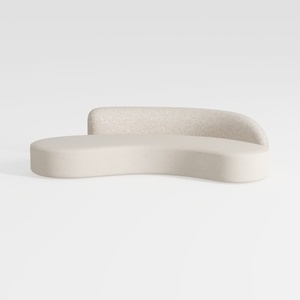
Minimalist Boucle Curved Sofa 3D Model
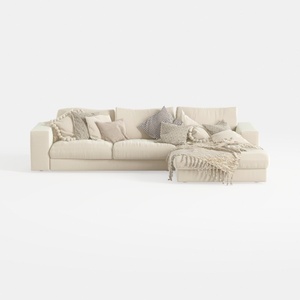
Minimalist Beige Fabric L Shaped Sectional Sofa with Throw Pillows 3D Model

Modern Olive Green Velvet Loveseat Sofa with Metal Legs 3D Model
Homestyler is your go-to online home design platform, perfect for anyone looking to create stunning spaces. Enjoy an intuitive design tool, breathtaking 3D renderings, a variety of inspiring design projects, and engaging DIY video tutorials. Transform your vision into reality effortlessly!
立即免费设计
































