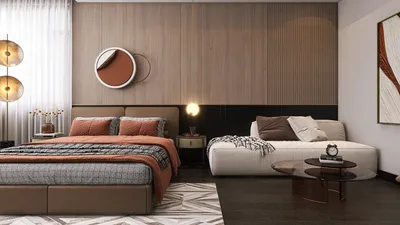


I once encountered a client who believed that their three-bedroom home required only a small linen closet — this misconception almost led us to run out of storage space during the renovation. This experience highlighted how the dimensions listed on paper can often obscure the true necessities of everyday living. Understanding how slight variations in square footage can either enhance or restrict the perceived space of a home is crucial for effective planning.
1. Understanding Typical Size Ranges and Their Implications
In the United States, most three-bedroom homes range from 1,000 to 2,200 square feet. On the smaller end, about 1,000 to 1,300 square feet, homes feature compact bedrooms and open-concept living. Mid-range properties, falling between 1,300 and 1,800 square feet, generally include a reasonable master suite along with two smaller bedrooms. In larger three-bedroom homes, with sizes over 1,800 square feet, you often find spacious closets, dedicated laundry areas, and sometimes additional flexible rooms. While smaller homes can mean lower expenses and simpler upkeep, they also require innovative storage and layout designs.
save pin
2. Analyzing Room Sizes
For typical bedroom dimensions, secondary bedrooms usually measure between 100 and 130 square feet, while a master bedroom ranges from 150 to 220 square feet. Living rooms typically cover 200 to 350 square feet, kitchens span 100 to 200 square feet, and bathrooms can vary between 30 to 70 square feet each. These approximate dimensions assist me in creating layouts, as real-life homes often deviate from textbook standards. Hence, I prioritize movement and furniture arrangements first.
save pin
3. Strategies for Making Compact Three-Bedroom Homes Feel Larger
In smaller three-bedroom houses, I utilize open sightlines, integrated storage solutions, and multifunctional furniture. For instance, substituting a conventional dining room with a breakfast bar can create additional space for a larger living area. These strategies are cost-effective, although they may require sacrifices such as reduced space for formal entertaining.
save pin
4. Prioritizing Between Square Footage and Layout Quality
When buying or designing, I often ask clients whether they prefer larger private spaces or more spacious communal areas. A well-designed 1,400 square foot layout can provide a better living experience compared to a poorly arranged 1,800 square foot space. Effective layouts enhance natural lighting and reduce long corridors — aspects I pay close attention to during my design concepts and while experimenting with layouts using tools like Homestyler.
save pin
5. Regional Variances and Architectural Differences
It's important to recognize regional differences: older homes in cities and cottages may feature smaller rooms but higher ceilings, while new suburban developments usually trend towards larger, more open floor plans. The architectural style also plays a role in usable square footage — for example, thick walls or expansive entryways consume space yet contribute to character. I always strive to balance aesthetic preferences with practical requirements when evaluating potential sizes.
save pin
Tips 1:
Budget consideration: adding 200 to 300 square feet can greatly enhance comfort but will also increase construction and energy costs. A practical recommendation is to measure your furniture and simulate living zones before finalizing a floor plan, while also contemplating versatile designs that can evolve alongside family requirements.
save pin
FAQ
Q: What is the average square footage for a three-bedroom home in the U.S.? A: Typically, it ranges from 1,300 to 1,800 square feet based on geographical location and construction era.
Q: Is it possible for a three-bedroom house to be under 1,000 square feet? A: While uncommon, this can occur in compact urban or tiny house designs, where you'll find extremely limited room sizes necessitating ingenious storage solutions.
Q: How does a larger master suite impact total square footage? A: A spacious master suite can add between 150 to 300 square feet when considering an ensuite and walk-in closet, so it’s essential to plan accordingly.
Q: Are open-concept layouts beneficial for smaller three-bedroom homes? A: Absolutely, open designs enhance the perceived space and flexibility, albeit sometimes at the expense of distinct room separation.
Q: How can I estimate my heating and cooling requirements based on square footage? A: HVAC calculations depend on several factors like insulation, window positioning, and more; square footage is just one consideration. For precise calculations, consult an HVAC specialist or refer to the ACCA Manual J guidelines.
Q: Should I always aim to purchase the largest three-bedroom property within my budget? A: Not necessarily; focus on the quality of the layout, storage solutions, and location instead of merely the square footage.
Q: What is the standard storage capacity in a three-bedroom house? A: Aim for multiple closets alongside attic/basement spaces or built-in options; smaller homes particularly benefit from smart storage implementations.
Q: Where can I try different layouts before committing to construction? A: Utilize online tools, such as Homestyler, to experiment with furniture arrangements and spatial flow prior to finalizing your plans.
save pin
If you're looking to transform your space effortlessly, Homestyler is the ideal online home design platform. With its user-friendly design tool, stunning 3D renderings, diverse design projects, and helpful DIY video tutorials, you can easily create your dream home, regardless of your experience level!
تصميم الآن مجانا
































