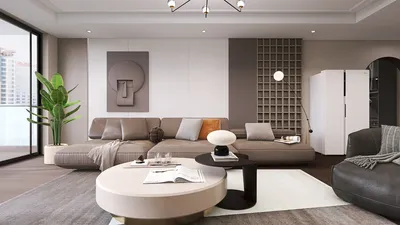


Once, I attempted to fit an entire laundry room into a 60-square-foot hallway at a client's insistence, thinking it would be doable. The outcome was far from ideal. This experience taught me that well-thought-out planning is more effective than cramming functionalities into small spaces. For those interested in maximizing creativity, small-to-medium house plans with three bedrooms and three bathrooms serve as excellent opportunities, providing private suites and versatility while offering sufficient zoning to avoid the hallway-laundry debacle.
1. Split-bedroom layout for enhanced privacy
I am a fan of a split-bedroom layout where the master bedroom is situated on one side and two additional bedrooms on the opposite. This configuration provides couples a truly private space as well as a quiet area for guests or office work. The advantage lies in the clear delineation of functions, which is particularly beneficial for families or those working from home. Although it may require a bit more circulation area, clever hall widths and pocket doors can easily address this issue. For added convenience, consider placing a full bathroom near the secondary bedrooms to prevent guests from passing through the master suite.
save pin
2. Jack-and-Jill bathroom for increased efficiency
A Jack-and-Jill bathroom that connects two bedrooms optimizes space and plumbing, and it’s often appreciated by children or visitors for its semi-private feel. The key is incorporating lockable vanities or dual sinks if the budget allows, which can help ease morning traffic. A potential drawback is ensuring adequate ventilation and privacy; installing a skylight or an exhaust fan combined with frosted glass doors can create a pleasant environment.
save pin
3. Flex room that adapts to your needs
In numerous three-bedroom designs I create, one bedroom often functions as a flex room, serving as a guest suite, home office, or fitness area. This versatility allows the home to evolve with its occupants over time. The trade-off might be a slightly smaller closet to keep the overall dimensions manageable. Ideally, the flex room should be positioned near a full bathroom to facilitate its function as a true guest suite when necessary or be isolated by a sliding barn door for professional calls.
save pin
4. Open living hub with distinct wet zones
Frequently, I design an open living hub that merges the kitchen, dining, and living areas, while strategically zoning the three bathrooms for easy accessibility. This setup fosters a social and efficient daily environment where cooking, helping with homework, and entertaining can all occur in an interconnected space. To manage potential noise levels, I incorporate acoustic finishes and partial-height walls to mark boundaries without compromising openness. Additionally, grouping wet areas can reduce plumbing complexity and overall costs.
save pin
5. Multi-entrance design for flexible occupancy
For a home that can adapt to various needs, I suggest considering a layout featuring a secondary entrance located near one bedroom and bathroom — ideal for an in-law suite or rental situation. This design allows occupants a degree of independence and can create the potential for rental income. However, it’s crucial to plan for circulation and security. In one of my projects, we added a small kitchenette to that wing and employed sound-isolating insulation, turning it into a favorite for family stays.
save pin
Design tools and next steps
When conceptualizing these ideas, I begin with sketches and then turn to a reliable planner to verify dimensions and sightlines. For those looking to quickly explore a layout, starting with a room planner can efficiently block out spaces and assess flow, as it is both quick and visual. Subsequently, using a floor plan creator enables refinement of plumbing layouts and door swings, ensuring that the connectivity between the three bathrooms and three bedrooms operates harmoniously.
save pin
Tips 1:
Budget note: Adding a third full bathroom can escalate construction costs due to plumbing requirements, but it also boosts resale value when well-executed. To save on expenses, consider utilizing a shared wet wall between two bathrooms, opting for durable finishes in high-traffic areas, and prioritizing natural light in bedrooms to create an illusion of spaciousness in compact areas.
save pin
FAQ
Q1: What is the typical square footage for an efficient 3 bedroom, 3 bathroom house plan?
A1: Efficient layouts for three bedrooms and three bathrooms typically range between 1,200 and 2,100 square feet, depending on room dimensions and circulation space; 1,400–1,800 square feet is ideal for comfortable living without excess hallway areas.
Q2: Is it worthwhile to add a third bathroom in a home with three bedrooms?
A2: Absolutely, as it enhances daily convenience and appeals to potential buyers, especially for multi-generational families or frequent visitors, but be mindful of the extra expenses for plumbing and fixtures.
Q3: How can I minimize plumbing costs while planning for three bathrooms?
A3: Cluster bathrooms along the same wet wall or arrange plumbing vertically to reduce runs and lower labor and material expenses.
Q4: Can a three-bedroom, three-bathroom plan fit on a narrow lot?
A4: Definitely — utilizing linear designs, positioning bedrooms longitudinally, and opting for compact Jack-and-Jill configurations can help accommodate narrower lots.
Q5: How can I maintain privacy in an open living area?
A5: Employ partial-height dividers, acoustic panels, and strategic furniture arrangements to create distinct zones while preserving a sense of openness.
Q6: What common errors should I avoid when designing a 3 bed/3 bath home?
A6: Steer clear of long, unutilized hallways and overly spacious circulation areas; ensure that bedrooms are not all arranged around a noisy living space without soundproofing; and verify that each bedroom has sufficient storage.
Q7: Where can I find dependable tools for visualizing house layouts?
A7: Explore a free floor plan creator to experiment with various room dimensions and layouts before diving into detailed design; such tools simplify the testing of different three-bedroom, three-bath arrangements.
Q8: Are there credible resources for learning about residential plumbing layout standards?
A8: Yes — consult local building codes and the International Residential Code (IRC) for guidelines; for specifics on plumbing fixture counts and venting, refer to the IRC or your local jurisdiction authority (source: International Code Council, https://codes.iccsafe.org/).
save pin
Discover your creative potential with Homestyler! This innovative online home design platform offers an intuitive design tool, stunning 3D renderings, a wealth of design projects, and engaging DIY video tutorials. Transform your space effortlessly, whether you're a beginner or an expert!
立即免费设计
































