

Over the years, I have utilized table saws and routers in compact garage workshops as well as larger studios, and I can confidently say that investing in a well-constructed router table extension is among the top enhancements that yield a significant return. When executed correctly, this extension boosts cutting precision, optimizes floor space, and centralizes dust collection alongside power management while ensuring safety remains paramount.
Ensuring precision and ergonomic design is critical. The WELL v2 Light concept guidelines recommend that task lighting should aim for around 500 lux for intricate jobs, which aligns with the lighting I use above the fence and bit area to minimize mistakes and eye strain. Research from Steelcase indicates that minimizing awkward reaches can alleviate fatigue during lengthy working sessions; I set my fence controls within a comfortable reach of 12 to 18 inches and adjust the table height to approximately 34 to 36 inches for the majority of users. You'll certainly notice the improvement within just one afternoon of using it. For pre-cut material layout, using a straightforward room layout tool can assist you in simulating clearances for infeed/outfeed areas and dust collection paths, enhancing efficiency in your workspace: room layout tool.
Both noise levels and safety must be carefully considered. Router operating noise can reach about 95 to 100 dB at ear level, prompting me to design with sound dampening in mind, employing rubber isolation pads beneath the insert plate and adding lined enclosures to reduce resonance. The WELL v2 guidelines emphasize the importance of controlling particulate matter; integrating a 2.5 to 4-inch dust port at the router box together with a 4-inch port for the table saw drastically reduces airborne particles. For those beginning to incorporate ergonomic principles into workshop designs, the International WELL Building Institute offers accessible resources on task comfort and effective lighting, which are beneficial even in hobbyist workshops.
Designing Your Router Table: Key Dimensions, Footprint, and Required Clearances
Begin by outlining your saw top and fence configuration. On standard contractor or cabinet saws, the router section typically occupies 18 to 27 inches of the right-side extension wing. My preferred dimensions for the router table surface are 24 inches in width by 27 to 30 inches in depth, providing ample support for common jigs and fine-tuning fences. Ensure a minimum of 36 inches of clear space around the saw, at least 48 inches in front for infeed processes, and a generous 60 inches behind for outfeeding during extended cuts. For shops smaller than 120 square feet, consider incorporating a fold-down leg beneath the router extension to prevent sag while preserving mobility.
Material Choices and Plate Selection
A flat and stable surface is more important than using unconventional materials. I recommend laminated MDF (comprised of two layers of 3/4 inch thickness) topped with high-pressure laminate (HPL) on both sides, as this combination provides rigidity, excellent glide, and moisture resistance. When facing significant humidity variations, Baltic birch plywood (between 18 to 24 mm thick) would be my secondary material of choice. Select a machined aluminum insert plate featuring leveling screws and either a magnet or snap ring for effortless lift-off. For heavy-duty lifts and large bits, opting for a phenolic top combined with an aluminum plate is advisable to minimize deflection.
Ensuring Top Flatness and Preventing Sag
Router tables can bend if reinforcement is overlooked. Install two steel T-bars or 1-inch square tubing along the front-to-back axis of the table, extending them to where they meet the edge of the insert plate. Incorporate four corner leveling points (using 10–32 set screws in threaded inserts) to achieve micrometer-level adjustments; aim for a variation of ±0.002 inches around the plate's edges. A straightedge paired with feeler gauges will prove far more effective than mere visual estimation.
Router Lift Mechanism, Bit Access, and Dust Containment
Investing in a quality lift with an above-table height adjustment is crucial for safely and accurately changing bits. Maintain a compact enclosure—it should be a 3/4 inch plywood box outfitted with a gasketed door, a 2.5 to 4-inch dust port aligned with the bit cavity, and a brush or silicone curtain that surrounds the plate opening to catch debris. I line the interior with thin closed-cell foam to help decrease high-frequency sounds. Adding a small adjustable vent slot ensures the router motor does not become starved for airflow.
Fence Configuration and Micro-Adjustment Techniques
Utilize a split fence constructed with independent faces (either MDF or aluminum) mounted on a robust extrusion. Integrate a micro-adjust wheel (offering adjustments of 0.001 to 0.003 inches per incremental click) accompanied by a locking lever. It's essential to maintain square alignment and coplanarity between the faces; using thin shim stock allows you to offset for jointing passes. Direct dust collection positioned behind the bit via a 2.5-inch port can significantly minimize scatter. For enhanced workflow, install featherboards onto T-tracks—one for infeed and another for outfeed—ensuring consistent pressure without resistance.
Incorporating Miter Slots, Outfeed Solutions, and Accessory Components
Integrate the miter slots from your saw into the router wing or align new slots using a fence-parallel jig for universal compatibility with sleds and coping jigs. You may want to consider a removable outfeed support that can be pinned into the back rail of the saw, aligning perfectly at a height of 36 inches, allowing for better control of sheet materials. In smaller workshops, I recommend creating accessory parking spaces: a magnetic strip for wrenches, a bit storage near the fence, and a dedicated rack for push blocks to prevent tools from straying into hazardous areas.
Electrical Components, Control Switches, and Safety Measures
Ensure that the power for both the saw and the router is drawn from a single GFCI-protected circuit that meets the required ratings; many 15A circuits struggle when both tools start up at the same time, thus it’s prudent to stagger the power on/off or allocate the router to a separate 20A circuit. I also recommend installing a large paddle switch positioned at knee height for easy access without direct visual contact. Additionally, introducing an interlock switch on the enclosure door is beneficial for newer users in the shop, preventing the router from operating with the door open. Keep bit guards and transparent polycarbonate shields readily available for edge profiling and template routing tasks.
Illumination, Color Choices, and Visual Comfort
Eliminating glare is essential for safety. I utilize LED task lights emitting between 4000 to 5000K with diffusers to provide approximately 500 lux on the work surface, while also avoiding glaring hotspots along the fence. Utilizing neutral matte finishes in gray or light taupe on the table limits harsh contrast with wood tones, as color psychology indicates that mid-value neutrals help alleviate visual fatigue during high-precision tasks. I prefer painting the internal surfaces of the enclosure in matte black or charcoal to make chips and the spinning bit more visible for quick reference.
Noise Control and Vibration Management
Routers generate tonal sounds that can quickly lead to fatigue. Decoupling the plate using thin rubber gaskets and increasing the mass of the enclosure panel effectively reduces resonance. I place the router on a neoprene pad and include a dead-blow strip on the door. Remember to keep hearing protection within easy reach; aim to maintain sound levels below 85 dB for the operator while dust extraction systems are in operation.
Construction Sequence: A Step-by-Step Guide
1) Measure the right-wing area of your saw and create a template. 2) Cut the table blank using two layers of MDF with HPL faces, routing the insert recess according to the plate manufacturer’s specifications. 3) Embed steel reinforcing bars and drill holes for leveling screws. 4) Attach the wing to the saw rails; if the span exceeds 22 to 24 inches, add a fold-down leg for extra support. 5) Construct the router enclosure and install the lift. 6) Set up a split fence using T-tracks and connect the dust collection port. 7) Align the table flush with the saw, targeting an accuracy of ±0.002 inches. 8) Calibrate the fence’s parallelism and execute test passes on scrap material to check for burn marks and snipe. 9) Connect the paddle switch and verify dust collection efficiency. 10) Finally, incorporate lighting arrangements and storage for accessories.
Optimizing Layout and Workflow Efficiency
Consider ease of movement—not merely machine placement. Arrange clamps, push sticks, and measuring tools within a triangular formation around the operator. Always ensure a clear path for exit behind the saw. If your workshop doubles as a garage, utilizing quick-disconnect fittings for dust extraction and folding outfeeds can facilitate stowing the equipment away within a mere five minutes. To effectively validate clearances before making any drilling commitments, use a room design visualization tool to run a layout simulation, allowing you to accurately position the saw, the range of fence movements, and outfeed support: layout simulation tool.
Regular Maintenance and Calibration Practices
Establish a quarterly maintenance schedule: verify plate leveling, gauge fence squareness, and inspect dust seals. Wax the table surface to enhance glide. Replace used featherboard faces and inspect bit bearings regularly. Keeping the router collet clean is crucial, as even a tiny fragment can compromise a bit's alignment and ruin an otherwise perfect edge profile.
Common Pitfalls to Avoid
• Overextending the wing without the necessary reinforcement can lead to sagging. • Neglecting to implement above-table height adjustment can transform bit changes into unsafe maneuvers. • Overlooking noise control and proper lighting can make work sessions exhausting and less precise. • Misalignment of miter slots can interfere with jig compatibility. • Inadequate airflow in the dust enclosure can cause the router to overheat.
Frequently Asked Questions
Q1: What dimensions should the router table extension have for a standard contractor saw?
A: A panel size of 24 inches in width by 27–30 inches in depth is ideal for most contractor and cabinet saws. Ensure that a minimum of 36 inches of space is available for the operator and around 48 to 60 inches for infeed/outfeed operations.
Q2: What is the required flatness for the router insert plate in relation to the saw top?
A: Aim for an accuracy of ±0.002 inches around the perimeter of the plate. Utilize leveling screws in threaded inserts and verify alignment with a straightedge and feeler gauges.
Q3: What is the optimal lighting level for performing router tasks?
A: Aim for approximately 500 lux on the work surface through diffused 4000 to 5000K LEDs, which aligns with the task lighting recommendations outlined in the WELL v2 guidelines for detailed operations.
Q4: How can I effectively manage the noise from the router?
A: Mitigate sound by decoupling the plate using rubber gaskets, increasing the enclosure's mass, and utilizing closed-cell foam lining. Always have hearing protection on hand and aim to keep sound exposure below 85 dB for the operator.
Q5: Which materials provide the best resistance to sagging for the router table?
A: Laminated MDF with HPL on both sides exhibits excellent stability and mobility. Baltic birch plywood serves as a sturdy alternative. Consider adding steel reinforcements or square tubing underneath to control any bending.
Q6: Is it feasible to use the table saw fence for the router?
A: Yes, this can be accomplished by attaching a split fence or utilizing a dedicated router fence clamped to the saw's fence. Ensure incorporation of micro-adjustments and efficient dust extraction positioned directly behind the bit for clean operations.
Q7: What should be the appropriate size for dust collection systems?
A: Pair a 4-inch port for the saw with a 2.5 to 4-inch port specifically for the router enclosure. Integrating a small air makeup slot is advisable to prevent overheating of the router while simultaneously improving chip capture efficiency.
Q8: How can I maintain a modular router table setup in a confined workshop space?
A: Consider features such as a fold-down leg, quick-release fence attachments, and quick-disconnect fittings for dust collection. Utilize a room design visualization tool to plan the layout effectively and confirm clearances before the drilling process begins.
Q9: What is the recommended table height?
A: Most users find a height of 34 to 36 inches to be preferable. Align the height of your tablesaw and ensure controls remain within a comfortable reach range of 12 to 18 inches for optimal ergonomics.
Q10: Is using an insert plate essential if I create a solid top?
A: If frequent bit changes and precise height adjustments are required, investing in an above-table adjustable machined aluminum or phenolic insert plate is worthwhile. This will promote flatness and streamline setup.
Q11: Will incorporating miter slots enhance functionality?
A: Absolutely. Extending the saw's miter slots into the router wing ensures universal compatibility for sleds, coping jigs, and fixtures, minimizing both setup time and potential errors.
Q12: What safety switches do you recommend installing?
A: A knee-height paddle switch for the router is indispensable. It’s also advisable to incorporate an interlock switch on the enclosure for safe operation in shared workshop environments.
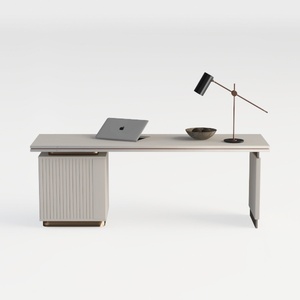
Modern Minimalist Solid Wood Office Desk With Gold Accents 3D Model


NicBex Computer Desk Home Office Desk with Storage
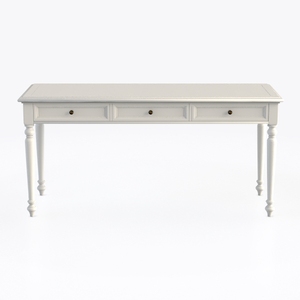
Classic White Solid Wood Three Drawer Writing Desk 3D Model
Looking to transform your space? Homestyler offers an intuitive online design tool that lets you create stunning designs effortlessly. With impressive 3D rendering, a wealth of design projects, and helpful DIY video tutorials, you'll find all the inspiration you need to bring your vision to life!
지금 무료로 디자인하세요
































