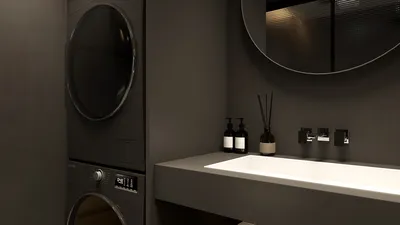


I once agreed to paint a client's small studio entirely in a matte black shade, believing it would create a “deep and chic” ambiance. However, it almost made the room feel swallowed, prompting me to add reflective accents and strategic lighting to rescue the space. This experience taught me invaluable lessons about flat finishes and room proportions. If you find yourself contemplating flat wall paint for a compact area, and are unsure whether it is too conventional or overly adventurous, let me guide you through five solid ideas that turn a matte finish into a design strength. For effective planning, I frequently advise clients to utilize Homestyler to visualize their space layout before finalizing colors and finishes.
1. Matte Monochrome Accent
Select a deep, singular hue and apply a flat finish to just one wall, providing a serene backdrop that avoids glossy reflections. This approach not only imparts a sophisticated and cozy atmosphere but also simplifies the decorating process; however, it’s essential to ensure there’s enough light or contrast to prevent the wall from appearing too heavy.
Tip: offset the matte wall with lighter fabrics and metallic or glass ornamentation to allow the wall to breathe, keeping it both budget-friendly and impactful.
save pin
2. Soft Textured Flat Finish
Incorporate a roller technique or micro-texture additive into flat paint to introduce subtle depth, providing a matte appearance with visual intrigue upon closer inspection. I applied this technique in a recent rental bedroom, where the flat finish concealed imperfections, and the texture captured ambient light just enough to create warmth.
Caution: textured flat walls can be challenging to touch up seamlessly, so it’s advisable to keep extra paint for repairs.
save pin
3. Low-Contrast Two-Tone Split
Horizontally divide a wall with two flat paints sharing the same undertone — using a darker shade on the lower half and a lighter one on the upper — to visually expand a narrow room. This is an elegant way to utilize flat wall paint for manipulating space perception without resorting to loud patterns.
This method is particularly effective in hallways and studios; the tricky aspect lies in ensuring the dividing line is perfectly level, so it's beneficial to use a laser level or professional guide.
save pin
4. Matte Color Blocking for Small Niches
Paint niches, alcoves, or the backs of shallow shelving units in a flat color that blends seamlessly with the wall to create storage that feels integrated. I frequently recommend this technique for open-plan small apartments, where you want to establish functional areas without the need for heavy furniture to divide the space.
To visualize how that area will interact within the entire apartment, I commonly suggest that clients use Homestyler to create a 3D layout, ensuring the matte color feels intentional rather than accidental.
save pin
5. Matte Murals and Minimalist Graphics
For small walls, a hand-painted or stenciled mural using flat paint can serve as art rather than mere wallpaper; minimalist geometric shapes in matte shades can add sophistication without cluttering the space. I once painted a simple matte triangle over a kitchenette backsplash, which unified the area and created the illusion of a larger kitchen.
In open kitchens or compact galley styles, combining a matte painted backdrop with a quick kitchen layout mockup using Homestyler can help ensure the finish complements cabinetry and hardware. However, note that flat paint on high-contact surfaces may require more frequent touch-ups compared to semi-gloss finishes.
save pin
FAQ
Q1: Is flat wall paint suitable for small rooms? A1: Absolutely — flat paint minimizes glare and creates a seamless background that can enhance the cohesion and tranquility of a small space, especially when accompanied by textured or reflective elements.
Q2: How durable is flat paint in comparison to eggshell or satin? A2: Flat paint is less washable than eggshell or satin and may show marks more easily, making it ideal for low-traffic walls. Sherwin-Williams states that flat finishes excel in coverage but lack the scrubbability of glossier sheens.
Q3: Can flat paint cause a room to look darker? A3: Yes, especially if very dark shades are selected without adequate lighting; you can balance this by incorporating lighter furnishings, mirrors, or strategic task lighting to keep the space feeling open.
Q4: How can I touch up flat paint without leaving noticeable patches? A4: Retain leftover mixed paint, feather the edges when applying touch-ups, and if feasible, repaint the entire wall for a flawless match, as flat finishes can exhibit slight variations between batches.
Q5: Is flat paint a viable choice for rental units? A5: Often yes — it conceals surface flaws and can be easily covered with a new coat; just verify with your landlord regarding color and finish preferences beforehand.
Q6: Which colors complement flat finishes in compact spaces? A6: Muted neutrals, soft pastels, and deep yet warm colors often work well; steer clear of highly saturated bright colors unless balanced with neutral tones.
Q7: Is flat paint advisable for kitchens or bathrooms? A7: Exercise caution; flat finishes can absorb moisture and stains more easily. For kitchens and bathrooms, consider semi-gloss for areas exposed to splashes and reserve flat paint for upper sections or decorative features.
Q8: What’s the difference between matte and flat finishes? A8: Although the terms are often interchangeable, "flat" typically refers to a sheen with very low reflectivity. It's best to test samples on your wall at various times of day and in both natural and artificial light to make an informed decision.
save pin
Homestyler is your go-to online platform for transforming home design dreams into reality. With its user-friendly design tool, stunning 3D renderings, and a wealth of DIY video tutorials, you'll have everything you need to create the perfect space, regardless of your experience level!
立即免费设计
































