

Homestyler is a powerful tool that enables users to create detailed 3D models for various projects, including papercraft. The process of preparing your models for use with Homestyler begins with sketching your design in compatible 3D software and continues through a structured approach for effective crafting. Here’s a streamlined method to develop your 3D models tailored for use in Homestyler:
1. Select Your 3D Design Tool: Begin with modeling software that works well with Homestyler, such as Blender, SketchUp, 3ds Max, or Maya. These applications allow you to construct intricate shapes while ensuring assembly remains straightforward.
2. Construct and Optimize Your Model: While designing your object, prioritize minimizing the polygon count. Intricate models can complicate the assembly process when transformed into paper templates. Eliminate redundant details, simplify curves when feasible, and maintain larger, flatter surfaces to facilitate easier folding.
3. Export to Compatible Formats: Homestyler primarily accepts formats such as .OBJ, .STL, .3DS, and .DXF. Finalize your 3D model in one of these formats and verify the mesh's integrity—check for holes or non-manifold geometries that could hinder the unfolding process.
4. Test in Homestyler: Load your exported file into Homestyler. Utilize its unfold functions to break your model into printable and assemble-friendly "nets." Adjust flap areas and fold lines as necessary to streamline the assembly process.
5. Fine-tune for Assembly: Post-unfolding, leverage Homestyler’s editing capabilities to enhance assembly ease—add tabs, label edges, and space components efficiently. Preview the results meticulously to identify possible folding or connection issues.
As an experienced designer, I’ve found that optimizing models for papercrafting often mirrors architectural design processes. Balancing aesthetics with structural integrity is vital in achieving both beauty and functionality. Whether you are a professional or a hobbyist, utilizing advanced visualization platforms like Homestyler can significantly enhance your project outcomes. For example, a specialized 3D rendering tool can aid in visualizing and refining your model's complexity before you bring it into Homestyler, making the preparation of templates much more intuitive.
Tips 1:
Before exporting your models, ensure to check for flipped normals and unwelded vertices. These common modeling issues could lead to complications within Homestyler and disrupt the generation of patterns. Make use of the diagnostic tools offered by your modeling software to resolve mesh concerns before importing to Homestyler.
FAQ
Q: Which file formats are supported by Homestyler?
A: Homestyler accepts .OBJ, .STL, .3DS, and .DXF formats for importing 3D models.
Q: Is Blender suitable for creating models for use in Homestyler?
A: Absolutely, Blender is fully compatible; however, ensure you export your models in the OBJ format and optimize their geometry for unfolding.
Q: How can I simplify a complex model for paper crafting?
A: Lower the polygon density, flatten curved surfaces, and combine unnecessary minute details for optimization tailored for paper construction.
Q: Are there resources available online for free Homestyler models?
A: Yes, various online platforms host free and paid Homestyler models; always verify licensing agreements before use or modification.
Q: Is there a way to preview my paper model prior to printing?
A: Homestyler provides a complete preview of both assembled and unfolded models, allowing you to detect any errors before printing or assembly takes place.
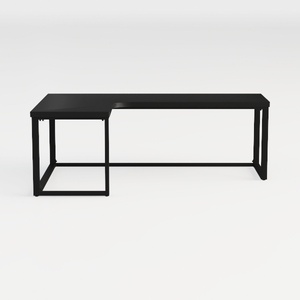
SEDETA L Shaped Gaming Desk, Reversible Computer D


Modern Solid Wood Metal Frame Office Desk With Cable Management 3D Model

Homestyler is your go-to platform for effortless home designing! With its user-friendly online design tool, stunning 3D renderings, and a wealth of inspiring design projects and video tutorials, you can easily transform your living space into your dream home—no expertise needed!
Diseño ahora GRATIS
































