Turkish-inspired Living Space Design
The 'Turkish-inspired Living Space' refers to a versatile, culturally rich interior environment that blends Ottoman craftsmanship, Anatolian motifs, and modern spatial functionality. Unlike narrowly defined rooms (e.g., kitchen or bathroom), this scene emphasizes holistic living zones—such as combined living-dining areas, lounge-style sitting rooms, or serene bedroom-bath ensembles—that embody hospitality, layered texture, and sensory warmth. Drawing from Turkey’s position at the crossroads of Europe and Asia, the design celebrates archways, hand-painted tiles, carved woodwork, domed ceilings, rich jewel tones, and organic materials like travertine, brass, and kilim textiles—all adapted for contemporary indoor space planning without sacrificing authenticity or comfort.
Design Challenges & Common Pitfalls
Key challenges include balancing ornate Turkish motifs with minimalist modern lifestyles; avoiding visual clutter when layering patterns (Iznik tiles, geometric rugs, lattice screens); achieving harmony between bold colors (sapphire, emerald, terracotta) and neutral backdrops; and integrating traditional elements—like low seating platforms or hammam-style wet zones—into standard residential layouts. Many designers also struggle with scale: oversized lanterns or intricate tile borders can overwhelm small spaces if not carefully curated using Homestyler design tools for precise proportion simulation and real-time material testing.
✅ Principle 1: Layer Textures & Materials Thoughtfully
Turkish interiors thrive on tactile contrast—rough-hewn stone against smooth ceramic, nubby kilim under velvet cushions, hammered brass beside matte plaster. Prioritize natural, locally resonant materials: travertine flooring, hand-glazed zellige tiles, walnut or olive wood carvings, and wool-and-cotton flatweaves. In Homestyler AI design, use the 'Material Swap' tool to test combinations in real time—e.g., overlaying a marble-effect render on a concrete base while preserving lighting fidelity—to ensure richness without chaos.

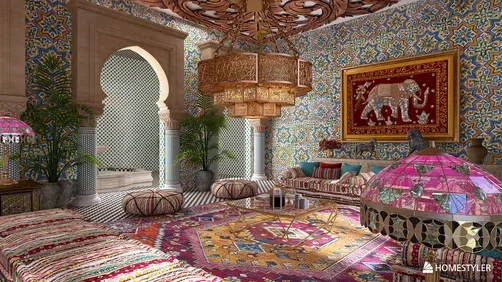
Cecilia Botha’s 'Turkish style' leverages Homestyler’s high-fidelity rendering to harmonize opulent textures: veined marble columns anchor the composition, while velvet-upholstered sofas and ornate Persian-style rugs introduce softness and depth. She uses the AI layout assistant to maintain balanced negative space—ensuring the carved archway and crystal chandelier don’t compete visually—demonstrating expert indoor space planning where material layering enhances, rather than obscures, spatial clarity.
Design Your Dream Space🎨 Principle 2: Curate Color Palettes Using Cultural Symbolism
Move beyond clichéd red-and-gold schemes. Authentic Turkish palettes draw from geography and heritage: cobalt blues from Iznik pottery, sage greens echoing Anatolian hills, burnt sienna from Cappadocian clay, and muted golds reflecting Ottoman gilding traditions. Use color intentionally—reserve bold hues for focal walls or tile medallions, and ground them with warm neutrals (beige plaster, raw linen, aged brass). Homestyler’s 'Color Palette Sync' feature allows one-click hue matching across walls, furniture, and decor—critical for maintaining chromatic cohesion across multi-surface Turkish-inspired living spaces.

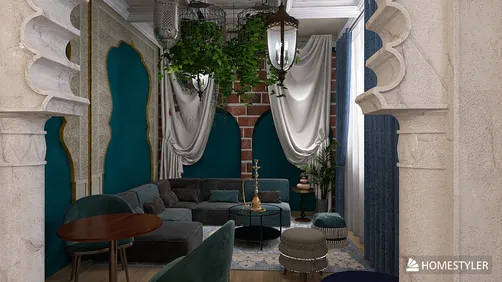
Mica Donker’s 'Turkish Inspired Living/Dining Space' applies culturally grounded color logic: deep indigo cabinetry contrasts with creamy plaster walls, while copper-toned pendant lights and terracotta floor tiles echo historic bazaar aesthetics. Using Homestyler’s AI-powered lighting simulator, she verified how daylight shifts affect pigment saturation—ensuring the turquoise accents remain vibrant at noon but soften elegantly at dusk—a masterclass in adaptive indoor space planning and Homestyler design techniques.
Start Your Free Design✨ Principle 3: Integrate Architectural Motifs with Functional Flow
Turkish design is inherently architectural—think pointed arches, muqarnas vaults, recessed niches (kubbeh), and latticed mashrabiya screens. Rather than applying these as superficial decals, reinterpret them functionally: an arched alcove becomes a built-in reading nook; a pierced screen partitions zones while filtering light; a domed ceiling detail houses concealed acoustic panels. Homestyler’s parametric modeling tools let designers adjust arch curvature, niche depth, or screen density in real time—enabling seamless fusion of heritage form and modern ergonomics within tight urban footprints.

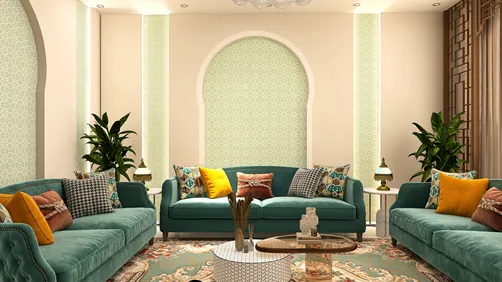
Marwa Abdelbast’s 'Turkish Inspired Elegance' exemplifies functional motif integration: a gently curved arch frames the entryway—not merely decorative, but guiding circulation toward a sunlit sitting zone. She used Homestyler’s 'Zone Flow Analyzer' to validate sightlines and traffic paths, ensuring the kilim rug anchors the conversation area without impeding movement. This reflects advanced indoor space planning where every ornamental gesture serves human-centered utility—an essential Homestyler design technique for culturally rich yet livable environments.
Create Your Turkish StyleFAQ
Q: Do I need professional architecture training to participate in the Turkish-inspired Decor for Web challenge?
Not at all. Homestyler’s intuitive drag-and-drop interface and AI-assisted layout suggestions make it accessible for beginners. Focus on storytelling through pattern, texture, and cultural reference—not structural drafting.
Q: Can I use non-Turkish models (e.g., Scandinavian furniture) in my Turkish-inspired design?
Yes—modern Turkish design thrives on fusion. The key is contextual harmony: pair a minimalist oak dining table with hand-painted Iznik-style tile inserts or drape a linen sofa with embroidered Anatolian throw pillows. Homestyler design techniques emphasize visual rhythm over rigid origin-matching.
Q: How does the 'toolLimits:[4]' restriction impact my workflow?
This means you may use up to four distinct AI generation prompts per design iteration—ideal for refining specific elements (e.g., 'generate Ottoman archway variants', 'suggest kilim-patterned rug options', 'optimize lighting for hammam-style bath'). It encourages intentional, focused indoor space planning rather than trial-and-error.
Q: Are there recommended Homestyler model libraries for authentic Turkish elements?
Absolutely. Visit the official contest model library via the contest URL (https://www. Homestyler.com/modelLibrary/detail/617) to access curated sets: 'Ottoman Archways', 'Iznik Tile Collections', 'Anatolian Wood Carving Kits', and 'Turkish Bath Fixtures'. These are pre-optimized for accurate scaling and lighting behavior—saving hours in manual adjustments.

Modern Minimalist Black Fabric Sectional Sofa 3D Model

Modern Navy Velvet Tufted Nailhead Trim 3 Seat Sofa 3D Model
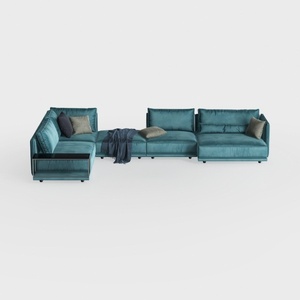

Modern Teal Velvet U Shaped Sectional Sofa with Throw Pillows 3D Model
Homestyler is an easy-to-use online home design platform that lets you create stunning 3D renderings and explore numerous interior decoration projects. With helpful DIY video tutorials, it’s perfect for bringing your home design ideas to life effortlessly.
Design Now for FREE