


Red and Green Living Room Design
The 'Red and Green Living Room' is a quintessential residential interior space where complementary color theory meets everyday functionality and emotional resonance. Unlike seasonal or thematic interpretations (e.g., Christmas décor), this scene emphasizes timeless spatial harmony—leveraging red’s energetic warmth and green’s grounding calm to create dynamic yet balanced living environments. It spans diverse scales—from compact urban apartments to expansive open-plan residences—and prioritizes human-centered experience: visual comfort, tactile richness, and psychological well-being. As showcased in the Homestyler Complementary Color Challenge, top-winning entries treat the living room not as a static backdrop, but as an evolving dialogue between hue, material, light, and form—demonstrating mastery of interior space planning through intentional contrast and thoughtful proportion.
Design Challenges and Common Pitfalls
Applying red and green in a living room carries inherent perceptual risks: over-saturation can trigger visual fatigue; poor value contrast may flatten depth; cultural associations (e.g., red = urgency, green = nature) can unintentionally skew mood perception. Common issues include relying on clichéd pairings (e.g., kelly green + fire-engine red), neglecting lighting interplay (where warm reds deepen under incandescent light while cool greens recede), and misjudging scale—using large red elements in small rooms without balancing green's expansive effect. Successful designers mitigate these by anchoring schemes in spatial hierarchy, material nuance, and contextual lighting—core competencies reflected in high-performing Homestyler AI design submissions.
🎨 Prioritize Chromatic Hierarchy Over Equal Dominance
Avoid treating red and green as equally weighted protagonists. Instead, assign one as the dominant anchor (e.g., deep forest green walls) and the other as the strategic accent (e.g., crimson velvet cushions or lacquered side tables). This prevents visual competition and supports spatial clarity—especially critical in multi-functional living rooms where zoning must remain legible. Value contrast (light vs. dark) and saturation modulation (muted sage vs. vivid tomato) further reinforce hierarchy without sacrificing vibrancy.

Sa Cindy’s '【System Auto-save】Untitled' exemplifies chromatic hierarchy: rich emerald-green walls establish calm depth, while precisely placed ruby-red throw pillows and a single crimson armchair deliver energetic punctuation—never overwhelming. Using Homestyler’s AI color palette generator, she maintained consistent undertones (both colors share warm earthy bases), ensuring harmony across materials like fabric, wood, and metal. This reflects advanced interior space planning—where color serves function, not just aesthetics.
Start Free Design Now🌿 Leverage Materiality to Soften Chromatic Tension
Texture and finish mediate the optical intensity of red–green contrasts. Matte green plaster absorbs light and grounds the space; glossy red lacquer reflects ambient light and adds focal energy. Natural materials—woven jute rugs, live-edge walnut shelves, linen drapery—introduce organic variation that diffuses potential harshness. This principle transforms bold color theory into tactile comfort, making the living room feel lived-in rather than staged—a hallmark of refined Homestyler design techniques.

Laurence Mignon’s 'Défi rouge et vert' masterfully employs material contrast: moss-green velvet sofa upholstery offers plush absorption, while high-gloss cherry-red media console and ceramic vases provide sharp, reflective highlights. In Homestyler, she used the 'Material Swap' AI tool to rapidly iterate finishes—testing matte vs. satin vs. gloss—until achieving optimal visual rhythm. This demonstrates how Homestyler design techniques support nuanced decision-making in interior space planning, turning abstract color theory into tangible sensory experience.
Begin Your Free Design💡 Calibrate Lighting to Unify Hue Perception
Lighting doesn’t just illuminate—it interprets color. Red intensifies under warm CCT (<3000K), while green gains vibrancy under cooler, daylight-balanced sources (4000–5000K). Strategic layering—ambient (ceiling), task (reading lamps), and accent (wall washers)—ensures both hues remain legible and emotionally coherent across day and night. Dynamic lighting controls allow users to shift ambiance: cozy red-dominant evenings versus fresh green-infused mornings—enhancing livability and long-term satisfaction.

Naama Cohen’s 'A Symphony of Red and Green' uses natural daylight as its primary color conductor: large windows flood the space with neutral white light, letting the true chromatic relationship emerge—emerald planters glow beside terracotta-red ceramics without distortion. She simulated lighting scenarios in Homestyler’s HDR environment presets (e.g., 'a_quiet_manor'), verifying hue fidelity at dawn, noon, and dusk. This precision underscores how professional interior space planning integrates environmental context—not just static renderings—with AI-powered realism.
FAQ
Q: Do I need professional design experience to join the Homestyler Red & Green Challenge?
A: No— Homestyler’s AI tools are built for all skill levels. Beginners can use one-click style transfer and auto-color matching; experienced designers leverage advanced material libraries (e.g., Bauhaus and Maximalist Collections) and custom lighting simulation. The challenge celebrates creative interpretation, not technical pedigree.
Q: How does the Homestyler AI help balance red and green without making spaces look festive or kitschy?
A: Homestyler’s color psychology engine analyzes hue, saturation, and luminance relationships in real time. It suggests harmonizing neutrals (e.g., warm greys, oat whites), recommends proportion ratios (e.g., 60% green / 30% red / 10% neutral), and flags clashing undertones—preventing clichés through data-informed guidance.
Q: Can I apply these red–green principles to other rooms, like kitchens or bedrooms?
A: Absolutely. While this guide focuses on the living room—the most socially complex and color-sensitive residential zone—the core principles (chromatic hierarchy, material mediation, lighting calibration) transfer directly. For example, in a kitchen, use sage-green cabinetry + brick-red barstools; in a bedroom, try olive-green bedding + rust-toned wall art—always guided by interior space planning logic.
Q: Are there Homestyler-specific resources to deepen my understanding of complementary color design?
A: Yes. The official 'Red & Green Design Inspiration' story (linked in contest resources) includes annotated breakdowns of top entries, plus downloadable color palettes and model library tags (e.g., 'designStyler:10072'). These assets integrate seamlessly with Homestyler design techniques for rapid prototyping and client presentation.

Modern Red Leather L Shaped Sectional Sofa 3D Model
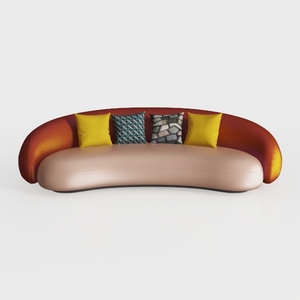
Modern Two Tone Fabric Curved Sofa With Decorative Throw Pillows 3D Model


Modern Red Fabric Tufted 3 Seater Sofa 3D Model
Homestyler is an easy-to-use online home design platform that offers powerful 3D rendering, a vast collection of design projects, and helpful DIY video tutorials. It’s perfect for visualizing and creating your dream space with confidence and creativity.
立即免费设计





