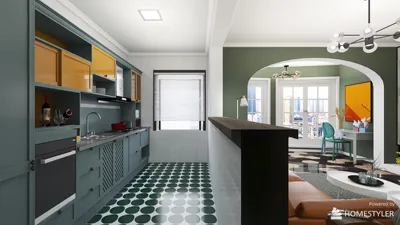


As we look toward the future, urban residents are facing challenges like noise disruptions, crowded elevators, and compromised privacy. I envision vertical housing as an adaptive interface that evolves with our needs, supported by strong industry trends; AIA surveys indicate a rise in demand for multi-family living as urban populations densify. Within this context, a design blueprint for a ten-story building offers insights for tomorrow's bandwidth management. The concept of spatial reasoning emerges naturally through my analysis of flow, sightlines, and smart caching systems intended for high-density living. The future is approaching rapidly, and I am already incorporating these ideas into my designs using tools like Homestyler.
Layered Core Spine
Design Logic: By designing a central service spine that includes elevators, utility risers, and smart mail systems, each floor functions as a modular operating system; the future of urban living demands efficient and maintainable structures.
Flow: The sequence flows from entry to an acoustic vestibule, into a living zone, followed by sleep clusters, and finally converging at the utility core; this layout effectively manages traffic directed to the central spine.
Sightlines: Curved corridors and strategically placed daylight openings create a tiered information flow—bright public spaces at the entry and more subdued areas deeper within.
Storage: Utilizing perimeter wall bays for storage while incorporating shared drop zones near the core for larger items, alongside climate-controlled lockers, ensures efficiency.
Furniture Fit: Designing for API-compatible widths allows for 36" circulation paths, 30" task zones, and modular sofas that seamlessly integrate with 8’ living spaces.
Verdict: This design feels akin to a forward-thinking architectural framework—complete with a stable core and adaptable endpoints—enabling user behavior to scale efficiently over ten levels.
save pin
Perimeter Daylight Ring
Design Logic: By aligning units with the facade and positioning services toward the interior, future wellness standards increasingly favor daylight as the primary user experience layer.
Flow: The pathway moves from the facade threshold through a vibrant living hub, then to a kitchen node, followed by bedroom areas, ultimately leading to the inner utilities; people traverse light as their guiding thread.
Sightlines: Long, unobstructed views towards windows; strategic architectural fins regulate cross-views, allowing privacy to be a customizable feature instead of rigid barriers.
Storage: Benches adjacent to windows and vertical storage niches work as memory systems that keep clutter off main pathways.
Furniture Fit: Built-ins crafted to align with mullion grids create effective spatial organization; living spans of 9–10’ optimize sectional dimensions without disrupting movement.
Verdict: By emphasizing the facade, each level functions akin to an efficiently indexed database, providing quick access, low latency, and a comfortable living experience.
save pin
Split-Core Neighborhoods
Design Logic: Implementing two smaller cores fosters micro-neighborhoods on each floor; this decentralized approach minimizes congestion and enhances community interaction.
Flow: Core A connects to shared lounge areas, which then lead to residential clusters and outdoor balconies; Core B serves as a counterpart to balance usage throughout the day.
Sightlines: Diagonal views link lounge spaces to exits, facilitating easy orientation; private rooms utilize layered thresholds to control visual access.
Storage: Dispersed closets combined with shared creative spaces serve as effective, adaptable storage solutions.
Furniture Fit: Compact lobbies accommodate sleek console seating, while units standardize to 12’ modules to optimize layout coordination.
Verdict: This creates a soft mesh structure; residents enjoy reduced friction and heightened flexibility as the building adapts to daily flows.
save pin
Final Takeaway
Viewing a floor plan for a ten-story building as a dynamic interface reveals its role in managing flow, privacy, and light akin to programming code. It’s crucial for vertical housing, multi-family designs, and high-rise units to treat spatial flow and storage as integral components of an intelligent system. I anticipate that within the next decade, stacked core designs and daylight-enhancing features will become the foundational operating structure of urban residences; based on my experience, the most advanced structures will not necessarily be larger, but more purposefully designed, as demonstrated in models created with tools like Homestyler.



Discover your inner designer with Homestyler! This user-friendly online platform offers a powerful design tool, stunning 3D renderings, and a wealth of inspiring design projects. Plus, you’ll find helpful DIY video tutorials to guide you every step of the way. Transform your space effortlessly!
立即免费设计
































