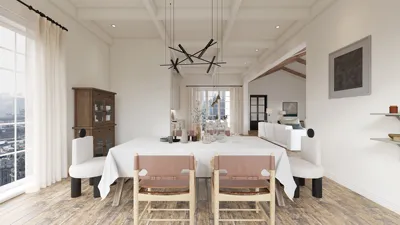


Having transformed numerous living rooms throughout my career, I’ve witnessed a prominent shift: today’s living rooms have evolved beyond merely accommodating a sofa and a television stand. Modern interior design trends emphasize the creation of multi-functional and aesthetically pleasing environments, where the arrangement of your TV plays a crucial role in shaping the ambiance of the space. For compact areas, inventive layouts can ignite creativity — demonstrating that a smaller living area can indeed foster significant design inspiration. In this article, I’ll introduce 10 of my top TV setup ideas for living rooms, merging my firsthand experience with some expert insights and recommending resources like Homestyler for visualization.
1. Wall-Mounted Minimalist TV Display
My Experience: In one of my apartments, mounting the TV on the wall liberated valuable floor space, making the room feel notably more spacious. I combined it with a low-profile console, ensuring a sleek and contemporary aesthetic.
Advantages: This setup conserves floor space, conceals cables effectively, and complements a minimalist living room design. According to a 2023 Houzz survey, wall-mounted configurations can enhance the perception of room size by up to 15%.
Disadvantages: Proper wall reinforcement is essential; adjusting height post-installation can be challenging.
Suggestion: Pair your wall-mounted TV with minimalist shelves to style the area, maintaining an airy and functional appearance.
2. TV Integrated into a Gallery Wall
My Experience: I once merged a client’s TV within a gallery wall, arranging art frames around it to ensure the dark screen blended harmoniously with the overall décor.
Advantages: This approach creates a striking artistic and functional focal point; the TV remains disguised when turned off, perfect for eclectic or contemporary spaces.
Disadvantages: This requires meticulous planning to ensure a balanced look; there’s a risk of overcrowding smaller walls.
Cost: Framing existing artwork is budget-friendly, with DIY options starting at around $20 per frame.
3. Corner TV Setup
My Experience: Placing the TV in a corner of a snug space allowed for more wall area dedicated to storage and art, reducing the room's electronic dominance.
Advantages: This maximizes awkward spaces and is particularly suited to open-plan living-dining areas, offering unique viewing angles.
Disadvantages: The seating arrangement needs careful consideration, and an angled TV mount may be necessary.
4. Floating Media Console
My Experience: I frequently recommend floating consoles to clients wanting storage without bulky furniture overwhelming the space.
Advantages: These units keep the floor visible, which helps the room feel more spacious, and allow for atmospheric under-console lighting.
Disadvantages: They have limited weight capacity, and cable concealment remains a necessity.
Example: After installing a floating unit with slim vertical shelves in a client’s compact 12’x14’ living room, the space felt significantly more open.
5. Concealed TV in Custom Cabinetry
My Experience: I enjoy integrating sliding panels or lift mechanisms that hide the TV when not in use — ideal for harmonizing technology with a tranquil environment.
Advantages: This method keeps the TV hidden, preserving the aesthetic flow of the room, while also reducing dust on the screen.
Disadvantages: This option can be pricier, and mechanical parts may require upkeep.
Suggestion: Consider custom cabinetry designs that incorporate integrated TV concealment, merging functionality and style effectively.
6. Above the Fireplace
My Experience: Mounting the TV above the fireplace creates a stunning focal point that unifies seating areas well, particularly in open-plan homes.
Advantages: This approach utilizes vertical space effectively, and it’s perfect for symmetry-oriented layouts.
Disadvantages: Mounting too high can strain your neck, and heat considerations are essential.
Expert Insight: The National Association of Home Builders recommends a mantel depth of at least 12 inches to protect electronics from heat.
7. TV with Open Back Shelving
My Experience: In an urban loft renovation, I placed the TV in an open shelving unit, effectively acting as a divider between living and dining areas.
Advantages: This design offers storage and display options while allowing light to flow through due to the open back.
Disadvantages: This arrangement demands skillful cable management; dust can accumulate more rapidly.
8. Mobile TV Stand
My Experience: Recently, I utilized a sleek mobile stand for a client who enjoys shifting their viewing position between the living room and bedroom.
Advantages: This offers flexible placement and eliminates the need for wall drilling.
Disadvantages: These stands may lack stability compared to fixed mounts, and visible cables can be an issue if not managed well.
Example: This solution is ideal for renters or temporary arrangements, with pricing starting around $100.
9. Integrated with Low Storage Unit
My Experience: A low, continuous storage bench beneath the TV enhances ground-level appeal while providing ample hidden storage — a common choice for family-friendly homes.
Advantages: This setup is perfect for storing media items, toys, and blankets, while maintaining clear sight lines across the room.
Disadvantages: It occupies valuable wall space, and customizations can be costly.
Suggestion: Enhance the unit with cushions on the ends for additional seating.
10. Framed or Disguised as Artwork
My Experience: Utilizing TV frames or displays like Samsung’s ‘The Frame’ transforms the TV into a piece of art when inactive — I often suggest this for art enthusiasts.
Advantages: This visually integrates the TV into the decor, offering a vast selection of frame designs.
Disadvantages: This option typically requires a higher initial investment, and frame styles might need refreshing to keep up with trends.
Example: One project incorporated digital artwork rotation along with ambient lighting controls to create a gallery effect.
Conclusion
A small or medium living room shouldn’t be viewed as a limitation; instead, it presents an opportunity for intentional and stylish arrangements. As highlighted by the American Society of Interior Designers, up-and-coming trends for 2024 focus on multifunctional furniture and inventive layouts. Which of these TV setup concepts would you consider for your space, perhaps with the assistance of tools like Homestyler?
Frequently Asked Questions
1. What’s the ideal living room configuration with a TV for compact areas?
Wall-mounted televisions paired with floating consoles are excellent choices for optimizing space while maintaining a refined design.
2. At what height should a TV be mounted in the living room?
The center of the TV should ideally align with eye level when seated, typically between 42 and 48 inches from the floor, according to ergonomic research.
3. Are gallery wall TVs practical options?
Yes, indeed — as long as they are carefully planned to balance frame sizes and allow for a comfortable viewing distance.
4. Is it feasible to place a TV in front of a window?
This can be done, but it isn’t ideal; glare and contrast issues can arise unless managed with blinds or curtains.
5. Is it safe to position a TV above a fireplace?
This is permissible if heat output is minimal and appropriate shielding (such as a 12-inch mantel) is installed, following NAHB guidelines.
6. What is the best method for concealing TV cables?
Consider using cable channels, in-wall routing, or integrated cabinetry solutions to keep wires neatly out of sight.
7. Are mobile TV stands sturdy enough?
Quality models can be stable if placed on even surfaces and not overloaded; locking wheels enhance stability.
8. What are some economical TV décor solutions?
DIY framing, repurposed art for gallery walls, and smart shelving can enhance style without stretching the budget.
Homestyler is your go-to platform for effortless home design! With its user-friendly online design tool, stunning 3D renderings, and a wealth of inspiring design projects and video tutorials, you can effortlessly transform your vision into reality. Perfect for both beginners and seasoned designers!
Design Now for FREE
































