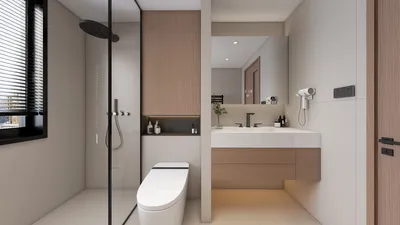


I once encountered a principal who requested that bathroom doors withstand the force of a marching band — an unusual but thought-provoking request. While we chuckled, it prompted me to consider more than just looks: school doors must be robust, accessible, and practical for confined areas. Even small bathrooms can yield significant design successes. Here are five actionable ideas I've implemented in school projects that effectively balance safety, privacy, and budget, utilizing the design tool Homestyler.
1. Sliding Pocket Doors
Sliding pocket doors seamlessly vanish into the wall, optimizing floor space—ideal for small stalls or staff restrooms. I installed these in a compact nurse’s suite, creating a sense of openness and simplifying cleaning. However, they do require precise framing and regular maintenance to avoid jamming, and compliance with fire codes is crucial.
save pin
2. Outward-Swinging Doors with Breakaway Hinges
Outward-swinging doors enhance escape routes and minimize congestion in hallways during peak times. In a renovation of a middle school, I suggested using breakaway hinges, allowing custodial staff to swiftly detach damaged doors without needing to replace the entire frame. Adding privacy hardware can prevent visibility from the corridors.
save pin
3. Frosted Glass Panels for Light and Supervision
Short frosted glass inserts at the top of stall doors allow natural light to flow in, facilitating supervision without sacrificing privacy. This strategy was successfully employed in a restroom located by a library, enhancing brightness. However, overusing these panels can render a space overly institutional, so it's best to reserve them for outer walls or transoms.
save pin
4. Durable Solid-Core Doors with Anti-Graffiti Finish
High-traffic school bathrooms require doors that withstand daily use and occasional vandalism. I oversaw a project in a St. Louis elementary school where we utilized solid-core doors with anti-graffiti coatings, saving significant time on repainting. Although the initial investment is higher, the long-term savings and reduced maintenance time are worthwhile.
save pin
5. Bi-Fold Doors for Resource Rooms
Bi-fold doors are excellent for storage or multipurpose bathrooms where space constraints limit full access. I implemented them in a custodial closet adjacent to restrooms; they are compact and user-friendly. While they might not feel as sturdy as conventional doors, selecting robust hardware can ensure their durability.
save pin
Tips 1:
A practical approach I’ve adopted is to work closely with the school's maintenance team when selecting door hardware. Standardizing locks, hinges, and finishes makes repairs easier. To visualize the impacts of door swings early on, I often create digital floor plans using Homestyler, an efficient tool for validating circulation and ensuring compliance with codes, which can prevent future issues.
save pin
FAQ
Q1: What type of door is ideal for elementary school bathrooms?
A1: Solid-core doors with anti-graffiti finishes are excellent for durability and cleanliness, while short frosted panels can enhance natural lighting. Make sure to check local codes for ventilation and egress standards.
Q2: Are outward-swinging stall doors compliant with building codes?
A2: Many areas permit outward-swinging doors for accessibility and evacuation purposes, but it’s vital to verify local fire and building regulations prior to installation.
Q3: How can I ensure privacy while maintaining supervision in school restrooms?
A3: Implement high transoms or frosted panels to allow light and partial visibility, in conjunction with policies for staff sightlines instead of fully open designs.
Q4: What kind of maintenance do custodians need to conduct on pocket doors?
A4: A monthly lubrication routine and annual track inspections will help prevent jamming; avoid heavy impacts and ensure that necessary hardware is accessible for repairs.
Q5: Are bi-fold doors secure enough for busy areas?
A5: With the right heavy-duty hardware, they can be secure, but they're most suitable for storage or low-traffic auxiliary spaces and less ideal for main student restrooms.
Q6: What is the additional cost for anti-graffiti finishes?
A6: They usually add a modest amount to the standard paint price; however, the savings in upkeep from reduced graffiti-related repairs often justifies the initial expense.
Q7: Can glass panels comply with accessibility standards?
A7: Yes, if installed and treated correctly; ensure that contrast and privacy adhere to ADA and local signage requirements. For precise guidance, consult the ADA Standards for Accessible Design (United States Access Board) at https://www.ada.gov/standards.htm.
Q8: What method can I use to test door layouts before building?
A8: Establish a quick scaled floor plan and create a virtual mockup to evaluate swings and clearances; utilizing online planners can expedite this process. For rapid layout experimentation, I often rely on specialized tools like Homestyler to efficiently explore options.
save pin
What began as an Autodesk innovation has evolved into a design platform used by more than 18 million people around the globe. Homestyler combines powerful rendering, an intuitive editor, and a vast furniture library to help you turn inspiration into photorealistic designs — whether you're redesigning a single room or planning an entire home.
Homestyler is your go-to online platform for home design! With its user-friendly design tool, stunning 3D renderings, and a wealth of DIY video tutorials, you can effortlessly transform your home ideas into reality. Perfect for both beginners and seasoned designers alike!
Design Now for FREE
































