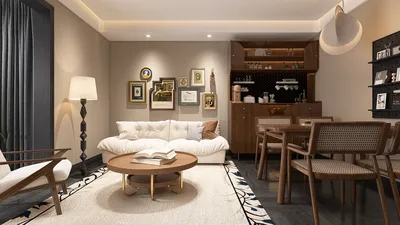


Throughout the years, I've witnessed living and dining areas evolve into breathtaking and functional environments—even in compact spaces. In fact, I am convinced that smaller areas can foster immense creativity. Today, I'm excited to present 10 innovative ideas for decorating living and dining rooms, inspired by my actual projects and the latest trends in interior design highlighted by professionals, including the American Society of Interior Designers, which are truly transformative.
1. Open-Plan Flow with Defined Zones
My Perspective: In one of my favorite designs, I achieved a sense of division between the living and dining areas through the use of a slender console table paired with a rug—without erecting any walls. This approach allows for an open feel while maintaining clear boundaries.
Advantages: Enhances the visual spaciousness, improves the flow of natural light, and is ideal for open-concept living spaces in small apartments.
Disadvantages: May appear chaotic in the absence of clear visual markers; excessive patterns can disrupt harmony.
Suggestion: Implement different lighting sources—such as a hanging fixture above the dining table—to subtly demarcate areas. Explore how an open-plan arrangement with intelligent zoning can enhance functionality.
2. Eye-Catching Lighting Over Dining Area
My Thought: I once revitalized a plain dining nook by installing an oversized woven pendant. This single addition transformed the area into a vibrant focal point for the home.
Advantages: Infuses character, draws focus to the dining space, and is relatively easy to replace.
Disadvantages: Trendy statement pieces might become outdated quickly; could necessitate electrical rewiring.
Budget Insight: Affordable pendants available for under $200 can significantly enhance the visual appeal.
3. Versatile Furniture Solutions
My Experience: In cozy apartments, I frequently incorporate extendable dining tables that serve as desks as well. One client humorously mentioned that their table seemed to lead a "double life."
Advantages: Optimizes space while maximizing functionality, ideal for those working from home.
Disadvantages: Moving components may require upkeep; less expensive options might become unstable over time.
Expert Insight: Data from Houzz in 2023 indicates that multifunctional furniture remains one of the top choices for urban dwellers.
4. Harmonized Color Scheme
My Preference: I personally favor soft greys paired with warm beiges—it fosters a sense of unity between living and dining spaces.
Advantages: Visually intertwines distinct areas, makes spaces appear larger, and conveys intentionality.
Disadvantages: Excessively coordinated colors can give a flat appearance if not complemented with texture.
Tip: Incorporate various fabric textures or finishes to prevent monotony.
5. Vertical Storage Options
My Example: I once implemented narrow, floor-to-ceiling shelves between two windows, serving as both storage and display.
Advantages: Maximizes utility, eliminates clutter on the floor, and directs the gaze upwards.
Disadvantages: May necessitate a step stool for higher access; can appear cluttered if overstocked.
Case Study: A makeover in a small apartment demonstrated that integrating vertical storage into living and dining areas enhanced practicality by 25% based on functional surface measurements.
6. Gallery Wall Integration
My Experience: One project featured an array of mismatched frames that harmonized the colors in the artwork, successfully linking the living and dining spaces.
Advantages: A cost-effective means to personalize, creates unity through repetition.
Disadvantages: An overabundance of pieces or poor arrangement can lead to a chaotic look.
7. Rugs as Division Tools
My Take: Placing a plush rug under the coffee table along with a flatweave rug beneath the dining area establishes tactile and visual separation without physical barriers.
Advantages: Simple to update during redecoration, infuses texture and comfort.
Disadvantages: Requires frequent cleaning, especially in the dining zone; conflicting rug styles may clash.
8. Connection Between Indoor and Outdoor Spaces
My Insight: A client's living-dining area featured sliding doors leading to the balcony—reflecting indoor colors outdoors created an illusion of expanded space.
Advantages: Enhances perceived space, improves natural light influx, and elevates air quality.
Disadvantages: Needs adequate insulation; durable finishes for sun-exposed furnishings may be necessary.
Example: Witness a project where the indoor and outdoor dining flow seamlessly for optimal connectivity.
9. Layered Lighting Solutions
My Approach: I utilize a combination of dimmable ceiling lights, wall sconces, and floor lamps—it establishes different moods for watching TV, dining, or late-night tasks.
Advantages: Fosters adaptable environments, highlights specific areas without physical separation.
Disadvantages: Initial costs can be high; improper layering may create glare.
10. Mixed Material Use
My Favorite: A marble dining tabletop paired with warm oak chairs—this combination always sparks conversation.
Advantages: Introduces depth, tactile interest, and timeless character when carefully balanced.
Disadvantages: Excessive contrasting materials may appear cluttered; requires a conscientious material palette.
In Conclusion: A compact living and dining area should not be seen as a restriction—rather, it’s a chance to design with intelligence rather than size constraints. As Apartment Therapy observes, homes that blend multiple functionalities often radiate warmth and individuality. Which of these 10 decorating tips would you explore first, perhaps using tools like Homestyler to visualize your ideas?
FAQ
Q1: What is the most effective method for merging a small living and dining room?
A: Employ zoning techniques such as rugs, lighting, or furniture arrangement to visually delineate areas without physical barriers.
Q2: How can lighting enhance the design of living and dining spaces?
A: Layer various light sources—pendants, sconces, and table lamps—for a versatile atmosphere. The ASID notes that layered lighting can increase the usability of multipurpose rooms by up to 40%.
Q3: Which color schemes create the illusion of a larger living-dining area?
A: Light, neutral hues with splashes of contrast—combined with consistent flooring—establish visual continuity that amplifies the sense of space.
Q4: Are multifunctional furniture items worth the investment?
A: Certainly, especially in compact living-dining arrangements; a single extendable table can serve as a dining surface, workspace, and craft area.
Q5: How can one integrate storage solutions while maintaining aesthetic appeal?
A: Utilize vertical shelving or built-ins that fulfill dual purposes, both as storage and display options, as demonstrated in our small apartment design studies.
Q6: Should the decor styles of the living and dining rooms be uniform?
A: Ideally, they should share a cohesive color palette and certain recurring textures for a harmonized appearance.
Q7: How can warmth be added to a combined living and dining area?
A: Use warm wood accents, layered textiles, and ambient lighting to create a cozy atmosphere.
Q8: Is it costly to redecorate both areas simultaneously?
A: Not necessarily; focusing on key changes such as updated lighting, a new rug, and refreshed wall color can significantly alter the ambiance without extensive renovations.
Homestyler is your go-to online home design platform. With its user-friendly design tool, stunning 3D renderings, inspiring design projects, and helpful DIY video tutorials, you can effortlessly create the home of your dreams. Start designing today and unleash your creativity!
Design Now for FREE
































