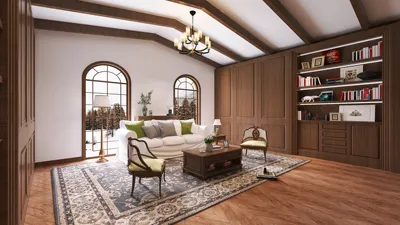


I often chuckle when recalling a client's request for a living room that resembled "an old Italian villa but furnished with IKEA pieces" — and that was the moment my fascination with limewash began. This finish offers walls a well-worn charm without artificial aging. For those interested in seeing authentic limewash projects, I curate a small gallery that showcases the interplay of texture and light in these unique designs.
Limewash is particularly suited to smaller spaces due to its matte finish that elegantly conceals minor flaws while enhancing natural light. Here, I'll share five innovative ideas I've applied in both apartments and cozy homes, complete with practical advice, budget considerations, and the insights I've gleaned over time.
1. Soft Corner Accent — muted depth without heaviness
I frequently suggest using limewash in a corner or alcove rather than repainting an entire room. This mineral finish introduces depth and drama, yet maintains an airy feel, ideal for renters desiring character without a permanent commitment. It's cost-effective if you limit the coverage, although initial application may be uneven; I generally apply a thin second coat to smooth out any streaks.
save pin
2. Tone-on-Tone Trim — subtle contrast that appears upscale
Applying a slightly darker limewash to trims and window frames compared to the walls creates a sophisticated design without the need for elaborate molding. This approach adds layers and a handcrafted essence to spaces; I've leveraged this technique to enhance entryways affordably. However, achieving consistent shades across batches can be challenging, so I ensure to mix extra paint for future touch-ups.
save pin
3. Kitchen Backdrop — breathable and inviting for compact kitchens
Limewash shines when used behind open shelving or on rustic brick backsplashes; it’s breathable and textured, establishing a warm, inviting atmosphere in kitchens. In smaller kitchens, I prefer pairing it with simple cabinetry to minimize visual clutter, allowing it to naturally soften the appearance of stainless steel and wood. Be mindful that limewash may not be stain-resistant near cooking zones; I advise sealing areas prone to splashes or using it in spots with minimal exposure.
save pin
4. Layered Neutrals in Bedrooms — calm, inviting sleep spaces
For bedrooms, I often layer two shades of limewash vertically — a darker tone on the lower third and a lighter shade above. This technique fosters a cocoon-like effect that feels embracing without being claustrophobic. It offers a tactile and dreamy look that captures beautifully on camera while effectively hiding wear better than flat latex finishes. The trade-off involves ensuring precise lines through careful masking or skilled brushwork; I tend to go freehand for a charmingly imperfect edge.
save pin
5. Bathroom Statement Wall — matte texture suitable for wet areas (with caution)
Indeed, limewash can be successfully utilized in bathrooms if planned judiciously: apply it to a feature wall away from direct splashes and combine it with wipeable tiles where necessary. The matte mineral finish contrasts beautifully with glossy fixtures and contributes to a boutique feel in compact spaces. Just be frank about maintenance — limewash tends to be more delicate than standard paints, so prepare for occasional touch-ups: clever tips for small bathrooms.
save pin
FAQ
Q1: Is limewash an appropriate choice for small apartments?
I use limewash frequently in apartments due to its ability to create a sense of spaciousness through soft light diffusion. It's particularly effective on accent walls and niches where complete coverage isn't imperative.
Q2: How does limewash's durability compare to regular paint?
Limewash is a breathable, mineral-based coating and performs well on textured surfaces, although it lacks the scrub resistance of acrylic paints. For high-traffic zones, be ready for periodic reapplication or selective sealing.
Q3: Is it possible to apply limewash over pre-existing paint?
Limewash can be applied to porous surfaces, but glossy latex should be sanded or treated with a bonding primer first. Always test a small area to verify adhesion and the final look.
Q4: Is limewash environmentally friendly?
Limewash is low in VOCs and mineral-based, making it a more eco-conscious alternative compared to many synthetic paints. Its breathable qualities also benefit older masonry by allowing moisture to escape.
Q5: What colors pair best with limewash?
Muted, earthy tones and off-whites are timeless choices, as they allow limewash to showcase its subtle depth and mineral variations. Bright, saturated hues are possible, but they may not appear the same as conventional paints.
Q6: How should I maintain limewash walls?
Maintaining limewash is simple: regular gentle dusting and spot touch-ups for any scuffs. Heavy scrubbing should be avoided. In wet areas, consider sealing or limiting limewash to surfaces not directly exposed to splashes.
Q7: Can applying limewash harm modern drywall?
With proper preparation, drywall can effectively accept limewash if primed appropriately. However, it performs best on traditional lime or plaster surfaces. For optimal results, discuss surface preparation and primer choices with your installer.
Q8: Where can I learn more about classic lime finishes?
For reliable information on historical lime usage and conservation, refer to resources provided by Historic England, which emphasizes the breathable characteristics of lime and its appropriate applications (Historic England: https://historicengland.org.uk).
save pin
Homestyler is your go-to online home design platform! With its user-friendly design tool, stunning 3D renderings, and a wealth of design projects and DIY video tutorials, you can easily transform your home into a stylish haven. Start designing today!
Design jetzt kostenlos
































