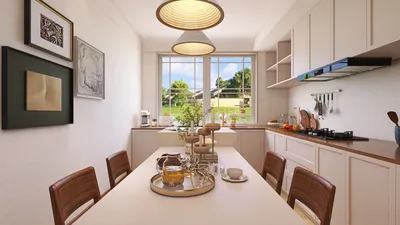


As we move toward the future, homes are increasingly required to adapt and function as interactive spaces that accommodate the needs of modern families, who balance aging-in-place, privacy, and noise control. I continuously design 3-bedroom ground-floor layouts where elements like natural light, circulation, and acoustic zoning are essential—The AIA highlights that most families are now prioritizing flexible work and caregiving areas. The ground floor becomes my experimental zone for spatial reasoning, envisioning the layout as an operational framework rather than merely a static plan. It’s crucial that these ground floor 3-bedroom designs anticipate the nuances of remote work, support multigenerational living dynamics, and enable climate resilience, all while maintaining a minimal footprint.
Split-Core Courtyard Spine
Design Logic: A central courtyard serves as the thermal and social heart of the home, effectively separating the primary and secondary bedrooms while ensuring optimal ventilation and natural light for years to come.
Flow: Entry → spine corridor → living space → courtyard pivot → main suite; children's rooms are accessed via a short loop leading to the bathroom, creating a quick and efficient route.
Sightlines: Layered perspectives are implemented, extending from the kitchen to the courtyard and beyond to the treeline, creating user interface tiers that display activity without compromising privacy.
Storage: Built-in storage along the perimeter serves as convenient cache; seasonal items are positioned near the entry, while frequently used items are readily accessible by the kitchen and bath.
Furniture Fit: Sofas positioned at 84–90" optimize corridor width; bed spacing of at least 30" ensures ergonomic movement for strollers and other mobility aids.
Verdict: This configuration encourages flow; five years down the line, it efficiently supports hybrid work, children's rest, and evening cooling, embodying a stable architectural design.
save pin
Front-Back Gradient, Quiet to Active
Design Logic: Buffer zones facing the street help absorb noise; bedrooms are strategically placed in the mid-field, while the living area opens to a garden, creating a transition from private to public spaces.
Flow: From the mudroom gateway → flexible office/guest area → bedroom zone → open kitchen/living area → patio; the layout flows left to right with easily discernible pathways to the baths.
Sightlines: Carefully planned cuts: diagonals from dining to garden are purposefully interrupted at bedroom thresholds to maintain controlled visual clarity.
Storage: Deep hallway niches act as efficient storage; a floor-to-ceiling pantry accommodates bulk items; and under-bench storage on the patio is perfect for tools and outdoor toys.
Furniture Fit: A dining table sized between 72–78" is placed centrally to enhance circulation; queen beds are aligned with 10' modules to prevent door collisions.
Verdict: This space operates calmly: mornings start quietly, evenings open up wide; in the winters to come, comfort remains steady with acoustically zoned spaces.
save pin
Ring Road with Core Utilities
Design Logic: A compact core containing bathrooms, laundry, and mechanical systems maximizes adaptability for aging-in-place, with rooms encircling it to minimize plumbing runs.
Flow: Entry hub → ring corridor → bedrooms and study as functional nodes → kitchen/living area as a central hub; paths remain clear and easy to navigate.
Sightlines: Gentle reveals between spaces come into play: from kitchen to play area; ring turns help reduce visual clutter, keeping private UI elements hidden until required.
Storage: Closets with a depth of wall space are strategically placed every 8–10 feet to provide consistent storage; the core accommodates tall utility storage for linens and emergency supplies.
Furniture Fit: Sectionals float in pathways of 36" clearance; bunk beds in the third bedroom adhere to egress and desk placement requirements.
Verdict: This design is a resilient core: utilities remain accessible, and rooms can easily transition from a nursery to a studio without disrupting functionality.
save pin
Final Takeaway
Ground-floor three-bedroom layouts are not about sheer size but about intelligent design that balances light, noise, and care. Whether referred to as ground floor 3-bedroom plans or family-oriented designs, the most efficient versions resemble sophisticated software, showcasing seamless movement and organized spaces. From my perspective, the most advanced homes of the future won’t simply be larger; they will be more thoughtfully planned, and in my experiences, even small spatial choices can redefine everyday living, showcasing tools like Homestyler to visualize these concepts effectively.
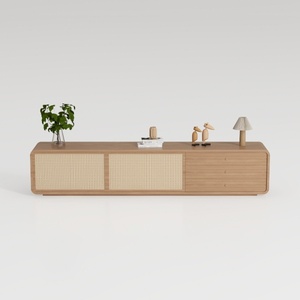
Walker Edison Sasha 4-Door Sideboard Buffet with
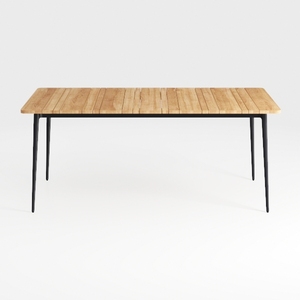
Branch Daily Desk - Functional at Home Office Desk

Zoe Ash Medium Record Storage Console
Homestyler is your go-to online home design platform, perfect for bringing your ideas to life! With its user-friendly design tool, stunning 3D renderings, and an abundance of DIY tutorials, you can effortlessly explore endless decorating possibilities and create your dream space with ease.
立即免费设计
































