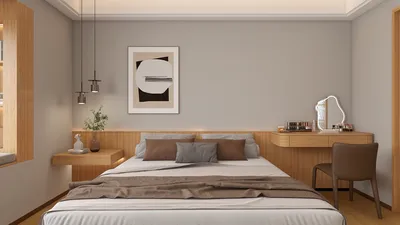


As the future approaches, our homes will need to adapt to new lifestyles while still operating within traditional limits. In densely populated urban areas, families require tranquility, storage solutions, and ample natural light, all while facing rising land prices. The latest findings from the AIA pulse indicate a growing preference for flexible spaces and multi-functional entrances in compact areas, which suggests a demand for leaner, more intelligent layouts. In this context, I propose three innovative floor plans for double-storey houses, providing a starting point for our daily routines with Homestyler.
Split-Core Stair with Front Court
Design Logic: The central staircase acts as the home's function center; the front setback is transformed into a small courtyard, exchanging width for more natural light. This design stacks two levels like modular units, with public spaces on the lower floor and private areas above, making it adaptable for remote work and aging gracefully in place.
Flow: Entry gate → spacious courtyard → foyer/drop-off area → living and dining spaces → galley kitchen → mid-stair junction → bedrooms; a straightforward sequence ensures minimal disruptions.
Sightlines: From the entrance, a diagonal line leads through the courtyard into the living area, intersecting with the void of the staircase; upstairs, a strategically placed window aligns the bed with the sky, providing a calming view that contrasts with more energetic spaces.
Storage: The foyer features a bench with storage, under-stair deep drawers, and an 18" deep pantry wall for longer-term organization; linens can be neatly stacked in a landing nook.
Furniture Fit: The living area accommodates a 72" sofa with a spacious 30" side path; the dining area includes a 60" x 30" table; a queen-sized bed allows for a generous 30" clear space on both sides; the API ensures low latency in design function.
Verdict: The airy front entry and central staircase optimize living flow; over the next five years, the courtyard will serve as a pivotal space for family activities and comfort.
save pin
Rear-Service Spine with Flex Loft
Design Logic: All utilities are centralized along a rear service spine, incorporating the kitchen, laundry, and bath. This design choice frees up the front section for flexible uses as living habits evolve.
Flow: Street entrance → small front porch → open studio space → kitchen/service spine → compact bathroom → staircase → flexible loft area → bedrooms; this setup facilitates smooth transitions.
Sightlines: The long front-to-back axis maintains focus; translucent panels over the service spine allow natural light to flow into essential wet areas while minimizing visual clutter.
Storage: Vertical storage solutions include tall pantry cabinets, overhead laundry units, and wall wardrobes beside the bed; seasonal items can be neatly placed above the staircase header.
Furniture Fit: The studio space fits a two-person workstation with a foldable Murphy table, while an upstairs 96" wall unit accommodates books and gadgets efficiently without overflow.
Verdict: By treating essential services as backend components, the front remains adaptable—ideal for changing work and lifestyle needs in the coming years.
save pin
Side-Light Ribbon with Bridge Hall
Design Logic: In tight urban settings, I designed a side-light ribbon with clerestory windows and a narrow courtyard, linked by a bridge hall that serves as a library space.
Flow: Entryway → compact vestibule → living area → side light courtyard → dining kitchen → staircase → bridge hall → bedrooms; visibility enhances spatial efficiency.
Sightlines: The design layers visuals with low furniture, mid-scale garden features, and high clerestory light, with the bridge hall curating views like a user interface, prioritizing tranquility.
Storage: Innovative storage solutions include toe-kick drawers, stair treads with access lids, and a bridge bookshelf serving as communal storage; the kitchen island integrates recycling systems with labeled bins.
Furniture Fit: The eat-in banquette features an 18" seat height and a 30" deep table; children's rooms can comfortably accommodate a 39" twin bed with a 24" clearance, ensuring rare errors in spacing.
Verdict: By utilizing light as a dynamic element, this narrow plot can function as an expansive living interface; in the next five years, the bridge hall will evolve into the family’s central gathering point.
save pin
Final Takeaway
With the innovative design of the double-storey house plans, each living space operates like a software system: the flows serve as instruction sets, storage mirrors cache functionality, and sightlines curate the living experience. Various configurations—such as compact two-storey homes, dense urban designs, and narrow lot developments—demonstrate that it's not the size but the intelligence of the structure that matters. Long-tail designs like ‘two-bedroom small footprint layout’ and ‘narrow lot double-storey plan’ enhance resilience. My ongoing experience suggests that the most effective future homes won’t necessarily be larger; instead, they will be crafted with higher intentionality, a principle I continue to embrace in my designs, alongside tools like Homestyler.
Tribesigns 70.86-Inch Executive Desk, Large Comput

Talataca Bookshelf Heart Shape Book Lovers Nerd

Haddockway Wooden Coat Rack Stand with 8 Hooks New
Homestyler is your go-to online home design platform, ideal for both beginners and pros. With its user-friendly design tool, stunning 3D renderings, a wealth of design projects, and engaging video tutorials, transforming your home ideas into reality has never been easier!
Desain sekarang Gratis
































