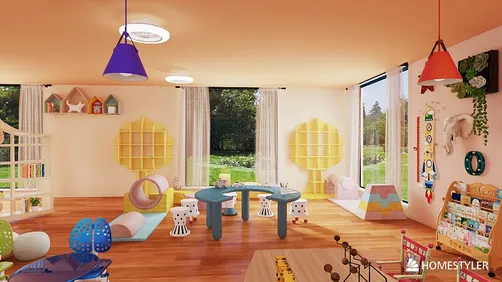
Kindergarten Classroom Design
A kindergarten classroom is a dynamic, multi-functional early childhood learning environment designed to nurture cognitive, social, emotional, and motor development. Unlike standard academic classrooms, it emphasizes sensory-rich zones (e.g., reading nooks, art corners, construction areas), child-scaled furniture, intuitive circulation, and biophilic elements — all supporting exploration, autonomy, and joyful discovery. As highlighted in the AIDA 'Marvelous Kindergarten for Web' competition, top-winning designs treat the space not just as infrastructure, but as an active pedagogical tool: where color psychology guides spatial zoning, flexible layouts accommodate evolving play-based curricula, and indoor space planning integrates seamlessly with outdoor learning extensions.
Design Challenges & Common Pitfalls
Designing for young children introduces unique constraints: strict safety regulations (e.g., rounded edges, non-toxic finishes, fall-height compliance), acoustical challenges due to high ambient noise, difficulty balancing open-plan flexibility with defined activity zones, and the tension between vibrant stimulation and visual calm needed for focus. Common oversights include inadequate storage leading to cluttered pathways, poor natural light distribution causing glare or shadows in play areas, and neglecting adult ergonomics (e.g., teacher workstations, supervision sightlines) — all undermining both learning efficacy and daily operational flow.
✅ Safety-First Spatial Zoning
Divide the classroom into clearly defined, age-appropriate activity zones (e.g., quiet reading, messy art, gross-motor play, sensory tables) using low-height furniture, color-coded flooring, or soft modular partitions — never fixed walls that obstruct supervision. Each zone must meet ASTM F1292 impact attenuation standards, maintain ≥1.2m clear circulation paths, and position high-risk elements (e.g., climbing structures) away from windows or hard surfaces. Prioritize non-slip, seamless flooring and eliminate trip hazards like exposed cords or uneven transitions.

Design Rays Architects’ 'A Creative Kindergarten Classroom' masterfully applies Safety-First Spatial Zoning using Homestyler AI design tools: they generated a 148.6 m² open layout with curved, low-profile shelving units acting as gentle zone dividers — visible in the render’s central play area — while maintaining unobstructed sightlines from the teacher’s station (positioned near the entrance). The AI-assisted material library ensured all selected furniture met global safety certifications, and real-time sunlight simulation (HDR: d_city_park) verified optimal glare-free illumination across all zones — a key part of professional indoor space planning.
Start Free Design🎨 Biophilic Color & Sensory Layering
Use color intentionally: warm, saturated hues (e.g., coral, sunflower yellow) in active zones to energize; cool, muted tones (e.g., sage, sky blue) in rest or reflection areas to soothe. Integrate tactile diversity — cork walls, woven rugs, smooth timber, textured wall panels — and multisensory elements like wind chimes, scent gardens (non-toxic herbs), or acoustic clouds shaped like clouds or animals. Avoid monochromatic schemes or overwhelming patterns that cause overstimulation or visual fatigue.

Marcella Reis Gonçalves’ 'Sala das Crianças (Pequeno Príncipe)' exemplifies Biophilic Color & Sensory Layering through Homestyler AI design techniques: she used the platform’s AI color harmony generator to create a gradient ceiling mural (asteroid-to-star transition) synced with wall-mounted felt constellations — enhancing spatial storytelling without visual clutter. The AI-rendered rural spring scene HDR (g_rural_spring_scene) ensured naturalistic lighting that made tactile wood and fabric elements appear authentically warm and inviting — reinforcing how Homestyler design tips elevate sensory intentionality in early years environments.
Begin Your Free Plan🌱 Flexible & Scalable Furniture Systems
Prioritize lightweight, modular, and stackable furniture scaled to 3–6-year-olds (e.g., tables at 45–50 cm height, chairs at 25–30 cm). Incorporate mobile storage carts with lockable casters, fold-flat easels, and convertible rug platforms that transform spaces within minutes. All pieces should support collaborative, individual, and small-group configurations — avoiding rigid rows. Use vertical storage (wall-mounted bins, pegboards) to maximize floor area and encourage child-led organization.

Nadya P’s award-winning 'Untitled' design demonstrates Flexible & Scalable Furniture Systems via Homestyler AI: she deployed parametric modeling to generate nested table sets (round + hexagonal) that auto-adjust spacing based on occupancy presets — visible in the wide-angle 2K render. Using the AI ‘Smart Resize’ tool, she scaled all seating to exact ergonomic ratios for preschoolers, then assigned interactive labels (e.g., ‘Story Circle’, ‘Science Lab’) directly in the 3D model — turning static furniture into curriculum-responsive assets. This reflects advanced indoor space planning where digital tools drive physical adaptability.
Create Free DesignsFAQ
Q: Do I need architectural credentials to participate in the 'Marvelous Kindergarten for Web' contest?
No — the AIDA competition welcomes interior designers, educators, students, and AI design enthusiasts. Homestyler design tips and built-in safety guidelines help non-architects create compliant, imaginative spaces.
Q: Can I use Homestyler’s AI tools to auto-generate a full kindergarten floor plan from a text prompt?
Yes. Homestyler’s AI Interior Designer supports detailed prompts like 'bright, safe, nature-inspired kindergarten classroom for 20 children, with reading nook, art zone, and soft-play area' — generating editable 2D/3D layouts, material palettes, and photorealistic renders in seconds.
Q: How does indoor space planning differ for kindergartens versus primary school classrooms?
Kindergarten planning prioritizes sensory variety, low-height zoning, and mobility over fixed desks; requires stricter fall-protection standards, higher surface-area-to-volume ratios for air quality, and integrated storage for manipulatives. Primary classrooms emphasize writable surfaces, tech integration, and student-led project displays — reflecting developmental shifts in autonomy and cognition.

Minimalist Solid Wood Linen Upholstered Dining Chair 3D Model

Minimalist Solid Oak Wood Bookshelf Open Storage 3D Model

Cartoon Bear Shaped Backrest Solid Wood Kids Chair 3D Model
Homestyler offers an easy-to-use online home design tool with stunning 3D renderings, inspiring design projects, and helpful DIY video tutorials. It’s perfect for bringing your interior decoration ideas to life quickly and creatively. Give your space a fresh new look today!
Desain sekarang Gratis