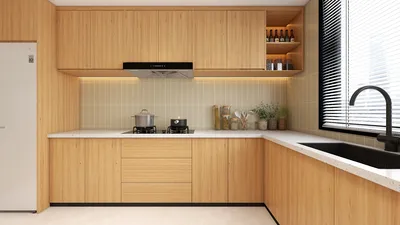


As we navigate our daily lives, the future is shaping our homes, with single-floor designs emerging as effective solutions for families facing increased complexity. My approach to crafting a USA 6 BHK single floor home plan is informed by a spatial reasoning toolkit, backed by insights from AIA and NAHB that highlight the growing trends of multi-generational living and aging in place. In this layout, I aim to tackle prevalent challenges such as clutter, fragmented spaces, and concerns over privacy, while also anticipating a lifestyle that adapts just like software.
Clustered Courtyard Spine
Design Logic: This design features six bedrooms surrounding a central light well, which promotes closeness among family members while ensuring acoustic privacy—future households require proximity without invasiveness.
Flow: The layout flows seamlessly from the entrance through a gallery spine leading to a central courtyard, then branching off to the bedroom clusters on either side and culminating in a kitchen pavilion—this clear sequence minimizes decision fatigue.
Sightlines: The design offers layered views from the front door to the green courtyard, subtly softened towards personal spaces; a UI-like structure segments public, semi-public, and private areas.
Storage: Built-in perimeter solutions serve as efficient caches, including wall bays that are 24-30" deep, linen towers strategically placed between rooms, and a light attic space above corridors for seasonal storage.
Furniture Fit: The area accommodates queen and king-sized furniture within dimensions of 76-80" by 96-108"; a dining table anchored on a 42" x 108" slab provides a stable dining experience, while lounge areas of 10' x 12' encourage relaxation.
Verdict: This configuration creates a structured environment where daylight serves as bandwidth, rooms function as distinct packets, and the courtyard operates as a low-latency switch for daily living.
save pinOpen in 3D Planner Processing...
Dual-Primary with Flex Lab
Design Logic: The plan incorporates two primary suites positioned at either end, ensuring autonomy for different generations, with a flexible lab in the center capable of transforming from a nursery to a telehealth space or studio.
Flow: The route begins at the carport, moving through a mudroom hub into the great room, then to the flex lab, and finally leading to the primary suites; this smooth execution path reduces the potential for traffic issues.
Sightlines: The great room offers expansive vistas, while the suites employ sight deflection measures for enhanced privacy; sliding glass doors frame regulated views of the horizon.
Storage: The mudroom serves as a functional cache with a 12' run, accompanied by twin walk-in closets ranging from 90 to 120 square feet, and a wall system in the flex lab featuring 18" modules for organizing gear and files.
Furniture Fit: The design allows for beds with 36" of clearance; the height-adjustable workbench varies from 30 to 42"; seating areas are planned to maintain 36-48" of circulation space, enhancing flow and usability.
Verdict: The lab functions as a future-ready node, integrating health, work, and creative spaces without necessitating overall redesigns.
save pinOpen in 3D Planner Processing...
Split Quiet + Social Grid
Design Logic: A north-south grid effectively segregates noise levels, with social spaces like the kitchen, dining area, and lounge on one side, and quiet sleeping areas on the other.
Flow: Upon entering, the progression moves through the social axis to a service bar and finally leads into the quiet axis; this straightforward layout minimizes audio interference and the overlap of events.
Sightlines: The social axis features long, bright lines; meanwhile, the quiet axis is designed with staggered portals and sound baffles—offering visual contrast for optimal energy management.
Storage: The service bar serves as a backbone for storage, including a pantry wall, utility lockers, and under-bench drawers; each bedroom incorporates a wardrobe ranging from 7 to 9 feet.
Furniture Fit: Grid cell dimensions are 12' x 14' for living spaces and 11' x 13' for bedrooms; modular sofas are designed in 9' arrays, while tables maintain a height of 30" to ensure universal accessibility.
Verdict: This grid functions akin to a well-structured codebase—reliable, scalable, and poised for future upgrades—such as electric vehicle charging and telehealth solutions.
save pinOpen in 3D Planner Processing...
Final Takeaway
In essence, a USA 6 BHK single-floor house plan emphasizes effective interfaces that facilitate energy management, privacy, and care. Variants such as six-bedroom ranches and single-level multigenerational configurations demonstrate how homes can operate like advanced software with flexible modules. Sustainable livability is achieved through streamlined flow, buffered sightlines, and well-placed storage, preventing chaos. From my experience, the most intelligent homes of tomorrow will not necessarily be larger; they will be designed with greater intention—and utilizing tools like Homestyler can help enhance this design process.
Meridian Furniture SienaNatural-T Siena Collection

Minimalist Solid Wood Linen Fabric Three Seat Sofa 3D Model

Minimalist Solid Wood Platform Bed 3D Model
Discover the magic of home design with Homestyler! This user-friendly platform offers an intuitive online design tool, stunning 3D renderings, and a wealth of design projects. Plus, its DIY video tutorials make transforming your space easy and enjoyable—perfect for any aspiring designer!
立即免费设计
































