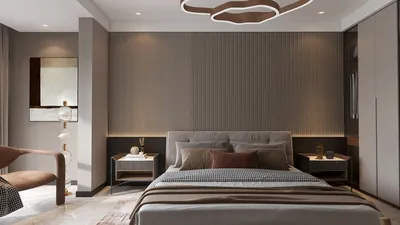


The emerging lifestyle demands flexible living arrangements, as modern families navigate busy schedules and require privacy. Recent NAHB surveys indicate a growing preference for multifunctional spaces such as flex rooms and combined living-sleep areas. In approaching the design of this L&T South City 4 BHK floor plan, I conceptualized it as an integrated system for future living needs—my clients desire an environment that fosters vitality. Here’s my vision for how this space can evolve as we step into the future. By utilizing a spatial reasoning toolkit, this 4-bedroom design serves as a guideline: routines harmonize, privacy zones increase, and shared moments become more defined.
Axis Living + Separate Private Wings
Design Principle: Position the living and dining areas as the central hub; divide the two bedrooms into distinct wings to enhance sound isolation and accommodate varying schedules.
Flow: Entry → utility area → living center → left wing (main suite) → right wing (children/guests), with the kitchen serving as a connector for both sides.
Sightlines: A long, unobstructed view from the entry to the balcony, with a cross-view to the kitchen; bedrooms are tucked behind staggered entries, gradually blending into quieter zones.
Storage: Perimeter cabinetry in the living area functions as a communal storage space, deep hall wardrobes act as distributed memories, and bed frames include hidden drawers for easy access.
Furniture Specifications: Sofa depth ranges from 38 to 40 inches, dining table measures 84×38 to accommodate six, with a king-sized primary bed providing a 30-inch clearance on the sides; desks for children span 48 inches aligned with window placements.
Conclusion: This divided layout maintains high social connectivity while preserving uninterrupted personal space—future residences can enhance routines seamlessly.
save pin
Functional Kitchen + Utility Center
Design Principle: The kitchen acts as an operations center, facilitating cooking, work, and device charging; the utility room serves as a buffer for equipment and deliveries.
Flow: From the entry and balcony to a drop zone, leading into the kitchen peninsula and utility corridor, then looping back to dining—this optimizes daily workflow.
Sightlines: The kitchen peninsula connects visually to the living area to create an open flow; a frosted utility door minimizes visual clutter, ensuring clarity throughout the space.
Storage: Tall pantry units, 24-inch deep side drawers, and ceiling-mounted racks in the utility area; organized bins function like a version control system for household items.
Furniture Specifications: The peninsula measures 96×36 with a 12-inch overhang, chairs can be tucked away; there’s a narrow space for a 24-inch fridge, and a stackable washer-dryer fits into a 30-inch slot.
Conclusion: This kitchen-utility center enhances daily activities—minimizing congestion while promoting calmness—equipped for hybrid work and smaller meal preparations.
save pin
Multi-Functional Room + Serene Primary Suite
Design Principle: One room serves dual purposes as an office during the day and a guest space at night; the primary suite provides acoustic separation and storage designed for daily routines.
Flow: Hallway → pocket door → flexible room → foldable bed; in the opposite wing → vestibule → primary suite → bathroom → walk-in closet forming a private cycle.
Sightlines: The flexible room allows for a controlled view of the hallway and balcony, offering presence without full exposure; the primary suite opens to a calming window view.
Storage: The flexible wall is equipped with adjustable rails and 18-inch deep shelves; the primary closet is organized based on routine: morning/evening, athletic, formal—similar to labeled datasets.
Furniture Specifications: The flexible area accommodates a 60-inch desk, a queen-sized Murphy bed with 18-inch clearance; the primary reflects a king bed, with a 36-inch dressing area and a bench for daily tasks.
Conclusion: The combination of a dual-purpose workspace and a tranquil primary suite merges versatility and rest, preparing for evolving roles and wellness needs.
save pin
Final Insights
The L&T South City 4 BHK layout resembles an innovative operating system: rooms function as modules, movement as coded interactions, and storage as a resource bank. This four-bedroom setup transforms the home into a future-ready platform where routines grow and privacy shields against external disturbances. I believe that over the next five years, advancements in planning will favor designs that prioritize bandwidth management over mere square footage—the most effective spaces will be those that are thoughtfully crafted, not just expansive.

Homestyler is an outstanding online home design platform that empowers you to effortlessly create and visualize your dream spaces. With its user-friendly design tool, stunning 3D renderings, and an abundance of DIY video tutorials, you can transform your home with inspiration and ease!
立即免费设计
































