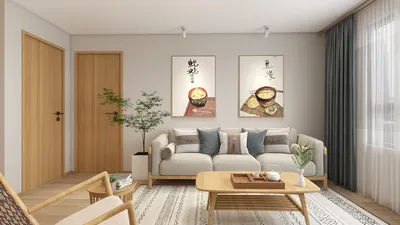


In the future, the essence of life is compacting time, attention, and energy into more efficient forms, while many current homes still struggle to maintain comfort—suffering from noise, clutter, and inefficient layouts. Statistics reveal a strong demand for flexible designs as families evolve, with homebuyers increasingly valuing efficient traffic flow. With this trend in mind, I'm exploring first floor house plans for 2 BHK, aware that the future is already approaching. Utilizing a spatial reasoning toolkit can be crucial.
Dual-Core Living with Split Privacy
Design Principle: Two bedrooms are positioned around a central living-dining area, functioning like dual processors sharing resources—ensuring privacy at the edges while fostering community in the shared space.
Flow: The sequence starts from the entrance → foyer as a buffer → core living area → dining → kitchen; side corridors lead to each bedroom, minimizing disruptions.
Sightlines: Front windows highlight the living area views; the kitchen receives lateral sightlines; bedrooms enjoy filtered perspectives, maintaining a serene and clear user interface.
Storage: Ample wall-depth wardrobes flank the space, complemented by corridor linen storage and bench seating in the foyer—providing effortless access.
Furniture Fit: A sofa ranging from 84 to 88 inches should complement a 10 to 12-foot living space; queen beds fit well in rooms measuring 10’6” to 11’; a dining setup for four in a 7-foot module respects API constraints.
Conclusion: This configuration prepares for flexible lifestyles—common areas for shared meals while maintaining quieter, private zones, adaptable for future changes over five years.
save pin
Front Social, Rear Quiet with Courtyard Node
Design Principle: Social areas face the street, while private zones open to the garden; a small courtyard serves as both a cooling feature and a mental retreat.
Flow: The pathway leads from entry → living → pivot to the courtyard → kitchen-dining → rear hallway → bedrooms; loop designs minimize bottlenecks, akin to non-blocking input/output.
Sightlines: A layered view from the street to greenery: the living area captures light, the kitchen views the courtyard, and bedrooms look skyward—creating a soft but clear hierarchy.
Storage: A pantry column, potential under-stair storage, and rear hall closets, with an outdoor wall dedicated to gear storage—ensuring everything stays organized near its point of use.
Furniture Fit: The sectional sofa should have at least a 36-inch clearance; the dining area measuring 36" x 72" should align with the terrace doors; beds centered with 24-inch side clearances.
Conclusion: The courtyard functions as both a thermal and emotional buffer, preparing the design for climate variations and reducing attentional fatigue.
save pin
Linear Spine with Pocket Flex Room
Design Principle: A streamlined circulation path acts as a clear instruction set; a pocket room can transition seamlessly from a study to a nursery or guest space.
Flow: The route is Entry → spine → living zone → kitchen-dining → pocket room → bedrooms; decision points are minimal, alleviating cognitive load.
Sightlines: The linear axis creates a sense of depth; side openings reduce glare; the pocket room employs translucent dividers for adaptive user interface layering.
Storage: A continuous millwork design along the spine serves as a storage hub; kitchen overhead storage and under-bed drawers ensure hassle-free access.
Furniture Fit: The spine width maintains 4 feet clear; the living area anchors a 6'–7' sofa; the pocket room accommodates a 48" desk or daybed without obstructing flow.
Conclusion: This layout adapts to varying family dynamics—work, relaxation, guests—without the need to redesign the entire space.
save pin
## Final Insights
First floor house plans for 2 BHK focus more on the coordination of bandwidth, privacy, and shared experiences than merely square footage. With options ranging from split-core designs to courtyard nodes, these interfaces can evolve alongside the new work-life blends—embracing two-bedroom configurations, compact layouts, and flexible pocket spaces. From my perspective, the most intelligent homes of tomorrow won’t necessarily be larger but will be more intentional, and I strive to design for that future vision, leveraging tools like Homestyler to enhance these concepts.
Discover the power of Homestyler for your home design needs! This user-friendly online platform features an innovative design tool, stunning 3D renderings, and a wealth of inspiring design projects. Plus, with DIY video tutorials, transforming your space has never been easier. Get started today!
立即免费设计
































