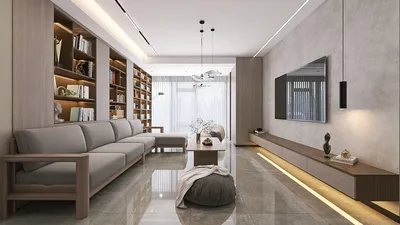


The future is approaching subtly, similar to an unobtrusive firmware update, while my clients grapple with issues like noise, glare, and disjointed routines. Industry research indicates that adaptable, multi-functional spaces top renovation priorities (Houzz). Viewed through this perspective, a 2160 sq.ft apartment layout transforms into a spacious interface—functioning as an operating system rather than just a backdrop. Each decision I make is influenced by a spatial reasoning toolkit, as this apartment is where future habits are refined.
Option A: Split-Core Gallery Loop
Design Logic: A centralized service core that includes the kitchen, pantry, and laundry serves as the anchor for a surrounding ring of living, study, and dining areas—designed for longevity in hybrid work and wellness.
Flow: The journey through the space begins at the entry, moves into a buffer vestibule, then transitions through living, dining, and the kitchen core, before branching into the study and bedroom wing; this seamless loop minimizes friction, akin to an efficiently organized process stack.
Sightlines: Diagonal perspectives from the living room to the study, enhanced by glazed partitions, create a layered user interface: a public foreground, a focused mid-level, and a private backdrop.
Storage: The core accommodates a deep pantry, a pull-out utility wall, and concealed laundry; the perimeter features bench-height storage along windows, ideal for seasonal item rotation.
Furniture Fit: Sofa modules measuring 36–40" in depth, a dining table sized at 96" x 42", and task desks that are 30" x 60"; these dimensions consider circulation flow and docking areas.
Verdict: This ring-based layout anticipates the next five years of hybrid routines, allowing work and leisure to intermingle without clashing.
save pin
Option B: Axial Living with Dual Suites
Design Logic: A prominent axis extending from the entry to the terrace divides the layout into two bedroom suites, balancing hospitality and privacy like parallel threads.
Flow: From the entry to the gallery hall, the layout flows into an open living/dining area and then to the terrace, leading to the left and right suites; this allows guests to conveniently exit without interrupting the home's ongoing activities.
Sightlines: A long axial view acts almost like a status bar; side alcoves create secondary focal points, keeping the main visual path clear and serene.
Storage: Each suite is equipped with wardrobes that include 30" deep modules, and there are hallway niches for quick-access storage; a credenza on the terrace accommodates outdoor items.
Furniture Fit: A sectional designed to fit 120" x 96", with options for two queen beds or one king and a flexible room; coffee table dimensions are 48" x 28" to maintain open flow.
Verdict: The axial design transforms a large space into a comprehensible user interface, facilitating multigenerational use while avoiding clutter.
save pin
Option C: Scalable Studio Spine
Design Logic: A spine wall equipped with sliding partitions adapts from an open loft to distinct zones, mirroring future dynamics that may expand and contract.
Flow: Starting at the entry, moving through a utility spine, leads to an adaptable living/studio area, followed by a kitchen node, a bedroom nook, and a media retreat; tasks proceed like microservices.
Sightlines: Clear sliding panels offer adjustable transparency—information density can fluctuate throughout the day.
Storage: The spine integrates 24" deep modular shelving, vertical bike hooks, and hidden bins; the bed platform features drawers for nearline storage.
Furniture Fit: A mobile workbench sized at 72" x 30", a drop-down dining table for six, and lightweight lounge pieces on casters—these elements are designed for quick reconfiguration.
Verdict: This spine model is designed to accommodate changing demands—it's a versatile plan that can flexibly support creation, hosting, and relaxation.
save pin
Final Takeaway
A 2160 sq.ft apartment layout emphasizes not just space but how the overall design orchestrates attention, movement, and storage. Configurations such as dual suites, gallery loops, and adaptable spines represent conceptual shifts that modern households will benefit from daily. In my view, the most intelligent homes of the future won't necessarily be larger, but rather more purposeful, and in my projects, I consistently observe how even minor spatial choices subtly transform lifestyle patterns, reminding me of tools like Homestyler that aid in visualizing such transformations.
If you're looking to transform your living space effortlessly, try Homestyler! This user-friendly online design platform offers powerful 3D rendering, diverse design projects, and easy-to-follow video tutorials. Whether you're a novice or an experienced designer, Homestyler makes home design fun and accessible!
Design jetzt kostenlos
































