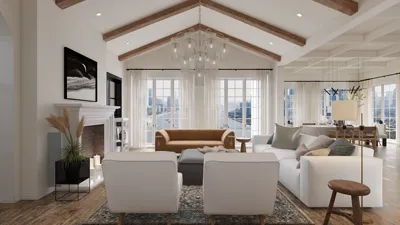


As we move towards the future, living arrangements are becoming more compact and efficient. Families are grappling with issues such as clutter, lengthy commutes, and the need for increased privacy. Observations by the AIA indicate a growing demand for multigenerational adaptability, which I notice reflected in many design requests. Utilizing a spatial reasoning toolkit has become crucial for developing house plans, particularly those featuring five bedrooms and a two-floor layout with a car park. The design interface must effectively address current disarray while accommodating future needs.
Ground-Level Loop: Car Park to Social Core
Design Logic: The car park functions like a charging station, seamlessly connecting to a mudroom and a central kitchen-living area. This layout takes into account electric vehicle usage, grocery deliveries, and the need for quick exits; thus, the logistics for the future are intricately woven into the design.
Flow: The pathway from entry to mudroom, pantry, kitchen, living space, and garden is designed for efficiency, minimizing noise and backtracking.
Sightlines: From the kitchen island, the main views extend towards the living area, stairwell, and yard. Additionally, there is a side view of the car park to signal arrivals, improving user interface clarity over confusion.
Storage: An expansive wall in the mudroom, a walk-in pantry, and an under-stair storage solution provide ample space, designed to accommodate weekly cycles and sports gear.
Furniture Fit: The island measures 10' x 4', sofa depth is 40", and dining setup is 96" with a circulation allowance of 42"; adhering to API restrictions ensures lane width and adaptability for events.
Verdict: The ground floor operates like an advanced router—facilitating quick transitions and low latency, ready for autonomous deliveries and hybrid living structures.
save pin
Second-Floor Sleep Grid: Five Rooms, Two Realms
Design Logic: The bedrooms are strategically divided into quiet and flexible clusters; the primary suite occupies one side while the children’s and guest blocks form a versatile arrangement for changing life phases.
Flow: The structured route goes from the stairs to the landing hub, then to the primary suite, kids' area, shared bathroom, laundry, and a flexible room—designed to minimize nighttime movements.
Sightlines: Well-defined corridors maintain privacy while allowing borrowed light through clerestory windows, keeping the space transparent without sacrificing tranquility.
Storage: Each bedroom features a reach-in or walk-in closet, while hallway linen towers serve as memory aids for seasonal changes.
Furniture Fit: Queen beds are centered with 30" clearance on both sides; desks are 48" wide with cable management systems; wardrobes are 24" deep—dimensions that adapt to both digital learning and restful needs.
Verdict: The sleep level resembles a stable dataset—quiet spaces that can be updated as needed, ensuring lasting comfort for both the short and long-term.
save pin
Hybrid Spine: Stair, Landing, and Pocket Office
Design Logic: The staircase functions as the primary spine of the home—bathed in natural light, with the landing designed as a pocket office, transforming movement into a meaningful transition.
Flow: The pathway from the car park leads to the stairway, then to the landing office and rooms; it navigates the family and work dynamics without friction, like interconnected threads.
Sightlines: A vertical light source creates visual hierarchy, illuminating the space and offering calm views to entrances, thus minimizing cognitive overload.
Storage: Custom millwork in the landing features 12" deep shelving, a concealed printer area, and document storage; drawers under the stair absorb any overflow.
Furniture Fit: The landing accommodates a 60" bench, and the office desk measures 30" x 60" with sound-reducing panels; the rise-run ratio ensures smooth navigation for both toddlers and elderly residents.
Verdict: This structural spine evolves—featuring work amenities, spaces for pause, and strategic light placement, all anticipating how families shift between focus and connection.
save pin
Final Takeaway
The configuration of a house with five bedrooms and a two-floor design complemented by a car park is more than just architectural layout; it acts as a responsive interface catering to logistical needs, privacy, and changing family routines. Options like a spacious five-bedroom family home or a two-story plan with a garage highlight that design cohesion is more essential than sheer size. Based on my observations, the most intelligent homes of the future will focus on intentional layouts, rather than increasing square footage, revealing that thoughtful spatial arrangements significantly enhance daily living experiences. Tools like Homestyler can further assist in visualizing and optimizing such designs.

Homestyler is your go-to online home design platform! With its user-friendly design tool, stunning 3D renderings, and a wealth of inspiring design projects and video tutorials, you can easily create and visualize your dream spaces—no design experience necessary.
立即免费设计
































