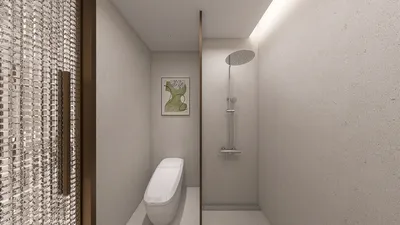


Effective space planning begins by acknowledging genuine constraints such as sightlines, circulation paths, acoustic privacy, and natural light. One of the most versatile tools I utilize to adjust these factors is a room partition that includes an integrated door. This allows for flexibility in modifying the space without committing to permanent walls. In both workplace and residential settings, I apply these partitions to switch between collaborative openness and focused solitude, making it possible for spaces to transform alongside changing routines while using platforms like Homestyler to visualize these adaptations.
Research consistently backs this flexible approach. According to Steelcase, about 70% of employees fluctuate between individual tasks and collaborative efforts within a single day, highlighting the necessity for adaptable boundaries to enhance comfort and efficiency. The WELL v2 standard reinforces this notion by establishing guidelines for acoustic comfort and manageable environments; implementing removable partitions and gasketed doors often leads to increased perceived productivity and diminished noise fatigue. For further insights on benchmarks concerning acoustics, daylight, and comfort, refer to the WELL Building Standard available at wellcertified.com.
Design Goals: Privacy, Flow, and Adaptability
In my initial assessment of a partition layout, I aim for targets focused on visual and acoustic privacy, efficient circulation, and the continuity of natural light. I maintain door widths between 34 to 36 inches for universal accessibility, ensure clear sightlines from primary entry points, and adjust partition heights to maximize light while minimizing direct distractions. The design must avoid creating dead-end circulation; instead, it should enhance logical routes, particularly in compact floor plans.
Spatial Ratios and Visual Balance
Partitions contribute vertical rhythm to spaces. I strive to balance the solid-to-void ratios to prevent heavy, dominating wall structures in smaller rooms. As a guideline, at least 30% visual permeability is crucial along major circulation zones for clarity; I achieve this through glazed panels or slatted dividers, utilizing solid sections in areas requiring concentrated focus. The door plays a pivotal role in this rhythm; its position and operation define how individuals perceive and interact with the space, as well as where they tend to pause.
Acoustic Strategy: Ensuring Door Effectiveness
If a door stands as the weak point within a partition, privacy diminishes significantly. I choose solid-core doors equipped with perimeter seals and drop-down thresholds when speech privacy is crucial, and I prefer partitions that extend to the ceiling or incorporate a sound-absorbing transom detail to reduce noise transmission. For teams that are particularly noise-sensitive, achieving a sound transmission class (STC) rating in the mid-30s can mean the difference between sustained focus and daily disruption. Avoiding gaps at the frame, poor-quality hinges, or rattling panels is essential.
Light Environment: Daylight, Glare, and Color
Partitions should mitigate glare and redirect daylight rather than obstruct it. I employ translucent panels, reeded glass, or perforated metal near windows to diffuse light while preserving brightness levels. For artificial lighting, a comfortable range of 300 to 500 lux is targeted for general tasks, with warmer temperatures of 2700 to 3000K recommended for relaxation areas, and 3500 to 4000K in spaces requiring more focused tasks. Proper shielding is necessary to prevent distracting reflections from screens adjacent to glazed partitions. Incorporating elements of color psychology, muted greens and soft neutral tones are great for fostering calm focus, while small bursts of vivid color can delineate zones without creating visual chaos.
Ergonomics and Door Operations
Human factors are central to selecting hardware. Lever handles are generally more effective than knobs in terms of accessibility and efficiency. Sufficient floor space on the pull side of the door is necessary to facilitate movement and minimize collision risks. In smaller rooms, I tend to favor sliding doors to maintain aisle width, although for heightened privacy, a well-sealed swinging door is often preferable.
Material Selection and Sustainability
I prefer modular systems that enable reconfiguration without extensive demolition. Using FSC-certified wood veneers, recycled aluminum frames, and low-VOC laminates ensures stable indoor air quality. When incorporating glass, laminated versions with acoustic interlayers outperform standard tempered options in terms of noise control. It's also prudent to consider the finish reflectance: mid-matte surfaces help reduce glare, while ultra-gloss finishes can exacerbate hotspots and show fingerprints.
Behavioral Patterns and Zoning
Partitions should facilitate movement in addition to merely sectioning off space. I position doors where they align with primary pathways and subtly guide team activities through micro-zones, such as a reading nook behind a partially glazed panel, a desk cluster set behind a solid band, or a maker bench buffered by a half-height acoustic divider. The key is to anchor noisy activities away from quiet workspaces, offering choices where doors provide the opportunity for temporary privacy without the need for complete separation.
Workplace Trends for 2024–2025
The rise of hybrid work has increased the demand for flexible, low-commitment boundaries. Recent renovations showcase sliding glass partitions with drop seals, acoustic felt composites, and demountable metal panel frames. An emerging trend is the inclusion of "quiet pods" adjacent to collaborative areas, utilizing gasketed doors, soft lighting within the 3000 to 3500K spectrum, and high-NRC materials. These pods aren’t isolated; they remain just a door swing away from collaboration.
Layout Strategies and Door Positioning
To finalize a layout, I simulate various traffic flows before deciding on door placements. In compact apartments or studios, a partitioned sleeping area with a flush pocket door can maintain the openness of the living space while delivering nighttime privacy. In office settings, I prefer to offset doors from main corridors to minimize intrusions into focus zones. If you’re considering layout iterations or circulation experiments, utilizing a room layout tool can assist in visualizing swing clearances and furniture placement: room layout tool.
Color and Finish Cohesion
Color serves as a visual boundary marker. I wrap partitions in finishes that coordinate with surrounding millwork and introduce accent elements—such as edge trims or door reveals—to emphasize thresholds. Light, desaturated palettes can create an illusion of greater space, while darker frames help articulate edges for more effective navigation. Ensuring that the door hardware matches the tones of electrical plates and window frames fosters a sense of visual continuity at eye level.
Installation Details and Tolerances
Actual site conditions surpass specifications on paper. Plumb frames, precise shim points, and continuous seals are vital for optimal performance. I request mockups for complex joints to ensure that thresholds do not create tripping hazards. For varying ceiling conditions, a compressible head detail greatly aids in maintaining a stable fit. Always align partition joints with floor transitions to avoid awkward cuts or misaligned lines.
Maintenance and Lifecycle Considerations
Flexible spaces thrive when maintenance is kept uncomplicated. Opt for finishes that can be cleaned with mild products and are resistant to scuffs. Modular panel systems and standardized hardware facilitate quicker upgrades. Over a period of five years, most clients value the ability to refresh a partition's aesthetics without needing to replace the entire setup.
FAQ
For tight aisles with moderate privacy needs, consider using sliding doors. Solid-core swing doors with proper sealing are best for critical acoustic privacy. User behavior and clearances should guide the decision-making process.
For general office or study areas in residences, target an assembly STC in the mid-30s. Ensure that perimeter seals and continuous frames are installed, as the door typically represents the limiting factor.
Not necessarily. Laminated glass with acoustic interlayers typically offers superior performance compared to standard tempered glass. When paired with sealed frames and soft finishes, it helps absorb reverberation effectively.
Implement translucent or patterned glass, manage luminance ratios carefully, and configure task lighting between 300-500 lux. Adjust the fixture shielding to prevent direct reflections on screens.
Select lever handles for better accessibility, install closers that prevent slamming, and use magnetic latches for quiet operation. Maintain a consistent finish tone with other trim elements throughout the design.
Achieve a balance between solid and transparent sections, ensuring at least 30% visual permeability along key routes, and position doors to facilitate seamless transitions between collaboration and focused work.
Yes, when designed with recycled aluminum, FSC-certified veneers, and low-VOC finishes. These modular systems minimize demolition waste and enhance reconfiguration capabilities over time.
Ensure a clear opening of 34 to 36 inches and provide sufficient maneuverability around the pull side. Avoid door swings that might collide with furniture or disrupt circulation.
Inspect seals semi-annually, tighten any loose hardware, and replace worn thresholds as needed. Employ soft furnishings and high-NRC finishes nearby to effectively control noise reverberation.
Absolutely. Utilize subtle variations in color palettes and trim reveals to indicate transitions. Keep accent details controlled to prevent any visual clutter from detracting attention.
Homestyler is your ideal partner for home design! With its easy-to-use online design tool, stunning 3D renderings, and a wealth of DIY video tutorials, you can explore limitless design possibilities and create your dream space effortlessly. Unleash your creativity today!
Zaprojektuj teraz za darmo
































