Forest Style Decoded: Nature, Texture, and Harmony in Modern Interiors
The Forest Style is more than a trend—it's a biophilic philosophy rooted in reverence for the natural world. Inspired by dense woodlands, moss-covered stones, and sun-dappled clearings, this aesthetic merges raw organic authenticity with refined contemporary living. As defined by Homestyler’s AIDA Design Competition sub-venue, Forest Style emphasizes 'natural simplicity and vitality'—achievable not through literal imitation, but through intentional materiality, layered greenery, and tactile warmth. It bridges rustic soul and digital precision: think live-edge dining tables rendered in photorealistic 3D, fern-filled indoor planters animated with real-time sunlight simulation, and reclaimed timber walls that breathe visual texture into minimalist floorplans. Unlike generic 'nature-inspired' themes, Forest Style insists on coherence—every element must feel like it belongs *in* the forest, not just *of* it.

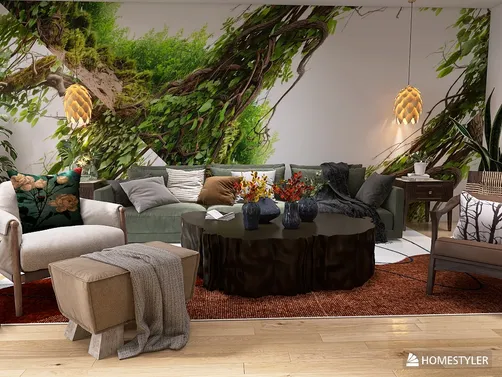
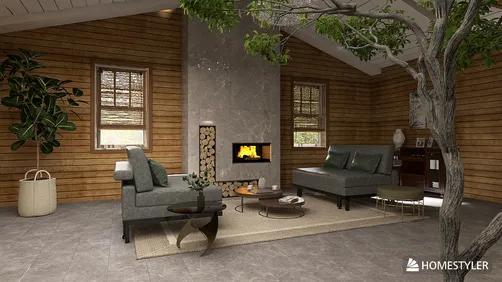
This work — The Forest House by Tora Luke — exemplifies how Homestyler transforms conceptual vision into immersive reality. The mural isn’t decorative wallpaper; it’s a curated botanical illustration rendered with depth and ambient occlusion, simulating light filtering through canopy layers. The black coffee table anchors the space without competing—its matte finish echoes wet stone, while surrounding greenery (ferns, monstera, pothos) is placed using Homestyler’s smart plant library, which auto-adjusts leaf density and shadow cast based on window orientation and HDR environment (here: g_hilltop). In Homestyler, users achieve this in under 3 minutes: drag a ‘Living Wall’ module, apply the ‘Moss Texture Pack’, then assign dynamic lighting via Sunlight Slider + HDR toggle — no rendering queue, no plugin. That’s Forest Style, engineered for speed and soul.
Design Your Forest Room🌿 Natural Materiality: Wood, Stone & Unrefined Surfaces
Forest Style rejects synthetic perfection. Its foundation lies in materials that bear time’s signature: grain-rich walnut slabs, rough-hewn oak beams, river-worn basalt tiles, and unsealed clay plaster walls. These aren’t background elements—they’re protagonists. Texture communicates age, origin, and honesty: a charred shou sugi ban wall whispers of controlled fire; a cracked limestone hearth tells of geological patience. Crucially, these materials are never isolated—they converse: warm wood softens cool stone; fibrous jute rugs echo bark patterns; hammered copper fixtures mimic water-polished pebbles. This dialogue creates sensory cohesion, turning interiors into quiet ecosystems rather than styled sets.

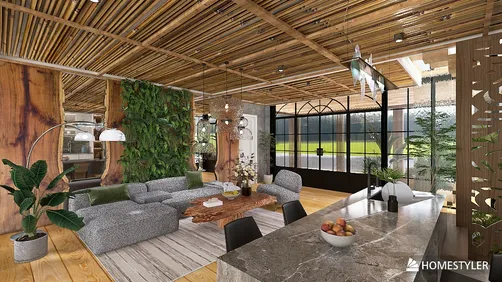
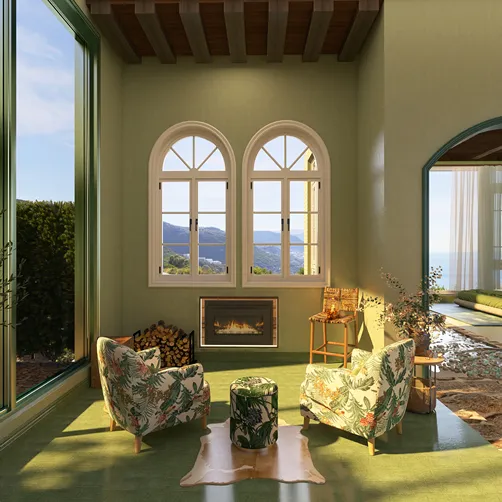
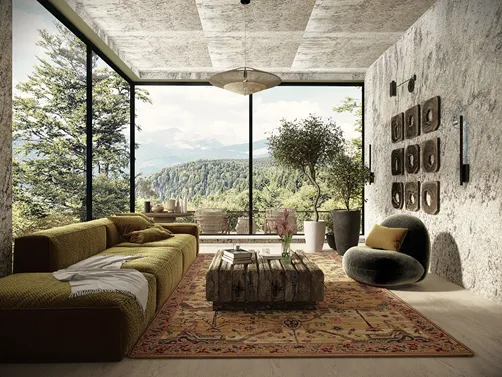
Vanessa Ribeiro’s Espaço Verde e Sereno masterfully deploys material storytelling: the sofa isn’t upholstered—it’s wrapped in undyed, nubby linen that mimics forest floor moss, while the tropical coffee table’s high-gloss surface reflects ceiling beams like still pond water. Note how Homestyler’s ‘Material Mixer’ tool enabled her to blend two base textures—‘Raw Oak’ + ‘Weathered Concrete’—to generate a custom tabletop surface with believable micro-imperfections. She then applied ‘Sunlight: g_lilienstein’ to cast long, soft shadows that enhance the tactile contrast. For designers: use Homestyler’s ‘Texture Overlay’ slider (0–100%) to dial in ruggedness without switching models—no export needed.
Start Your Green Space🌱 Strategic Green Integration: Beyond Potted Plants
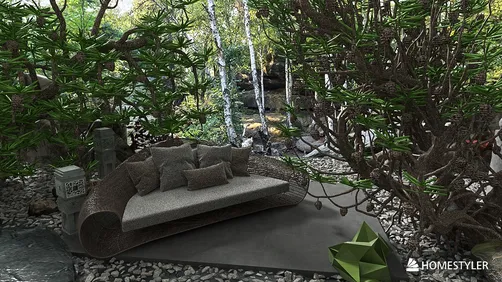
Greenery in Forest Style is architectural—not ornamental. It’s vertical gardens tracing stairwells, creeping ivy softening drywall edges, suspended air plants nestled in reclaimed timber niches, and large-scale fiddle-leaf figs acting as living room ‘columns’. Species selection is intentional: feathery maidenhair ferns evoke understory mist; sculptural snake plants suggest resilient desert fringes; trailing philodendrons mimic vine-laced trunks. Crucially, placement follows biophilic principles—plants cluster near windows (for photosynthesis realism), flank seating zones (for psychological enclosure), and appear at varying heights (ground cover → mid-layer → canopy). This layered green strategy creates spatial depth, oxygenates visuals, and fulfills our innate need for fractal complexity.

Julie Turner’s Forrest style space for web redefines functional spaces: a bathroom becomes a moss-draped grotto. Dual sinks sit atop a single slab of live-edge maple, while a built-in planter runs beneath the vanity—filled with moisture-loving ferns and tillandsias. Homestyler made this possible via ‘Smart Zone Planting’: she selected the vanity footprint, chose ‘Bathroom-Adapted Greens’, and set humidity level (High) and light exposure (Medium). The platform auto-generated root structures, drip trays, and realistic leaf translucency—all synced to her chosen HDR (d_city_park). No manual modeling. Just intention, then instant immersion.
Create Natural Interiors🌲 Light & Spatial Flow: Windows as Living Canopies
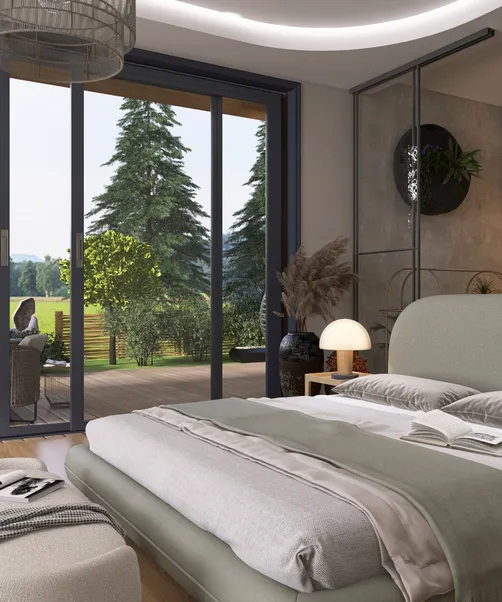
Light in Forest Style isn’t illumination—it’s atmosphere. Large, often frameless glazing dissolves boundaries between indoors and out, turning windows into living canvases for seasonal change. Light quality matters deeply: diffused morning glow through layered foliage, sharp noon sunbeams piercing gaps in overhead branches, or golden-hour warmth pooling on timber floors. Spatial flow supports this: open-plan layouts avoid visual barriers; curved walls mimic natural contours; floor-to-ceiling glass doors slide away completely. Ceilings may feature exposed beams or coffered designs evoking tree canopies—always prioritizing volume, breathability, and directional light choreography over enclosed, static rooms.

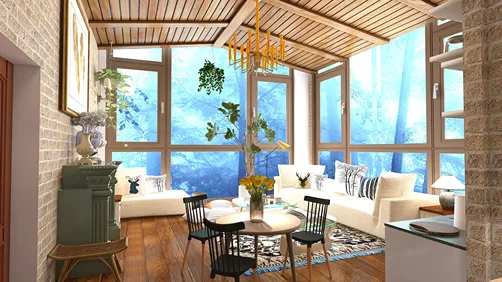
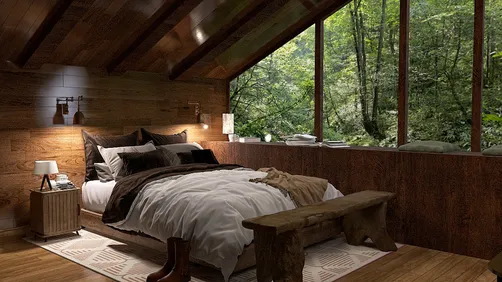
Asia Garbini’s Green outside the window proves how Homestyler leverages environmental context as a design layer. The entire composition hinges on one real-time variable: the view beyond the window. Using Homestyler’s ‘Dynamic Vista’ feature, she imported a custom forest panorama, then set ‘Time of Day’ to ‘g_ljz_day’—generating authentic dappled light patterns that shift across the wooden bedframe and textured rug. The layered bedding (linen + wool + faux-fur throw) mirrors forest strata, while recessed wall niches hold dried eucalyptus—modeled from Homestyler’s ‘Botanical Archive’. Result: a bedroom that doesn’t just face the forest—it participates in its rhythm.
Build Your Garden OasisFAQ
Q: What defines true Forest Style vs. generic 'nature-inspired' design?
Forest Style requires material honesty, layered biophilia, and spatial continuity with the outdoors—not just adding a potted plant to a white box. It demands texture (rough wood, raw stone), strategic green architecture (vertical gardens, canopy-height trees), and light choreography (large glazing + HDR environments).
Q: Can I create Forest Style interiors without professional 3D skills?
Absolutely. Homestyler’s intuitive drag-and-drop library includes pre-textured timber walls, smart plant modules with growth simulation, and one-click HDR lighting presets (like ‘sunny_vondelpark’ or ‘bergen’). No coding, no rendering waits—just design, preview, and share.
Q: Are there Homestyler-specific assets for Forest Style?
Yes. The ‘Forest Style Kit’ (free in the Model Library) contains 47+ items: charred wood cladding, moss-textured tiles, modular living walls, native fern species packs, and weathered stone fireplaces—all optimized for real-time 3D rendering and cross-platform compatibility.
Q: How does Forest Style support well-being in digital design?
Homestyler’s real-time biophilic features—dynamic light/shadow, seasonal plant behavior, and acoustic material tagging—enable designers to simulate restorative environments before construction. This validates wellness claims (e.g., stress reduction, focus improvement) with visual fidelity, aligning with WELL Building Standard principles.

Minimalist Boucle Fabric Tufted Sofa 3D Model

Minimalist Solid Oak Fluted TV Stand with Black Metal Legs 3D Model

Minimalist Brown Velvet L Shaped Sectional Sofa 3D Model
Homestyler offers an easy-to-use online design tool with stunning 3D renderings, inspiring design projects, and helpful DIY video tutorials. It’s perfect for bringing your home decoration ideas to life, whether you’re a beginner or a design enthusiast.
Zaprojektuj teraz za darmo