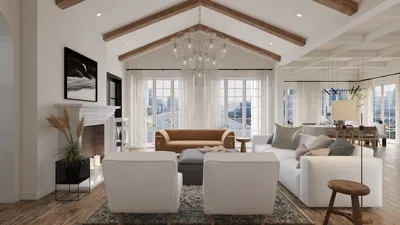


I often find humor in the time when a client requested a 'grand farmhouse table' for their compact 28 m² studio — I nearly suggested we lower the stairs out the window. That experience emphasized the importance of starting with a scaled room plan: accurately sketching proportions conserves both budget and pride. It's this approach that taught me how to design a small dining table for two, ensuring it feels deliberate rather than cramped, often with the help of tools like Homestyler.
1. Drop-leaf by the window — cozy seating for two with a view.
Drop-leaf tables are my preferred choice when natural light is the highlight of a space. When not in use, they fit snugly in narrow areas, and when friends come over, they can be easily unfolded for an intimate dinner by the window.
One of the benefits is their adaptability and affordability, although some drop-leaf tables may have limited leg space. It's essential to verify hinge placement and measurements to ensure a comfortable fit before making a purchase.
save pin
2. Wall-mounted fold-down table — embracing urban minimalism.
I've installed wall-mounted drop tables in micro-apartments where every square inch counts. These tables can serve as prep space during meal preparation and fold away to create a clear area for activities like yoga or morning stretches.
While they tend to be lightweight and budget-friendly, a secure wall mounting is crucial. I always remind clients to include costs for a stud mount or professional assembly to avoid unexpected complications.
save pin
3. Narrow bistro set or counter-height duo — small yet sociable.
In kitchens that lack the space for a full-sized table, I sometimes shift the concept into the cooking area and create a two-person bistro nook. A thoughtfully designed two-person kitchen layout makes the area feel more purposeful and social.
Narrow sets ensure easy movement and are ideal for two people, although they can seem cramped during larger meals; opt for slim chairs or stools that can be discreetly tucked away to maximize space.
save pin
4. Round extendable table — gentle curves for small spaces.
Round tables comfortably seat two and eliminate sharp corners that disrupt flow. An extendable center leaf provides additional space for guests without dominating everyday use.
The drawback is that high-quality extensions may come with a slightly higher price tag, and for those with limited storage, a model where the leaves can be neatly stowed away is preferable.
save pin
5. Built-in banquette with flip-up table — a fusion of seating and storage.
One of my favorite tricks for small dining areas is to create a cozy banquette with storage drawers underneath and a foldable or telescoping tabletop. This design establishes a warm, permanent seating area for two while cleverly hiding seasonal items inside the bench.
Although this requires a bit more investment and may involve some carpentry work, the ultimate reward is comfort, storage, and a photorealistic 3D render using tools like Homestyler, which helps visualize the final atmosphere before construction.
save pin
Extras: quick styling and budget-friendly suggestions.
Keep chairs lightweight and low-profile — designs in wire, acrylic, or slim wood help maintain an airy feel in the room. A single pendant light positioned above the table adds drama without creating clutter.
When on a budget, consider secondhand vintage tables or a straightforward DIY tabletop mounted on a pedestal base, which can achieve a designer look for a fraction of the cost. If you’re reformatting a small kitchen, a two-stage approach where you first refine the layout before introducing furniture can save money and prevent regrets — for visualizing potential layouts, explore tools like Homestyler.
save pin
FAQ
Q1: What’s the minimum table size for two people?
I advise a minimum width of 60–70 cm (24–28 in) per person for sufficient elbow room; ideally, a round table should measure around 80–90 cm (31–35 in) in diameter for optimal comfort for two.
Q2: How much clearance should I allow around a dining table?
For ease of seating and movement, aim for roughly 90 cm (36 in) between the table's edge and any walls or obstacles. This aligns with the National Kitchen & Bath Association (NKBA) guidelines.
Q3: Are fold-down tables sturdy enough for daily use?
Certainly — well-made wall-mounted tables with reliable hardware can handle regular dining usage, but it's crucial to verify weight limits and ensure proper installation into wall studs for long-lasting dependability.
Q4: What chair styles are most suitable for compact spaces?
Opt for chairs that can fit under the table and have a slim or armless design; stools or benches provide additional flexibility if storage or stackability is a concern.
Q5: Can a small dining table serve as a workspace as well?
Of course — multifunctional pieces are vital in compact living spaces. Just be sure to check the table height and surface depth for ergonomic laptop use, and consider adding a small task lamp.
Q6: Is a round table a better choice than a square one for tight rooms?
Round tables minimize sharp corners that could obstruct traffic and often create a more open atmosphere than a square table of identical size, making them a savvy option for narrow layouts.
Q7: How should I select lighting for a two-person table?
A single pendant light positioned 60–75 cm (24–30 in) above the table typically generates an inviting pool of light; for tighter areas, a slim-profile fixture ensures unobstructed sightlines.
Q8: Can I visualize my tiny dining nook before making a purchase?
Absolutely — mockups and 3D visuals are invaluable for assessing scale, color, and traffic flow prior to buying; that's precisely how I validate designs for clients to avert costly errors.
save pin
Looking to transform your home? Homestyler is your go-to online design platform! With its user-friendly design tool, stunning 3D renderings, and a wealth of design projects and video tutorials, you can easily create and visualize your dream space, no matter your experience level.
Desain sekarang Gratis
































