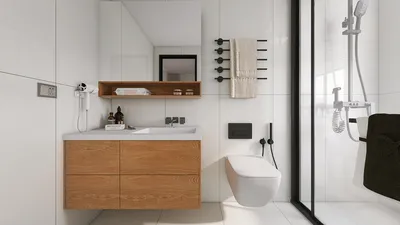


A powder room, also known as a half-bath, serves as a compact restroom typically situated near the more social areas of the home. It's designed primarily for guests or quick usage and contains a toilet and a sink, but usually lacks a shower or bathtub. A thoughtfully designed powder room not only enhances convenience but also positively influences the flow of circulation and privacy, contributing significantly to the overall hospitality of your house. Incorporating design tools like Homestyler can aid in optimizing your layout.
Right-sizing is crucial in powder room design. In the residential projects I’ve managed, the typical size for a powder room ranges between 15 to 30 square feet, with frequent dimensions being about 3' x 6' or 4' x 5'. For comfort and adherence to building codes, ensure clearances: at least 21" in front of both the toilet and sink, and 15" from the centerline of the toilet to adjacent walls. The WELL v2 Restorative Spaces guidelines underscore the significance of glare control and adequate lighting levels for visual comfort, while the IES advises a task lighting range of 300–500 lux around mirrors to minimize eye strain. By implementing layered lighting designs at these standards, you can ensure that even a small powder room remains functional and inviting.
The guest experience is central to design. Research by Herman Miller emphasizes how environmental quality directly correlates to perceived comfort and functionality. These principles apply to compact spaces as well, where attention to factors like lighting, acoustics, and spatial arrangement can greatly reduce discomfort. Creating a straightforward circulation path—a door that swings without obstructing movement, direct access to the sink for easy handwashing, and a toilet positioned with privacy in mind—contributes to a tranquil micro-environment that guests will appreciate.
Definition: Understanding the Powder Room
In home design, a powder room, or half-bath, is equipped solely with a toilet and a sink. It is predominantly located on the first floor, close to living and dining areas or entry points, allowing guests to access these facilities without intruding on private areas like bedrooms. Unlike a full bathroom intended for bathing, the powder room is primarily used for quick handwashing and restroom access.
Typical Dimensions and Clearances
Standard dimensions for a powder room are between 15 and 30 square feet, with common layouts being 3' x 6', 4' x 5', or a square 5' x 5'. It's vital to maintain a minimum of 21" of clear floor space in front of fixtures and a minimum of 15" from the centerline of the toilet to any walls or objects. A comfortable entryway should range from 28 to 32" wide; opting for pocket doors can alleviate swing-related conflicts in confined spaces.
Planning Location and Circulation Flow
Powder rooms should be conveniently located near social areas, albeit with a degree of separation for privacy. This can be achieved by incorporating a small hall or vestibule. If your floor plan is adaptable, using an interior layout tool can help precisely assess door swings, fixture placement, and privacy screens, further enhanced by utilizing solutions like Homestyler.
Lighting Considerations: Lux Levels, Color Temperature, and Glare Control
To prevent shadows and glare, layered lighting is crucial in a powder room. Aim for 300–500 lux around the mirror for effective grooming and hygienic practices. Pair warm-neutral 2700–3000K bulbs for a flattering light that complements skin tones, using low-glare fixtures and frosted diffusers. Ideally, place sconces at eye level (typically 60–66" from the floor, based on user height) beside the mirror for balanced vertical illumination; an additional dimmable overhead light may provide general ambient lighting. For tasks at the mirror, it's best to avoid relying on single downlights that can create harsh shadows. Adhere to IES task lighting standards and the WELL v2 Visual and Lighting principles to enhance comfort and reduce glare.
Expert Insight: The International WELL Building Institute (WELL v2) offers extensive guidelines on visual comfort and glare reduction tailored for smaller residential environments. Research by Herman Miller solidifies the connection between environmental quality and user satisfaction, stressing the importance of attentive lighting and acoustic hold in compact spaces.
Managing Acoustics and Ensuring Privacy
Managing sound within a powder room focuses on both noise containment and masking. Employ solid-core doors, gasketed frames, and soft-textured materials such as textile wall coverings or framed artwork to enhance sound absorption. Ideally, situate the room away from primary sightlines, utilizing a short vestibule if feasible. To maintain privacy without drawing attention, install a small, quiet exhaust fan with a sone rating of 1.5 or less.
Ergonomics and Human Factors Considerations
Ergonomics plays a significant role in user comfort, focusing on reachability and space clearances. Install lavatories at a height of 32–34" from the floor for the majority of users and ensure that lever handles and faucets provide ample knuckle space. Position mirrors around 60"–64" high; consider a taller or tiltable mirror if your household has individuals of varying heights. Include a small ledge or shelf near the sink for personal items while keeping it safely away from splash zones.
Color Psychology and Material Choices
Color sets the mood in any room. Soft, neutral tones and desaturated colors create a calming atmosphere, while a deep accent color can infuse sophistication without making the space feel smaller, assuming adequate lighting is provided. Research from Verywell Mind indicates that shades of blue and green promote tranquility, while warmer tones add an invigorating energy—balancing these can enhance light reflectance and keep the room feeling spacious. When selecting materials, prioritize moisture-resistant options such as semi-gloss paints, ceramic or porcelain tiles, and sealed stone surfaces. Use non-slip tile (with a COF rating of 0.42 or greater when wet) to minimize safety risks, and opt for matte finishes to reduce glare. Should sustainability be a priority, seek out low-VOC paints and FSC-certified wood materials.
Fixtures, Storage Options, and Hardware Selection
Utilizing a compact, wall-mounted sink can create the illusion of a larger floor area, while a petite vanity may offer essential storage for tissues and hand towels. Consider installing skirted toilets for easier cleaning and concealed trapways for aesthetic appeal. Touchless faucets and soap dispensers promote hygiene while conserving water usage. Choose intuitive hardware: lever handles, soft-close toilet lids, and magnetic catches for quiet operation.
Ventilation and Odor Management
Incorporate an exhaust fan vented externally, sized between 50 and 80 CFM, to efficiently handle the ventilation needs of small powder rooms. Pair it with an occupancy or humidity/odor sensor for automated operation. Keep scents subtle and fresh, avoiding overly perfumed fragrances by utilizing discreet diffusers positioned away from the sink area.
Lighting Techniques and Mirror Pairings
To achieve even illumination, install two vertical sconces on either side of a 20–30" wide mirror. If space is exceptionally limited, consider an integrated LED mirror with a color rendering index (CRI) of 90+ to ensure accurate color representation. Consistent color temperatures across all light sources are essential to maintain a uniform visual tone throughout the room.
Examples of Effective Layouts
For a linear layout, position the door to swing open toward the sink, with the toilet situated for privacy beyond it; this creates an unobstructed path for immediate handwashing. For a corner layout, place the vanity along a narrow wall and offset the toilet to reduce direct visual access from the door. If visualization is needed prior to construction, utilize an interior layout planner to simulate the arrangement of fixtures and door swings effectively with tools like Homestyler.
Design Etiquette and Aesthetic Considerations
Keep essentials readily visible, such as fresh towels, high-quality soap, and an inconspicuous waste bin. Avoid overcrowding the space; a singular focal feature— like a small framed print or a singular vase— suffices. Maintain an extra toilet roll discreetly positioned in a closed compartment. Although a soft rug may seem inviting, it can retain moisture, so opt for a washable mat only if adequate ventilation exists.
Design Trends for 2024–2025
Emerging trends feature compact vanities with inbuilt storage solutions, matte brass or black fixtures, and micro-mosaic tiles to enhance texture. Warm-neutral color schemes accented with a single bold tone (oxblood or deep teal) remain prominent, complemented by high-CRI LEDs to ensure accurate color rendering. Touchless fixtures and antimicrobial surfaces are also on the rise, indicating a shift toward higher hygiene standards.
Common Pitfalls to Avoid
Be cautious of oversized fixtures that disrupt circulation, a reliance on a single downlight casting harsh shadows, or door swings that may collide with the toilet. It's also common to overlook the importance of acoustic privacy and to have inconsistent color temperatures across lighting. Aim to keep all sources within the range of 2700–3000K for coherence unless a cooler contemporary look is desired.
Frequently Asked Questions (FAQ)
Q1: What is the minimum size of a functional powder room?
A1: Ideally, aim for a minimum of 15 to 20 square feet, ensuring at least 21" of clearance in front of fixtures and a minimum of 15" from the centerline of the toilet to adjacent walls. Many compact designs can effectively utilize a footprint of 3' x 6' if the circulation is efficiently planned.
Q2: Should I choose 2700K or 3000K for lighting in a powder room?
A2: Both color temperatures work well; 2700K offers a warmer, cozier feel, while 3000K maintains a crisp white light. Ensure the lighting at mirrors falls within 300–500 lux and opt for low-glare sconces to promote balanced vertical illumination.
Q3: Is it acceptable to position a powder room off the main entry?
A3: Yes, as long as there is visual separation; employing a short hallway or a discreet door location ensures guests don't feel exposed during entry or exit.
Q4: Is an exhaust fan necessary even if there’s no shower in the room?
A4: Definitely. Install one rated between 50 and 80 CFM with quiet operation (approximately 1.0 to 1.5 sones). This will significantly enhance odor control and air quality.
Q5: What color schemes are most effective for small powder rooms?
A5: Soft neutrals paired with one bold accent color work best. According to color psychology, hues of blue and green evoke calm, while warmer shades can infuse energy. Ensuring proper light levels will help prevent dark colors from feeling cramped.
Q6: How can I enhance acoustic privacy in a powder room?
A6: To improve sound privacy, incorporate solid-core doors, a short vestibule, soft wall art, and a quietly operating fan. Refrain from using hard-surface materials excessively to mitigate echoes; by mixing textures, you’ll create a more serene space.
Q7: Are touchless fixtures beneficial?
A7: Yes, touchless fixtures stand as a great investment in hygiene and water conservation. When paired with durable finishes and clear user feedback (like LED indicators), they become easy to use.
Q8: What is the ideal mirror size for a powder room?
A8: Typically, a mirror measuring 20–30" wide suits most vanities. Ensure vertical lighting is positioned at eye level, and consider a mirror with a CRI of 90+ for accurate color rendering.
Q9: Should I opt for a pocket door in my powder room?
A9: Pocket doors are excellent for saving space in compact areas where swing clearance is constrained. Ensure that the door features solid tracks and soft-close hardware for smooth and quiet operation.
Q10: What type of storage is appropriate in a powder room?
A10: Keep storage minimal—only space for tissues, hand towels, and a few toiletries. A shallow vanity or recessed medicine cabinet will suffice without crowding the limited area.


If you're looking to transform your space effortlessly, Homestyler is the answer! This user-friendly online design tool offers stunning 3D renderings, an array of design projects, and insightful DIY video tutorials. Bring your home design vision to life and unleash your creativity today!
Concevez maintenant gratuitement
































