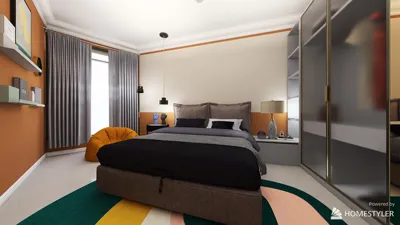


I once created an inverted ombre sunrise on a client's accent wall, blending vibrant colors from the base upwards, and the outcome delighted the client, prompting us to keep it. This fortunate event illuminated the idea that design principles are merely guidelines, and that limited spaces can inspire immense creativity. To visualize concepts before finalizing decisions, I often utilize Homestyler to create a quick room mockup which helps assess scale and lighting.
1. Warm Sunrise Gradient Behind the Bed
Begin with a rich coral hue at the base that beautifully transitions into soft peach and pale gold near the ceiling, replicating the feel of dawn's light. This strategy instantly infuses warmth into a small bedroom while serving as a captivating focal point without requiring additional furnishings.
Advantages: Provides a cozy, striking alternative to a headboard while concealing scuff marks near the bed; however, it requires careful blending—practicing on a spare board beforehand is advisable.
save pin
2. Narrow Hallway Glow
Introduce a horizontal ombre effect that transitions from a cool dawn blue at one end to a warm apricot at the opposite end, which can visually elongate a hallway. This clever technique tricks the eye and adds character to an otherwise plain corridor.
Budget-friendly tip: purchase sample sizes to experiment with color combinations—this way, you'll spend less than on a full gallon and still achieve a breathtaking effect.
save pin
3. Mini Mural over the Kitchen Backsplash
On a compact backsplash strip, craft a subtle sunrise ombre that harmonizes with your cabinetry—think pale lemon transitioning into soft coral. This approach delivers small-scale impact at a low cost and is especially advantageous for renters when using removable panels.
Practical tip: accurately measure and outline your area on the floor plan to ensure the gradient aligns with your appliances and tiles; proper alignment is crucial for creating harmony.
save pin
4. Ombre Ceiling for a Studio Apartment
Reverse the gradient by starting with lighter tones near the walls, deepening towards the center, giving the impression of an open sky above. In compact studio spaces, this understated drama can create a sense of height and intentionality.
A minor challenge: ceilings often require ladders and additional paint—it's essential to weigh the pros and cons of a DIY project versus hiring a professional. For precision, I tend to handle the cutting-in myself and leave the broader areas to a pro if height or time constraints are an issue.
save pin
5. Accent Niche or Alcove with Tinted Glaze
For alcoves, consider using a translucent glaze ombre—less paint with added sheen—so the finish shifts with daylight. It offers an elegant, low-build option, perfectly suited for a reading corner or floating shelves.
Tip: assess in natural light during the morning, as the ombre effect mimics sunrise best when exposed to daylight. To preview how it integrates into your space, create a scale mockup using Homestyler before committing to large paint orders.
save pin
FAQ
1. What paint finish works best for sunrise ombre wall paint?
Eggshell or satin finishes are ideal choices since they reflect just the right amount of light to showcase the gradient while avoiding the appearance of visible brushstrokes. Matte finishes can dull the colors, while high gloss can accentuate imperfections.
2. How many paint colors should I use for an ombre wall?
Typically, I utilize 3 to 5 tones: one base color, two transition shades, and one highlight. Fewer colors simplify blending and lower costs; adding more colors contributes to a richer sunrise effect.
3. Can I implement an ombre wall in a rental?
Definitely—employ removable panels, temporary wallpaper strips, or paint a slim board that can be hung. Always review your lease and take photos to document the condition both before and after any changes.
4. How should I prep the wall?
Ensure to clean, patch, and prime as necessary. A smooth, even surface greatly facilitates blending and aids in achieving a professional ombre look, even if you're doing it yourself.
5. Are ombre paints safe for indoor use?
Opt for low-VOC or zero-VOC paints for improved indoor air quality. As advised by the U.S. Environmental Protection Agency (EPA), selecting low-VOC options and ensuring good ventilation helps diminish indoor air pollution.
6. How much does a small ombre accent cost?
Be prepared to spend anywhere from a minimal amount (using sample pots and DIY methods) to a few hundred dollars if hiring a professional for a feature wall. My projects often remain budget-friendly, relying on color layering instead of expensive materials.
7. How long does it take to create a DIY ombre wall?
Set aside a weekend: prep on the first day, painting and blending on the second day, and finishing touches the next morning once the paint has dried. Duration varies depending on wall size and drying conditions.
8. Can I repaint over an ombre wall if I change my mind?
Absolutely—a solid coat of primer or paint will refresh the surface. I always suggest keeping leftover paint samples handy in case you wish to adjust or remove the ombre in the future.
save pin
Homestyler is your go-to online home design platform, perfect for anyone looking to transform their space. With an intuitive design tool, stunning 3D renderings, a wealth of design projects, and helpful DIY video tutorials, bringing your vision to life has never been easier!
Design Now for FREE
































