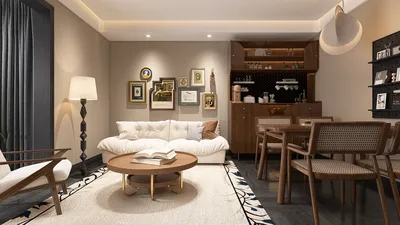


I vividly recall a client who required a formal dining setup for six people within a limited area that could only accommodate a twin bed. This experience taught me that constrained spaces challenge our creativity and can lead to innovative solutions. I meticulously sketched out ideas, took measurements, and utilized a 3D floor planner to illustrate how a slender, extendable table could effectively fit. Compact living spaces often ignite substantial ideas, and in this article, I’m excited to share five real-life inspirations that I have employed to transform small living-dining arrangements into functional and stylish environments using tools like Homestyler.
1. Multi-purpose furniture: sofa bench + extendable table
I frequently recommend incorporating a bench that can neatly be tucked behind a low sofa. By day, it acts as seating and a visual focal point, and by night, it expands to provide additional dining seats. This solution is budget-friendly and optimizes usable floor space, although it’s wise to choose cushions that can be stored easily for swift transitions.
save pin
2. Defining spaces with rugs and lighting
Create distinct zones with a rug under the sofa and another rug or runner beneath the dining area; a pendant light overhead effectively signals ‘dining’ without needing physical barriers. However, careful consideration of scale is essential—oversized rugs can dominate the room, while undersized lighting fixtures may look whimsical but lack impact.
save pin
3. Wall-mounted tables and retractable options
I adore drop-leaf or wall-mounted tables for tight setups, as they can be retracted when not in use. If your dining space is adjacent to the kitchen, using a kitchen layout planner like Homestyler can assist in aligning a compact prep counter with a folding table, ensuring smooth traffic flow. The trade-off may be reduced durability, so opt for sturdy hinges and ensure enough room for chair clearance when the table is opened.
save pin
4. Utilize vertical space: storage towers and open shelving
When floor space is at a premium, I always advise looking upward—tall cabinets, floating shelves, and narrow display units can keep your area organized and aesthetically pleasing. Regular editing of displayed items is crucial to prevent the space from feeling cluttered; I suggest using closed storage at lower levels and curated open shelves at eye level.
save pin
5. Harmonious color scheme, reflective surfaces, and adaptable layouts
Employing a unified paint color across both areas while incorporating mirrors or shiny finishes can create the illusion of a larger combined space. Before finalizing any built-in designs, I often use a free floor plan creator, like Homestyler, to experiment with various layouts, ensuring optimal sightlines and pathways—this method is both economical and efficient. However, selecting resilient finishes that endure daily use while maintaining a calm, cohesive look poses a challenge.
For a quick budget-friendly tip: focus on versatile seating and light fixtures instead of custom cabinetry—this approach can yield value swiftly.
save pin
FAQ
Q1: What table shape is most suitable for a small living-dining setup?
Round or oval tables work well in tight spaces as they facilitate movement and eliminate sharp edges. For flexibility, consider an extendable oval table that can accommodate guests when needed.
Q2: How can I create zones without constructing walls?
Employ area rugs, pendant lighting, and furniture like bookshelves or consoles as low dividers to delineate living and dining areas while preserving an open feel. These elements do a great job at establishing separation without obstructing light or flow.
Q3: Are benches more advantageous than chairs?
Benches conserve space by neatly tucking under tables, adding a relaxed charm to the area. However, they may be less comfortable for extended dining, so integrating a cozy side chair at the head of the table can provide a good balance.
Q4: What lighting options are ideal for combined spaces?
A layered lighting approach—ambient ceiling lights paired with a pendant above the dining table, plus task lamps for the sofa—offers versatility in mood and functionality. Opt for energy-efficient LED bulbs with dimmable features, making them perfect for multifunctional areas.
Q5: How can I create the illusion of a more spacious area?
Maintain a consistent flooring style and a harmonious color palette, incorporate mirrors, and select furniture with exposed legs to allow light to flow; these strategies can significantly enhance the visual openness of the room. Avoid cluttering the view with overly busy patterns.
Q6: Can my dining arrangements also serve as a workspace?
Absolutely—an extendable or drop-leaf table can function as a work surface during the day and transition into a dining table at night. A slim rolling cart can store office supplies and be easily hidden away when guests visit.
Q7: Are there any energy-saving lighting tips I should consider?
Utilize LED bulbs and programmable dimmers to enhance energy efficiency while customizing the ambiance. For authoritative advice on lighting efficiency, refer to the U.S. Department of Energy (energy.gov), which provides practical insights on lighting and control options.
Q8: What steps should I follow to begin planning my layout?
Start by accurately measuring doors, windows, and pathways, then experiment with several layout options—either on paper or digitally—before making any purchases. I always suggest drafting a simple sketch or model, allowing you to adjust scale and placement without incurring costly mistakes.
Homestyler is your go-to online home design platform! With its user-friendly design tool, stunning 3D rendering, and a wealth of DIY video tutorials, you can effortlessly create and visualize your dream spaces. Whether you’re a beginner or a pro, Homestyler inspires creativity and makes home design a breeze!
立即免费设计
































