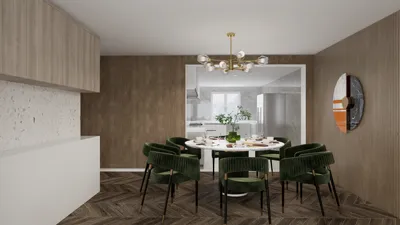


During one of my late-night projects, I nearly ended up gluing my jeans to a tabletop—trust me, it's a long story! However, that incident made me realize just how much a round dining table can offer in terms of solutions for small spaces. It turns out that confined areas can ignite a wave of creativity, prompting me to view every nook as a design opportunity. In this post, I’ll present five practical ideas for constructing DIY round dining tables, inspired by both real-life projects and my own experiments. You can also explore some of my layouts in my small project gallery featuring Homestyler designs.
1. Solid wood single-slab centerpiece
There's something wonderfully authentic about a single-slab round table top. Its tactile nature, warmth, and the way it ages gracefully are unmatched. While its durability and striking appearance are significant advantages, finding and flattening such a slab can be challenging—consider enlisting the help of a joiner or a flattening jig.
save pin
2. Foldable round for tiny kitchens
If you're short on space, a folding or drop-leaf round table is an incredible asset. It expands to provide ample dining space for gatherings but can effortlessly tuck away when not in use, allowing for an unobstructed flow. The trade-off is that it requires more hardware and sturdy hinges to function properly.
save pin
3. Pedestal base with mixed materials
Building a table with a single pedestal base grants additional legroom and gives you a chance to experiment with different materials—think wood tops paired with metal columns and stone bases for a bit of flair. If you're interested in visualizing proportions before making cuts, take a look at my before-and-after transformation images through Homestyler. The key is striking a balance in weight to prevent tipping when people sit.
save pin
4. Modular pie-slice segments
For a fun and portable solution, consider constructing the tabletop from removable pie-slice panels that interlock. This design works wonderfully for renters and event settings, but be mindful that precise seams and a solid connection system are essential to avoid unsightly gaps.
save pin
5. Reclaimed materials with modern joinery
Incorporating reclaimed boards or even an old door can instantly add character while promoting sustainability. Modern joinery methods, such as butterfly keys, smooth out cracks and stabilize the tabletop. If you're using Homestyler, you can even create layout mockups to visualize how the footprint will fit in your kitchen before cutting materials; this method helps minimize waste and avoid scale errors.
save pin
Tips 1:
Budget tip: A simple round tabletop made from plywood with a solid edge can look upscale while staying within budget, whereas a single-slab hardwood piece is an investment that will last for decades. Finish advice: opt for a water-based polyurethane for quick drying times and a reduced odor in smaller living spaces.
save pin
FAQ
Q1: What diameter is comfortable for a round dining table?
For a comfortable setting, a table diameter of 36 to 48 inches suits 2 to 4 people nicely; whereas 48 to 60 inches accommodates 4 to 6. Always measure the circulation space: aim for at least 36 inches from the table edge to any wall or obstacle.
Q2: Which wood species are best for a DIY round table?
Popular options for table tops include maple, oak, and walnut due to their hardness and finish absorption capabilities. For a budget-friendly alternative, consider birch or poplar with a veneer top that can achieve a similar look at a lower price point.
Q3: How do I prevent a round table from wobbling?
To avoid wobbling, ensure that the base is properly centered and that the tabletop is securely attached using figure-eight connectors or threaded inserts. Installing leveling pads on the base can help balance out uneven flooring.
Q4: Is a pedestal base strong enough for heavy tops?
Absolutely, as long as the pedestal and mounting plate are appropriately sized for the top and constructed from durable materials. For large stone tops or thick single slabs, a wide and heavy base is essential to prevent tipping.
Q5: What finish is safest for indoor air quality?
Opt for low-VOC, water-based finishes and ensure a complete cure time with proper ventilation. For more information on indoor air quality and VOCs, please refer to the U.S. EPA's comprehensive overview on volatile organic compounds.
Q6: Can I build a round table without a router?
Yes, you can create circles using a jigsaw and then sand the edge for a smooth finish. Alternatively, you can apply a simple edge band rather than routing it. Although a router quickens the process, it's not a requirement for creating a clean edge.
Q7: How do I join pie-slice segments securely?
Using biscuits, dowels, or splines at the mating edges combined with a locking tabletop fastener system underneath will help keep the top level. Precision during cutting is critical for tight seams.
Q8: Any tips for matching chairs to a round table?
Select chairs with slim profiles to maintain an airy feel around the round outline; armless chairs fit neatly under the circular edges. If you’re mixing styles, repeating a particular material or color can help unify the look.
save pin
Homestyler is an amazing online home design platform perfect for any DIY enthusiast. With its user-friendly design tool, stunning 3D renderings, and a wealth of design projects and video tutorials, you'll effortlessly create and visualize your dream spaces!
Design Now for FREE
































