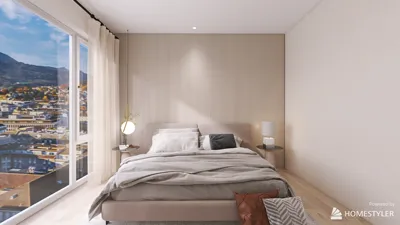


I once came close to persuading a client to paint their small studio a striking navy shade — until I realized how it might absorb the light and furnishings. That experience imparted a crucial lesson: compact spaces can ignite significant creativity, yet selecting the perfect blue-grey hue is essential to elevate its appeal. To effectively visualize your layout before making a decision, utilizing tools like Homestyler can help you conserve both time and paint.
Soft Mist — Light Blue-Grey for Small Rooms
I often opt for Soft Mist tones when aiming for an airy feel in a room, while still adding a touch more character than plain white. These delicate blue-greys reflect light beautifully, making even the smallest bedroom or hallway appear more spacious, particularly beneficial for those residing in compact urban apartments.
Advantages: enhances brightness and creates an illusion of expanded space, harmonizes beautifully with warm wood finishes. Challenge: it can appear cool under warm incandescent lighting, so it's wise to test with samples at various times throughout the day.
save pin
Coastal Steel — Cool Blue-Grey for Living Areas
Coastal Steel is my preferred choice when clients desire a serene, contemporary living room that maintains a grounded feel. This hue complements mixed-metal accents and linen textures exceptionally well — delivering an elegant yet casual ambiance.
Advantages: creates an excellent backdrop for artwork and layered textures. A minor drawback: excessive coolness can come off as stark without the addition of soft textiles or warm lighting, so consider adding rugs and cushions for a cozier atmosphere.
save pin
Warm Harbor — Blue-Grey with Taupe Undertones
Warm Harbor lies at the intersection of blue and greige; I recommend it for clients who appreciate blue but seek a warmer tone that performs well in varying light conditions. It serves as a clever solution for open-plan homes where interconnected areas need visual harmony.
Practical tip: charting your space's relationships is helpful—when I create precise floor plans, I can predict how a color will flow into adjacent rooms, saving time on potential repainting. Budget consideration: mid-range paints in this category usually provide good coverage, thus requiring fewer coats than very pale alternatives.
save pin
Deep Slate — Moody Blue-Grey Accent Wall
For a dramatic effect without going fully black, consider a Deep Slate blue-grey accent wall, which adds depth and coziness. I implemented this in a client’s den last year, paired with warm brass lighting — instantly, the entire room felt enveloping and inviting.
Advantages: establishes contrast and accentuates furniture outlines. Challenge: limit its application to a single wall or a ceiling feature in smaller rooms to prevent overwhelming the space with its richness.
save pin
Steel Blue-Gray — Kitchen-Friendly Blues
Steel blue-grays prove to be surprisingly suitable for kitchens: they conceal smudges more effectively than pure white and pair wonderfully with white marble or butcher block. If you're looking to experiment with kitchen arrangements and envision your cabinets and island against a blue-grey backdrop, feel free to do so—layout dramatically influences perceived color.
Advantage: both practical and stylish; a slight downside is that reflective surfaces might highlight undertones, so it’s important to test near appliances and under task lighting.
save pin
FAQ
1. What distinguishes blue grey from grey blue?
I conceive of blue grey as a grey imbued with a blue touch, while grey blue refers to a blue softened by grey. In practice, the distinction is subtle, highlighting the importance of testing samples on your wall under natural lighting.
2. Which blue grey is most suitable for north-facing rooms?
North-facing rooms receive cooler, bluer light, so it's best to select a warm-leaning blue grey (with slight taupe or greige undertones) to maintain a welcoming atmosphere.
3. What paint finish should I choose for blue grey walls?
Typically, I recommend eggshell or satin for living areas—providing sufficient sheen for easy cleaning while minimizing glare. High-gloss works wonderfully for trim if you're looking to create a sharp contrast.
4. Do blue greys appear differently in bathrooms?
Indeed. Bathrooms frequently feature multiple lighting sources and reflective surfaces that enhance undertones, making it vital to test swatches near mirrors and under vanity lights before making a commitment.
5. How many paint samples should I test?
I advise trying at least three shades from the same color family on different walls and observing them in morning, afternoon, and evening light. I always suggest applying full-size patches rather than relying on tiny sample cards.
6. Can I utilize blue grey for kitchen cabinets?
Absolutely—blue grey cabinets can be a timeless choice. Select a hue with the right undertone to complement your countertops and cabinet hardware, and consider a durable finish for longevity.
7. Will blue grey lessen the need for additional decor?
A well-chosen blue grey can simplify styling by providing a tranquil, cohesive backdrop. However, textural accents and warm metals typically help prevent the space from appearing flat.
8. Are there expert sources on color behavior?
Yes—paint manufacturers like Sherwin-Williams offer insights on undertones and Light Reflectance Values; check out Sherwin-Williams for detailed technical color information (https://www.sherwin-williams.com).
save pin
Homestyler is your go-to online home design platform, offering an easy-to-use design tool and stunning 3D renderings. Explore a wealth of design projects and gain inspiration from DIY video tutorials. Transform your space effortlessly and unleash your creativity today!
Design jetzt kostenlos
































