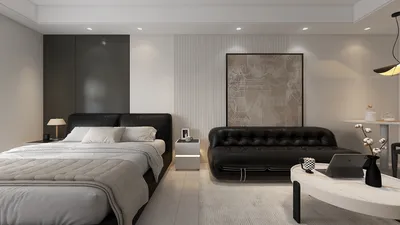


I once persuaded a family to paint all their interior doors in a striking black—and then I realized toddlers have a knack for touching everything. The resulting fingerprints were phenomenal; however, the lesson remained clear: the finish is equally as important as the color. To achieve a successful room makeover that suits your lifestyle, it’s crucial to prioritize the paint finish for interior doors, alongside the chosen hue. Room makeover
Satin: The Everyday Workhorse
For most bedroom and hallway doors, I opt for satin finishes due to their perfect balance of durability and subtle sheen. Satin conceals minor imperfections better than glossy finishes, can be easily cleaned with a damp cloth, and holds up well in high-traffic areas. While it may appear a bit muted in low light, for busy families, satin is an exceptionally forgiving choice. You can visualize how the finish will blend within your home using tools like Homestyler for 3D rendering.
save pin
High-Gloss: Dramatic and Reflective
High-gloss paint can turn an ordinary door into a stunning design feature—imagine striking entrances and contemporary trims. It showcases millwork beautifully and wipes clean effortlessly, but it also magnifies every imperfection in preparation and sanding. If a sleek, polished appearance is what you desire—and you're willing to invest time in prep work or hire professionals—high-gloss is truly unmatched. Consider using Homestyler to see how high-gloss might transform your space before committing.
save pin
Matte or Eggshell: Quiet and Modern
Matte and eggshell finishes provide a contemporary, understated look that's perfect for minimalist settings and painted panel doors. While they conceal light scratches and diffuse light nicely, they tend to show scuffs and greasy marks more easily than satin finishes. Therefore, they are best suited for lower-traffic areas. When I recommend matte finishes for closet doors, I often suggest a semi-durable eggshell for adjacent rooms to maintain an appealing balance—especially when considering kitchen areas and corresponding kitchen layout ideas.
save pin
Textured & Faux Finishes: Character on a Budget
Distressed, rubbed, or textured finishes bring character and can effectively hide flaws on older doors. I once helped a client who adored antique aesthetics but required an economical upgrade; we utilized a glazing technique to simulate a lovely patina. This approach is both creative and forgiving; however, it may not suit those seeking an ultra-clean modern finish—touch-ups often require a more artistic approach.
save pin
Two-Tone & Accent Panels: Small Change, Big Impact
Applying a different finish or color to door panels compared to the stiles enhances visual depth—experiment with a satin frame paired with a matte inset, or introduce a contrasting hue on four-panel doors. This method is one of my favorite strategies for adding visual interest without the need to replace doors, and it harmonizes beautifully with hardware selections. To preview this effect in a real space, using mockups and 3D renderings via Homestyler can help you avoid unexpected surprises before applying any paint.
save pin
Quick Tips & Budget Reminders
Preparation is vital: sanding, priming, and utilizing a high-quality brush or spray ensures a superior finish. For painted hollow-core doors, employ a primer and aim for at least two topcoats. If you're working with a limited budget, concentrate premium finishes on visible doors (entryways, living areas) while opting for satin in less prominent spaces.
save pin
FAQ
Q1: What is the ideal paint finish for interior doors?
A1: I generally recommend satin for most homes; it is robust, easy to clean, and strikes a good balance in sheen without highlighting every imperfection. High-gloss is suitable for feature doors, and matte finishes are best for quieter, low-traffic rooms.
Q2: Is it advisable to use the same finish on door trims and walls?
A2: While it's possible, the choice is largely stylistic. Trims typically benefit from a higher sheen than the walls to enhance their profile and resist scuffs.
Q3: Is high-gloss paint more challenging to apply?
A3: Indeed, high-gloss finishes expose application flaws, necessitating excellent surface preparation, and often benefit from spraying rather than brushing to achieve the smoothest finish.
Q4: How many coats do doors typically require?
A4: Generally, two topcoats over a properly applied primer are sufficient; more coats may be necessary for dramatic color changes or when applying water-based paints over challenging surfaces.
Q5: Which finish is best for hiding fingerprints?
A5: Satin and matte finishes are better at concealing small marks compared to high-gloss; however, satin is easier to clean—matte can be tougher to maintain without affecting its appearance.
Q6: Can I paint over stained or varnished doors?
A6: Yes, provided you sand properly and use a bonding primer. For glossy varnish, it’s crucial to scuff-sand and apply an adhesion primer prior to repainting.
Q7: Are there health or VOC considerations when painting?
A7: Choose low-VOC or water-based paints for interior applications, and ensure good ventilation while painting. Many manufacturers offer low-VOC options—always check product specifications when purchasing.
Q8: Where can I find expert guidance on paint finishes?
A8: Reputable manufacturers like Sherwin-Williams provide detailed explanations on finish characteristics and recommendations; refer to their guidance on paint finishes for comprehensive details and product specifications (https://www.sherwin-williams.com/homeowners/products/product-types/paint/finishes).
save pin
Homestyler is your go-to online home design platform! With its user-friendly design tool, stunning 3D renderings, and a wealth of DIY video tutorials, you can effortlessly create and visualize your dream spaces. Start your interior design journey today with Homestyler!
Design Now for FREE
































